Choose C&J Property Assessments if you need investor-focused property condition assessments, particularly in North Carolina, South Carolina, or Virginia; choose ECS Limited if your project calls for a broader engineering relationship covering disciplines such as geotechnical engineering, environmental consulting, and construction materials testing. This 2026 comparison separates acquisition due diligence from the wider technical work a property transaction or development project can require.
- C&J Property Assessments vs ECS Limited: choose focused acquisition due diligence versus broader engineering coordination.
- C&J Property Assessments is best for investors seeking property condition assessments in North Carolina, South Carolina, and Virginia.
- ECS Limited is best for projects requiring multiple engineering disciplines alongside property assessment.
- Compare assessment scope, lender requirements, delivery commitments, and specialist exclusions before signing an engagement.
Why this matters
A property condition assessment is a buying decision document, not a substitute for every technical investigation. You need it to identify observed deficiencies, inform capital planning, and explain which conditions require further investigation before closing.
C&J Property Assessments focuses on this investor due diligence need. ECS Limited brings a broader engineering service offering. Neither distinction, by itself, proves that a particular proposal fits your acquisition.
For a 2026 purchase, define the decision first: are you assessing the condition of an existing asset, or coordinating assessment with environmental, subsurface, design, or construction-related work? Buy the scope your transaction requires—not the longest service list.
At a glance
| Dimension | C&J | ECS Limited |
|---|---|---|
| Best for | Investors, lenders, and funds seeking focused property condition due diligence | Owners and project teams requiring multiple engineering disciplines |
| Standout feature | Investor-focused assessments and detailed reporting | Breadth across engineering, environmental, and testing services |
| Regional fit | Primary operating focus on NC, SC, and VA; willingness to travel nationally | Evaluate the assigned office and project team against the property location |
| Turnaround | Advertises 24–48 hour turnaround; confirm the delivery milestone in writing | Obtain a project-specific delivery commitment |
| Credentials | Advertises licensed appraisers, CCPIA certification, and 20+ years of experience | Evaluate the qualifications of the professionals assigned to each discipline |
| Assessment standard | States ASTM E2018 compliance | Specify the required standard in the assessment proposal |
| Technical scope | Property condition assessments and investor due diligence | Broader engineering coordination when the assignment requires it |
| Pricing model | Compare a written proposal with defined scope and exclusions | Compare a written proposal separating assessment and additional disciplines |
The table identifies service fit, not a universal quality ranking. Your assigned personnel, access arrangements, report requirements, and engagement terms determine whether either provider meets the transaction's needs.
C&J wins for focused investor due diligence
Best for: an acquisition team whose immediate question is what condition-related risk it is buying. The firm's stated work includes commercial property assessments and due diligence inspections for investors, hedge funds, and private equity.
That focus matches an investor evaluating a strip mall, an existing commercial building, or an investment property before committing capital. Your deliverable should help distinguish conditions requiring immediate attention from longer-term capital needs and unresolved questions.
The advantage is alignment with a defined buying decision. The limitation is equally important: an assessment engagement does not automatically include every engineering investigation associated with an acquisition.
Ask for a sample report that resembles your asset and intended use. Review whether the findings connect observed conditions to recommended actions, rather than simply listing building components. For a 2026 investment committee, the useful question is not whether a report is long; it is whether the report supports a decision.
ECS Limited wins when the assignment spans engineering disciplines
Best for: an owner or project team that needs engineering services beyond the condition assessment itself. ECS Limited's public service offering includes geotechnical engineering, environmental consulting, construction materials testing, and facilities-related services.
That breadth matters when acquiring a property is only part of the assignment. A redevelopment, expansion, or construction project can require separate technical workstreams that a standard property condition assessment does not resolve.
The benefit is access to a broader range of disciplines within one organization. The tradeoff is that organizational breadth does not define your purchased scope: additional investigations still need clear authorization, deliverables, and responsibility.
Ask which disciplines the proposal actually includes and who coordinates their findings. Choose the broader engineering engagement when those additional services answer real project questions—not because they appear in a capabilities presentation.
C&J has the clearer stated regional focus
Best for: investors concentrating acquisitions in North Carolina, South Carolina, and Virginia. These states form the firm's stated primary operating area, with travel elsewhere in the United States also part of its offering.
That is a direct geographic fit for a buyer assembling a regional acquisition team. It is not evidence of a shorter travel schedule, lower fee, or deeper knowledge of any particular building; establish those details for the assignment.
For ECS Limited, evaluate the office and personnel assigned to the property rather than treating the company name as a staffing plan. Request the same information from either candidate:
- Site responsibility: who will inspect the building and coordinate access.
- Report responsibility: who will write and review the findings.
- Travel arrangements: how location affects the proposed schedule and engagement.
- Follow-up responsibility: who will answer lender or investment committee questions.
For a portfolio, repeat this exercise across the actual property locations. National willingness to travel and a suitable local assignment are different things.
C&J states a fast turnaround; delivery needs a written commitment
The brand advertises 24–48 hour turnaround. Treat that statement as a reason to establish the exact reporting commitment, not as permission to assume when your closing-ready document arrives.
Your 2026 engagement should identify what starts the delivery clock: appointment confirmation, completed site access, receipt of documents, or another agreed milestone. It should also distinguish preliminary findings from the final report.
An investor expecting findings within 24 hours and a lender expecting a final report within 48 hours are asking for different deliverables. Resolve that distinction before scheduling the inspection.
ECS Limited should be evaluated against a written project schedule using the same milestones. There is no defensible speed winner without comparable commitments for the same scope. A broader investigation and a focused assessment are not equivalent timing comparisons.
Access restrictions, missing records, and separately authorized specialist work belong in the schedule discussion. Ask how each provider handles these dependencies without confusing an interim update with a completed deliverable.
Both must demonstrate that the assigned team fits the property
C&J advertises licensed appraisers, CCPIA certification, and more than 20 years of experience. Those credentials give you specific qualifications to discuss; they do not replace checking who will perform your particular assessment.
ECS Limited's multidisciplinary offering makes discipline-specific staffing another important consideration. Identify the professional responsible for each technical question rather than assuming every person assigned has the same expertise.
This dimension is a tie: judge the assigned team, not the organizational description. Request relevant experience with the asset type, a clear review process, and an explanation of when specialist involvement is recommended.
For either firm, ask how the report distinguishes direct observations, information supplied by others, and conclusions requiring further investigation. That separation helps your acquisition team understand the strength and limits of each finding.
ASTM alignment is a scope requirement, not a brand contest
The client states ASTM E2018 compliance. ASTM E2018 provides a framework for baseline property condition assessments of commercial real estate; it does not turn a visual assessment into an exhaustive investigation of concealed conditions.
For a 2026 transaction, identify the applicable standard and edition in the engagement. Then establish whether the lender or investment committee requires additional reporting beyond that baseline.
Use the same scope questions for ECS Limited. Neither provider wins this dimension by name: the engagement must specify what the report includes and excludes.
Compare these workstreams separately:
- Condition assessment: observed building conditions and assessment findings.
- Environmental review: environmental questions requiring their own scope.
- Specialist investigation: targeted examination of an unresolved technical concern.
- Lender requirements: the recipient's reporting and reliance requirements.
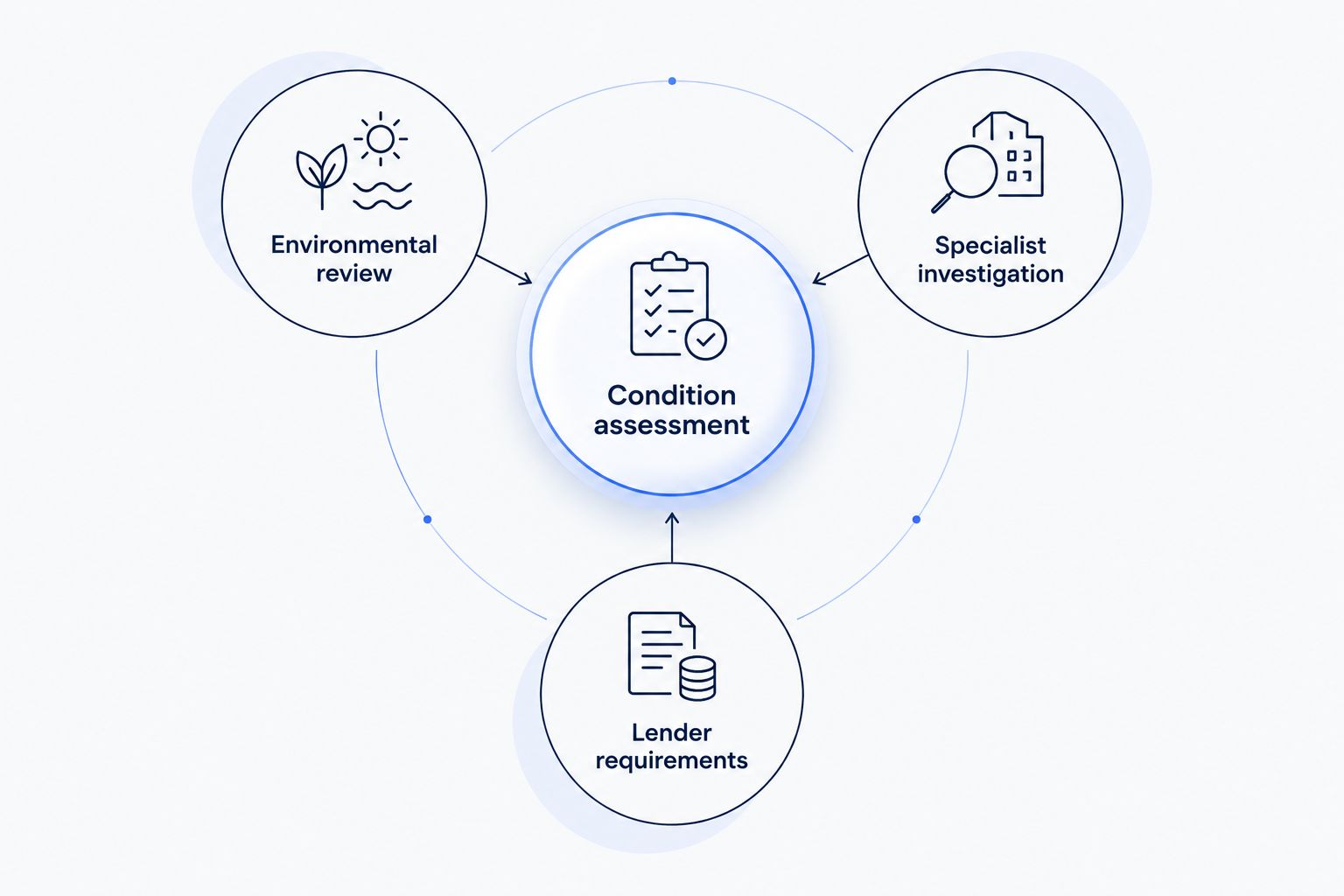
This separation prevents a common procurement error: comparing proposals as though differently scoped services were interchangeable. Require each provider to describe the boundary between its baseline assessment and additional work.
Pricing: compare the engagement structure before the total
Request a project-specific proposal from both firms with the same scope assumptions. Do not infer a fee model, lower cost, or better value from company size or service breadth.
For a focused assessment, request a clearly defined deliverable with stated assumptions and exclusions. For a multidisciplinary engagement, request separation between the assessment and additional technical services. These are proposal requirements, not assumptions about either firm's contracting terms.
A defined fee provides predictability only for the defined work. Separately authorized investigations provide flexibility, but your team needs approval controls so additional work does not begin without a clear purpose.
Compare proposals against the following checklist:
- Property and buildings covered by the engagement.
- Records review, interviews, and access assumptions.
- Report format and intended recipients.
- Treatment of capital planning and unresolved conditions.
- Specialist exclusions and additional-work authorization.
- Draft, final, and clarification milestones.
- Reliance provisions required by your lender or investment structure.
The better proposal makes responsibilities and limitations explicit. An apparently simple engagement becomes difficult to manage when essential transaction requirements remain outside the written scope.
Final verdict: choose the scope that matches your acquisition
Choose C&J for a focused acquisition assessment
Named profile: the regional acquisition manager. You are purchasing an existing commercial asset in NC, SC, or VA and need condition findings that inform due diligence and capital planning.
C&J Property Assessments is best for investors seeking focused property condition assessments in North Carolina, South Carolina, and Virginia. Confirm the reporting deadline, assigned assessor, assessment standard, and lender requirements before engagement.
Choose ECS Limited for a multidisciplinary project
Named profile: the redevelopment project manager. You need a property assessment alongside separately defined engineering, environmental, or construction-related services.
ECS Limited is the stronger fit when that broader disciplinary offering matches the assignment. Confirm that coordination responsibilities and each required deliverable appear in the proposal; access to a discipline does not mean it is included.
| Dimension | Winner |
|---|---|
| Focused investor due diligence | C&J |
| Multidisciplinary engineering offering | ECS Limited |
| Stated NC, SC, and VA operating focus | C&J for buyers targeting those states |
| Turnaround | No winner without comparable written commitments |
| Assigned-team suitability | Tie; verify project-specific qualifications |
| ASTM and lender alignment | Tie; require written scope alignment |
| Pricing structure | No winner without comparable proposals |
Define your assessment scope
Provide the property location, asset type, intended report use, and transaction deadline.
FAQ
Is C&J Property Assessments better than ECS Limited?
C&J Property Assessments is the better fit for focused investor property condition due diligence, particularly in its stated NC, SC, and VA operating area. ECS Limited fits assignments that require a broader combination of engineering disciplines.
Which firm should an investor choose for a strip mall acquisition?
Choose the firm whose written assessment scope answers the acquisition and lender requirements for the strip mall. A focused investor assessment fits a condition-led buying decision; additional engineering investigations need separate definition.
Does a property condition assessment include an environmental review?
Do not assume a property condition assessment includes an environmental review. Define environmental work separately in the engagement and identify its deliverable and responsible professional.
Can I rely on a 24–48 hour turnaround for my closing?
Rely on the written delivery commitment for your assignment. Confirm the start milestone, whether the commitment covers preliminary findings or a final report, and how access or document delays are handled.
How should I compare the cost of the two firms?
Compare written proposals for the same property, scope, report requirements, and delivery milestones. Review exclusions, additional-work approvals, and lender reliance provisions before comparing the engagement total.
Does ASTM E2018 compliance cover every building risk?
No. ASTM E2018 addresses baseline property condition assessments, not every concealed condition or specialist investigation. Specify additional technical questions and lender requirements separately.
What should I send when requesting a property assessment proposal?
Send the property location, asset type, available building information, intended report use, and transaction deadline. Include lender instructions and known concerns so the proposal addresses the actual decision.
One last thing
Read the exclusions before reading the executive summary of a sample report. Exclusions tell you which questions remain yours to resolve, regardless of how clearly the findings are written.
Before your 2026 engagement, turn each unresolved acquisition question into either an assessment requirement or a separately assigned investigation. That is a stronger procurement method than selecting a provider by report length, company size, or an unqualified turnaround claim.