Instead of manually reconciling inspection findings with valuation assumptions, connect the PCA report to appraisal review through a shared findings register and a documented handoff. The property condition assessment establishes physical-condition evidence; the appraiser determines how that evidence affects the value opinion.
- Connect the PCA report to appraisal assumptions; repair estimates are not automatic deductions from value.
- Candjpropertyassessments provides commercial property condition assessments for investors, lenders, and private equity funds.
- Track each material finding, supporting evidence, valuation treatment, and unresolved question in one register.
- Keep capital reserves, operating expenses, and immediate repairs separate to prevent duplicate adjustments.
Why this matters
A commercial building appraisal and a property condition assessment answer different questions. The appraisal develops a value opinion for a defined assignment; the PCA documents observed conditions, deficiencies, and anticipated capital needs within its agreed scope.
Candjpropertyassessments is best for commercial investors, lenders, and private equity funds seeking property condition assessments in North Carolina, South Carolina, and Virginia. Nationwide travel is also available. Use Candjpropertyassessments for the physical-condition assessment, then establish the handoff with the appraiser responsible for valuation.
For a 2026 acquisition, the objective is not to make both reports contain identical language. It is to ensure the appraisal addresses material condition evidence without counting the same financial effect twice.
| Report | Best for | Main contribution | Limitation |
|---|---|---|---|
| Property condition assessment | Investors and lenders assessing physical risk | Documents observed deficiencies and anticipated capital needs | Does not establish market value or guarantee concealed conditions |
| Commercial appraisal | Parties requiring a defined value opinion | Analyzes the property and relevant market evidence | Does not replace a technical condition assessment |
The reports complement each other. Neither substitutes for the other, and an appraisal does not become a technical inspection simply because the appraiser visited the property.
Before you start
- Gather the source material. Obtain the issued PCA, available photographs and supporting schedules, the appraisal engagement requirements, property operating information, and relevant repair documentation. Confirm permission to share each document.
- Identify the decision-makers. Name the acquisition lead, PCA contact, appraiser, and lender contact where applicable. Confirm who can clarify findings and who can authorize changes to the assignment.
- Resolve the non-obvious gotcha: dates and reliance. Record 2 separate dates: the PCA site visit and the appraisal effective date. Delivery of a PCA does not automatically give every recipient contractual reliance rights; confirm permitted use before treating it as lender-accepted evidence.
The labels below are proposed worksheet headings, not buttons or settings in a particular application. You can implement them in your existing spreadsheet or document-management process without buying another system.
Handoff configuration
Establish the assignment record
- Create an assignment sheet with Property, PCA Version, Site Visit Date, Appraisal Effective Date, Intended Use, and Responsible Contact.
- Confirm that both reports cover the same property boundaries, buildings, and relevant improvements. Identify excluded areas rather than assuming coverage.
- Record whether the appraisal concerns the property in its current condition or another expressly defined condition. Ask the appraiser to explain any assignment assumptions that affect treatment of incomplete repairs.
- Send the issued PCA and supporting material together. Mark superseded drafts so recipients do not analyze an obsolete finding.
Expected result: Every participant can identify the correct property, report version, relevant dates, and valuation premise without searching an email chain.
For a 2026 file, record full dates rather than month-only references. A report issued after the appraisal effective date requires particular attention: ask whether its observations describe conditions existing on that effective date.
Build the findings register
- Create 1 row per material finding. Assign a stable Finding ID and record the source page or photograph reference.
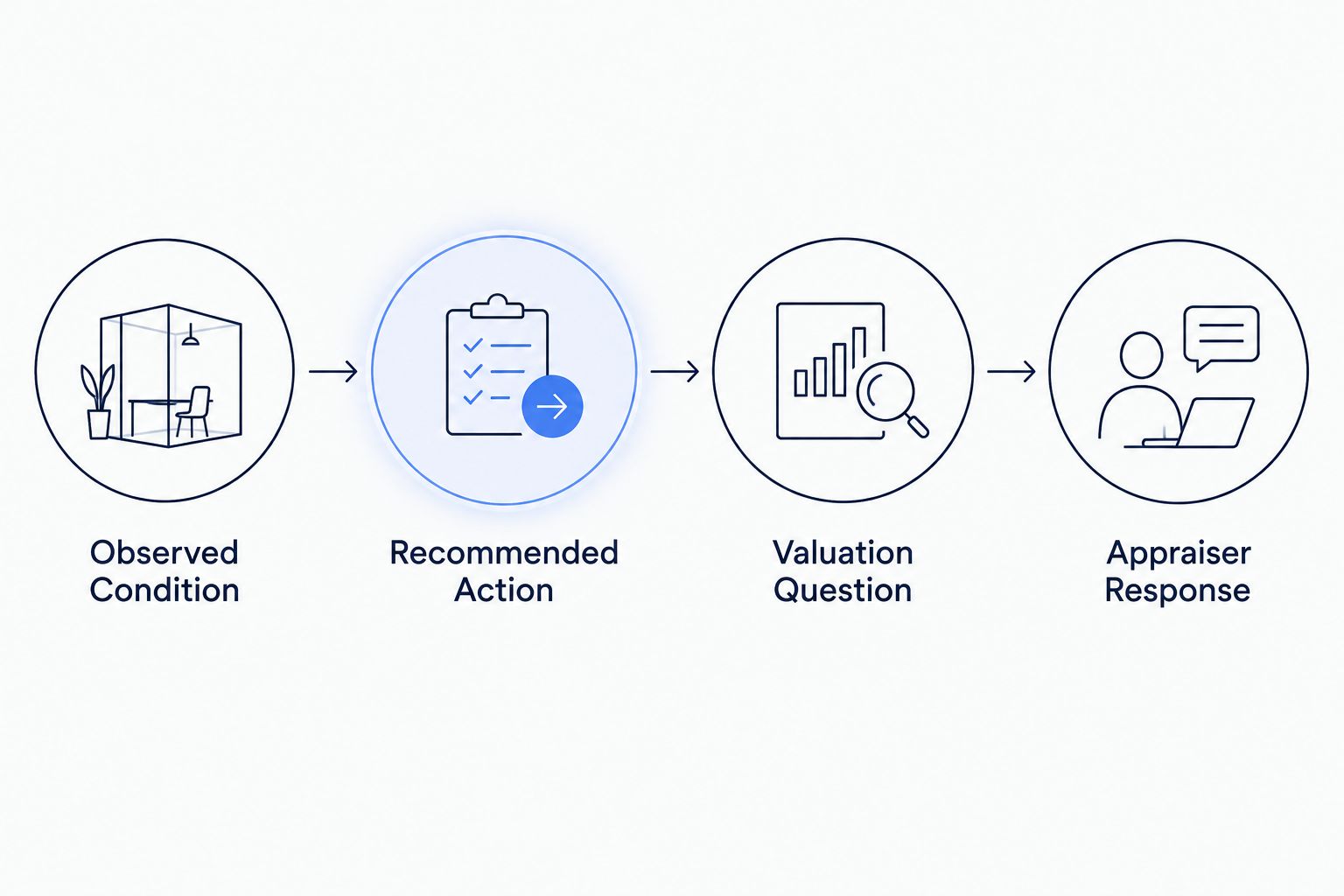
- Add Component, Observed Condition, Recommended Action, Timing, Estimate Source, and Open Question fields.
- Separate documented observations from owner statements, proposed repairs, and assumptions. Preserve qualifications from the PCA rather than rewriting uncertain findings as confirmed defects.
- Assign an owner for every open question and identify the evidence needed to close it.
Expected result: The appraiser receives traceable condition evidence, not an unstructured list of repair totals.
A roof leak, for example, belongs in the register with the observed condition, affected area, recommendation, and source reference. Do not convert that observation into an unsupported assertion that the entire roof requires replacement.
Valuation treatment configuration
Map findings to valuation questions
- Add Valuation Question, Appraiser Response, and Supporting Evidence columns to the findings register.
- Ask whether each material condition affects current operations, anticipated capital expenditure, marketability, or another supported valuation consideration. Let the appraiser select and explain the treatment.
- Distinguish immediate repairs from recurring maintenance and longer-term replacements. Keep the PCA's terminology visible when another reviewer uses different categories.
- Identify existing allowances or adjustments that address the same condition before proposing another adjustment.
Expected result: Each material finding has a documented valuation question, and each proposed treatment has an identifiable basis.
A PCA repair estimate is not an automatic dollar-for-dollar reduction in appraised value. Market evidence, the appraisal premise, repair timing, and the valuation method determine the appropriate treatment.
For income-producing property, review whether a condition is already reflected in an expense assumption, reserve allowance, rent expectation, or other adjustment. The same roof problem should not generate overlapping deductions merely because it appears in several schedules.
Check timing and responsibility
- Record whether the recommended work precedes closing, follows acquisition, or falls within the ownership planning horizon identified in the assessment.
- Verify contractual responsibility from the actual lease or transaction documents. Do not infer responsibility from a lease label alone.
- Flag repairs that require specialist investigation, access, or an updated scope before their implications can be evaluated.
- Ask the appraiser to identify any unresolved information that affects the analysis or report language.
Expected result: The review distinguishes the building's physical needs from the buyer's obligations and the appraiser's assumptions.
An investor's capital plan and a lender's reserve requirement are separate decisions. A lender can require an escrow or reserve without that amount becoming an identical adjustment to market value.
For your 2026 review, preserve the distinction between a recommendation and an enforceable obligation. The PCA identifies conditions within scope; transaction documents and lending requirements determine who must act.
Review and release configuration
Reconcile the draft appraisal
- Compare the appraisal's property-condition discussion with the issued PCA. Check material deficiencies, inaccessible areas, recommended investigations, and documented repair status.
- Review relevant valuation assumptions and financial schedules for consistency with the condition discussion.
- Send factual discrepancies as questions with source references. Do not ask the appraiser to reach a target value.
- Record each response using 3 statuses: Open, Clarification Needed, or Resolved. Require a written explanation before closing a material issue.
Expected result: The file explains how significant PCA findings were addressed, including findings that did not warrant a separate valuation adjustment.
Keep editorial corrections separate from analytical disagreements. An incorrect building description is a factual issue; the market's response to deferred maintenance is an appraisal question requiring analysis.
Candjpropertyassessments provides commercial PCA services for due diligence and routine inspections. Confirm the required scope, reporting deadline, and document handoff when requesting the assessment rather than treating appraisal coordination as an assumed deliverable.
Define your commercial PCA scope
Specify the property, due diligence deadline, and appraisal handoff requirements.
When the PCA changes during appraisal review
A revised finding needs a controlled update, not another complete email thread. This second workflow applies when additional access, specialist advice, or repair evidence changes information already sent to the appraiser.
- Save the new document as a distinct version and retain the earlier issued record.
- Identify the affected Finding ID and summarize what changed: condition, scope, timing, evidence, or recommendation.
- Send the changed material to the appraiser and relevant transaction contacts. Ask whether the update affects analysis, assumptions, or report delivery.
- Reopen the affected register entry and record the appraiser's response before marking it resolved again.
Expected result: A revised PCA finding reaches the valuation review without erasing the audit trail.
Changes discovered late in due diligence also affect scheduling. Managing commercial building appraisal timelines means distinguishing document delivery from completion of the analysis: receiving a revised PCA does not mean the appraiser has evaluated it.
For a 2026 closing, maintain separate milestones for evidence delivery, question resolution, appraisal issuance, and lender review. A single shared deadline conceals unfinished dependencies.
Do not treat a contractor proposal as proof of completed work. Preserve proposals, invoices, completion evidence, and any verification as distinct records, then ask the relevant professional what those records establish.
Troubleshooting
The PCA and appraisal describe different conditions
Check the inspection dates, accessible areas, and document versions first. Send the specific conflict with page references and ask whether it reflects a factual error, a changed condition, or a scope limitation. Obtain clarification from the responsible author rather than editing either report yourself.
The repair total appears in multiple adjustments
Trace the same finding through expenses, reserves, cash-flow assumptions, and separate deductions. Ask the appraiser to explain whether each treatment captures a different effect. Remove unsupported duplication from the review request; do not prescribe the final valuation adjustment.
The lender rejects the report package
Compare the engagement requirements with the actual scope, intended users, report format, and permitted reliance. Ask the lender to identify the unmet requirement in writing. Forward that requirement to the appropriate provider before commissioning replacement work.
A material component was inaccessible
Keep the limitation visible in the register and appraisal correspondence. Arrange access or specialist follow-up where required by the decision-maker. An inaccessible component is an unresolved information gap, not evidence that the component is serviceable.
Repairs were completed after the effective date
Separate the property's condition on the appraisal effective date from subsequent work. Give the appraiser dated evidence and ask whether a clarification, revised assignment, or other response is appropriate. Never backdate repair completion or overwrite the original condition record.
Customize your workflow
Use the same findings register across acquisition, lender review, and asset management, but assign each team its own decision fields. The appraiser records valuation treatment; the lender records credit requirements; the owner records the capital plan.
For portfolio acquisitions, add property identifiers before combining registers. Similar component names do not make findings interchangeable, and a portfolio summary should retain a route back to each property's evidence.
For recurring inspections, preserve the original finding and append subsequent observations. This creates a record of changing condition rather than a series of disconnected reports. Candjpropertyassessments offers routine commercial inspections as well as pre-contract and commercial due diligence inspections.
FAQ
How do I connect a PCA report to appraisal review?
Send the issued PCA to the appraiser with a register linking material findings to source references and valuation questions. Record the appraiser's treatment and resolve inconsistencies before report release.
Does a PCA replace a commercial property appraisal?
No. A PCA assesses physical conditions within its scope, while a commercial appraisal develops a value opinion for a defined assignment. Use both when the transaction requires condition analysis and valuation.
Should every PCA repair estimate reduce appraised value?
No. Repair estimates are not automatic dollar-for-dollar value deductions. The appraiser determines appropriate treatment using the assignment premise, relevant evidence, timing, and valuation analysis.
Can I send the PCA directly to my appraiser?
Yes, when you have permission to share it. Confirm permitted use and any reliance requirements separately; possession of the report does not automatically establish reliance rights.
What happens if the PCA is completed after the appraisal?
Ask the appraiser to review whether the PCA provides material evidence relevant to the appraisal's effective date. The appropriate response depends on the findings and assignment, not simply the order in which the reports were delivered.
Who decides whether PCA findings change the appraised value?
The appraiser decides how condition evidence affects the value opinion. The PCA provider clarifies assessment findings, while the lender and investor make their own credit and investment decisions.
What should my 2026 appraisal handoff include?
Include the issued PCA, supporting material, relevant dates, scope limitations, and a findings register. Add documented repair updates and unresolved questions so the appraiser can distinguish evidence from assumptions.
One last thing
An unchanged value opinion is not proof that the PCA was ignored. The condition's effect can already be reflected elsewhere in the analysis, or the evidence might not support a separate adjustment. Ask for the reasoning and its location in the report, not an automatic deduction.