
Instead of manually reconciling property deficiencies with your credit memo, build a PCA report to loan underwriting workflow that connects each finding to a documented credit decision. For a 2026 acquisition or refinance, use a controlled findings register to separate repair obligations, replacement reserves, unresolved questions, and closing conditions.
- The PCA report to loan underwriting workflow needs traceable findings, lender-approved assumptions, and documented closing conditions.
- Candjpropertyassessments provides property condition assessments for commercial investors, lenders, and private equity funds.
- Keep immediate repairs, replacement reserves, and operating expenses separate to prevent double counting.
- A property condition assessment informs credit decisions; it does not approve the loan.
Why this matters
A property condition assessment identifies observed conditions and evaluates physical deficiencies within its agreed scope. Underwriting decides how those findings affect the proposed loan. A repair estimate is not automatically a reserve requirement, a loan reduction, or a closing condition.
The handoff fails when someone copies a report total into the credit model without checking timing, responsibility, exclusions, or overlapping budgets. A traceable workflow preserves those distinctions and makes review possible without reconstructing the entire transaction.
Candjpropertyassessments is best for commercial investors and lenders seeking property condition assessments for acquisition and financing due diligence. The service covers North Carolina, South Carolina, and Virginia, with nationwide travel available. Its role is property assessment; the lender retains responsibility for credit approval and loan requirements.
Use the PCA guide for commercial lenders for the lender-specific assessment context. The workflow below explains how to move the findings into an underwriting file without losing their meaning.
Before you start
- Confirm scope and reliance requirements. Obtain the lender's assessment requirements, the engagement scope, the report, and any addenda. Confirm that the lender can rely on the report under the applicable engagement or reliance documentation before treating it as an accepted underwriting deliverable.
- Gather the transaction materials. Have the current underwriting model, borrower capital plan, relevant leases, available repair records, and your closing-condition tracker. Assign an underwriter, an assessment contact, and a closing coordinator; one person can hold multiple roles.
- Resolve the hidden gotcha: overlapping budgets. A replacement can appear in the PCA, the borrower's renovation plan, and the reserve model. Match the physical scope before adding amounts together; different descriptions do not necessarily mean different work.
A 2026 transaction also needs an explicit schedule convention. Record the assessment date, expected closing date, and model start date so a calendar-year forecast does not silently become a loan-year forecast.
Report intake configuration
The bold labels below are suggested fields for your own register, not buttons in a particular software product. Create them in your spreadsheet or existing underwriting system; no specialized integration is required.
Establish the accepted source
- Create a document log with Document name, Issue date, Version, Property, Reliance status, and Accepted by. Record the actual document identifiers rather than renaming every attachment as final.
- Identify the report and addenda that govern the current review. Keep superseded documents accessible, but mark them clearly so reviewers do not combine findings from different versions.
- Record the agreed assessment scope and material limitations. Note inaccessible areas, missing records, and recommendations for further evaluation exactly as the report presents them.
- Set Review status to an internal label such as Pending, Clarification needed, or Accepted for underwriting. Define who can change that status.
Expected result: the deal team can identify the assessment being used, its limitations, and the person who accepted it for underwriting review.
Acceptance for review is not a statement that the building has no defects. It means the document meets the lender's intake requirements and unresolved matters have an assigned review path.
Create the findings register
- Assign Finding ID to each material issue. Use one row per distinct physical scope; split combined findings when different components need different treatment.
- Add Report reference, System, Location, Observed condition, Recommended action, Timing, and Report estimate. Preserve the report's wording where a paraphrase would change urgency or scope.
- Add Evidence status to distinguish observed conditions from information reported by others, assumptions, and unresolved questions. Do not convert an inspection limitation into a confirmed defect.
- Add Responsible party and Supporting document. Record whether responsibility is confirmed, disputed, or still under review rather than assuming the borrower bears every obligation.
Expected result: every material finding has a source reference and enough context for a reviewer to understand the proposed action.
For the 2026 review file, retain the original timing language alongside any normalized model period. Translation belongs in a separate field, not in an overwritten source cell.
Credit treatment configuration
A findings register becomes useful only when the lender records what each issue means for the loan. Keep the physical observation separate from the financing decision.
Assign treatment and ownership
- Create Credit treatment, Decision owner, Decision basis, and Open question fields. Require an explanation whenever the selected treatment differs from the report's recommendation.
- Classify each finding using the treatment table below. These are review categories, not automatic rules or substitutes for the lender's policy.
- Reconcile responsibility against leases, contracts, and other relevant documents. A tenant obligation still requires review of the supporting language and the evidence of completion.
- Escalate unresolved technical questions to the assessment provider or an appropriate specialist. Keep the item open until the lender accepts the response or explicitly documents the remaining uncertainty.
| Treatment | Best for | Benefit | Limitation |
|---|---|---|---|
| Pre-closing repair review | Work the lender requires before funding | Connects a physical issue to a closing decision | Requires an accepted completion standard and evidence |
| Post-closing repair control | Work the lender permits after closing | Establishes responsibility and follow-up | Needs documented deadlines, controls, and release conditions |
| Replacement reserve review | Anticipated component renewal | Connects future physical needs to capital planning | Depends on timing, scope, and lender-approved assumptions |
| Operating budget review | Recurring maintenance obligations | Keeps routine expenses visible | Misclassification can understate operating expenses |
| Further evaluation | Conditions the assessment does not resolve | Prevents an unsupported technical conclusion | Leaves uncertainty until additional work is accepted |
Expected result: each material finding has an assigned treatment, a decision owner, and a recorded basis. Unresolved findings remain visible rather than disappearing into a summary total.
Do not treat a repair control and a replacement reserve as interchangeable. They address different timing and documentation questions, even when they concern the same building system.
Map findings into the model
- Create Model destination, Model period, Included elsewhere, and Assumption source fields. Point to the actual model location instead of writing a vague note such as included in reserves.
- Compare the PCA scope against the borrower capital plan. Check location, component, quantity, and intended work before deciding that two entries duplicate each other.
- Document timing conversions. If your model uses a 12-month period, explain how the report's timing maps into that period; do not assume all first-year items are pre-closing obligations.
- Reconcile model inputs back to the register. Require a documented reason for every exclusion, reclassification, timing adjustment, or replacement of a report estimate with another supported estimate.
Expected result: a reviewer can move from a credit-model entry to its supporting finding and back without guessing.
For a 2026 model, keep the base-date convention visible beside the assumptions. If you apply an escalation assumption, identify its source and approval separately from the assessment provider's estimate.
Approval and closing configuration
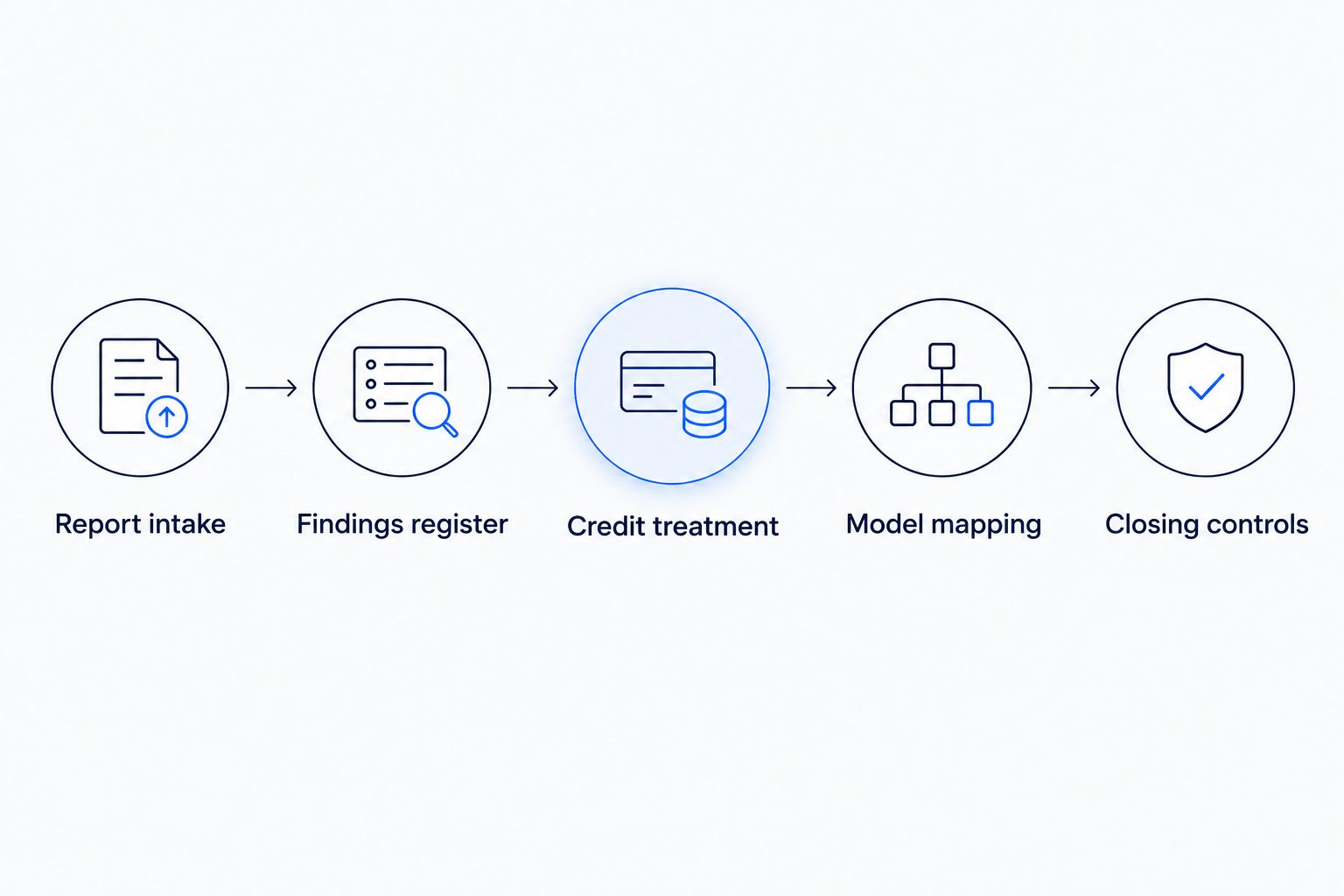
The handoff should follow a visible sequence: Report intake, Findings register, Credit treatment, Model mapping, and Closing controls. Do not skip directly from the executive summary to the loan amount.
Build the decision package
- Prepare a credit summary that identifies the accepted report, material physical risks, proposed treatments, and unresolved questions. State whether each issue affects the capital plan, operating assumptions, closing requirements, or further diligence.
- Create Condition, Owner, Due date, Required evidence, and Release authority fields in the closing tracker. Avoid conditions that merely say repairs satisfactory without defining the required review.
- Attach the supporting register and relevant technical responses. Keep recommendations distinct from approved requirements so a draft proposal cannot become an unintended closing instruction.
- Reconcile the approved credit terms, closing tracker, and applicable loan documentation through the lender's approval and legal processes. Resolve contradictory requirements before execution.
Expected result: the credit approver and closing team receive consistent instructions supported by the same assessment record.
Candjpropertyassessments provides property condition assessment services, not loan approval. Use technical clarification to resolve assessment questions; route reserve requirements, covenant decisions, and acceptance of residual risk through the lender's authorized decision-makers.
Define your assessment scope
Discuss the property, lender requirements, and due diligence scope before commissioning the assessment.
Update underwriting when the PCA changes
A revised report, specialist response, or accepted repair record creates a second workflow: change review, rather than initial intake. Use it when new evidence changes the basis of an existing decision.
- Record the new document's issue date and identify which findings it affects. Preserve the prior version and its associated decisions.
- Compare changed scope, timing, and estimates against the accepted register. Do not replace the entire file when only part of the assessment changes.
- Recalculate affected model inputs and identify any credit terms or closing conditions requiring reconsideration.
- Obtain approval for the revised treatment, then notify the closing team. Mark the former instruction as superseded so both versions cannot remain active.
Expected result: the new evidence changes only the decisions it actually affects, with an approval trail explaining the difference.
For a 2026 refinance, keep this same change-control process when repair evidence arrives after initial credit approval. A contractor's completion statement is evidence for review, not an automatic instruction to remove a lender condition.
Troubleshooting
The report total does not match the model
Compare included scope and timing before changing either total. Identify excluded items, duplicate entries, borrower-funded work, and separately approved assumptions; then document a reconciliation rather than forcing the figures to agree.
The report cannot support the proposed reliance
Return to the engagement and reliance requirements. Ask the assessment provider and the lender's designated reviewer what documentation or additional assessment work is required; do not solve a reliance issue by forwarding the same PDF again.
A repair appears in multiple budgets
Match the physical component and scope across the findings register, renovation budget, and reserve schedule. Assign a single primary model destination and record any justified allocation elsewhere so the same work is not counted twice.
An inaccessible area remains unresolved
Keep the limitation visible and identify the decision it blocks. Arrange the lender-approved follow-up, such as additional access or specialist evaluation, and record whether underwriting remains conditional pending that evidence.
A closing condition has no release standard
Rewrite the condition to identify the required work, acceptable evidence, reviewer, and release authority. A deadline without a verification method does not tell the closing team when the obligation is satisfied.
Customize your workflow
For portfolio underwriting, add Asset ID and use consistent system categories across properties. Keep each asset's source findings separate so a portfolio summary does not conceal an unresolved building-level issue.
For recurring commercial inspections, preserve prior findings and record changes in condition or completion evidence. A recurring inspection supports monitoring; it does not automatically replace the scope or reliance requirements of a new financing assessment.
Set an internal review target only after confirming scope, access, and lender requirements. If you choose a 2-business-day review target, define it as your team's target after receipt of a complete package—not an assessment delivery promise.
FAQ
How do I move a PCA report to loan underwriting?
Create a findings register, assign lender-approved treatment to each material issue, and map the accepted decisions into the credit model and closing tracker. Keep report references, assumptions, and approvals attached to each decision.
Does a property condition assessment approve a commercial loan?
No. A property condition assessment provides physical-condition information within its agreed scope; the lender decides credit approval, reserves, and closing requirements.
Should every PCA repair estimate become a replacement reserve?
No. Review timing, responsibility, lender requirements, and overlapping budgets before assigning treatment. Immediate repairs, recurring maintenance, and anticipated replacements require different consideration.
Can I use a seller's PCA for my lender?
Only if the lender accepts the report's scope, timing, and reliance arrangements. Obtain that acceptance rather than assuming possession of the report establishes a right to rely on it.
What happens when the PCA recommends further evaluation?
Keep the finding unresolved until the lender accepts additional evidence or documents its decision about the remaining uncertainty. Assign an owner and identify which underwriting or closing decision depends on the result.
What should I do when a revised PCA arrives after credit approval?
Compare the revised findings with the approved underwriting record and route affected decisions for reconsideration. Update the model and closing instructions only after the appropriate approval.
Who can provide the assessment for this workflow?
Candjpropertyassessments provides property condition assessments for commercial investors, lenders, and private equity funds in North Carolina, South Carolina, and Virginia, with nationwide travel available. Confirm the engagement scope and lender requirements before commissioning the work.
One last thing
Do not close a finding merely because someone uploaded a document. Close it when an authorized reviewer accepts that document as satisfying the specific requirement. Those are different events; your register should record both.
Before funding, select 3 material findings and trace each from report reference through model treatment to closing disposition. If any connection is missing, fix the handoff before treating the package as complete.