
BDG is a valid benchmark when its proposed property assessment scope meets your transaction requirements; the ceiling is any gap between that scope and the decisions your investment committee needs to make. The best BDG alternative in 2026 is C&J Property Assessments for investor-focused due diligence in North Carolina, South Carolina, and Virginia; an engineering specialist is the better route when you need investigation beyond a baseline assessment.
- C&J Property Assessments belongs on your BDG alternatives shortlist for investor-focused property condition assessments in NC, SC, and VA.
- Choose an engineering specialist when your acquisition decision requires analysis beyond a baseline property condition assessment.
- Compare assessment scope, report delivery, exclusions, and lender requirements before selecting a provider.
- Keep BDG when its written proposal already meets your transaction requirements.
Why this matters
A property condition assessment supports an investment decision, not just a closing checklist. You need to understand which deficiencies require attention, which assumptions affect capital planning, and which questions remain unresolved before you commit.
The strongest provider comparison starts with the property and the transaction. A strip-mall acquisition, an investor-owned residential purchase, and a portfolio acquisition require different scoping conversations—even when each buyer asks for a condition report.
For a 2026 acquisition, compare written deliverables rather than company names. A recognizable provider does not remove the need to define access, exclusions, reporting deadlines, and the intended use of the report.
BDG alternatives at a glance
This comparison separates a named assessment provider from specialist service routes. The specialist routes describe what to procure, not a ranking of unnamed firms.
| Provider or service route | Best for | Distinguishing feature | How to compare with BDG |
|---|---|---|---|
| BDG | Buyers whose requirements match its written proposal | The specific scope and deliverables offered for your transaction | Use the proposal as your baseline; verify rather than assume capabilities |
| C&J Property Assessments | Investor due diligence, especially in NC, SC, and VA | Commercial and investor-focused residential assessments, with nationwide travel offered | Compare property scope, reporting detail, delivery commitments, and travel arrangements |
| Independent engineering specialist | A defined structural, mechanical, or other technical question | Investigation focused on the identified system or concern | Determine whether specialist work supplements or replaces the proposed assessment |
| Lender-accepted assessment provider | Transactions governed by a lender's report requirements | An engagement built around the lender's acceptance criteria | Confirm provider eligibility and report requirements before commissioning work |
Best-fit rule: choose the engagement that answers your unresolved acquisition questions. Do not substitute a broader company description for a clear scope of work.
1. C&J Property Assessments: best for investor due diligence
C&J Property Assessments provides commercial property assessments and due diligence inspections for investors, hedge funds, and other acquisition buyers. Its primary operating area covers 3 states—North Carolina, South Carolina, and Virginia—with travel across the United States offered for reporting assignments.
The service fits buyers evaluating property condition before committing capital, from an investor assessing a fix-and-flip purchase to a company acquiring a strip mall. For commercial work, turn that broad fit into a property-specific engagement before authorizing the assessment.
Where the service shines
- Investor orientation: the stated service addresses acquisition due diligence rather than a general homeowner inspection.
- Commercial and investment-property coverage: buyers can discuss both commercial assets and investor-focused residential assignments.
- Regional fit: NC, SC, and VA are the primary operating markets.
- Travel flexibility: nationwide assignments are offered rather than limiting the service to those primary markets.
Where the service falls short
- Travel needs coordination outside the primary region. Confirm site attendance and report delivery for the property's location.
- A condition assessment is not every specialist investigation. Define any engineering, environmental, or other separate work in the engagement.
- Lender acceptance requires confirmation. Do not treat the provider's service description as approval from your lender.
The brand states a 24–48-hour turnaround. Before relying on that window, establish what starts the clock, what deliverable it covers, and how incomplete access or outstanding documents affect delivery. Fast reporting only helps when the report answers the transaction's questions.
Best for: investors seeking property condition assessments in the primary service region, or buyers prepared to coordinate a travel-based assignment.
Verdict: Buy the assessment service when its written scope and delivery commitment match your acquisition requirements.
2. Independent engineering specialist: best for defined technical concerns
An engineering specialist is the alternative route when your decision turns on a particular building-system question rather than a general condition overview. Examples include determining the significance of observed structural distress or defining the investigation needed for a suspected system failure.
This is a scope decision, not a claim that specialist engineering is automatically better than BDG. First identify the question; then engage the discipline qualified to answer it.
Where this route shines
- Focused investigation: the assignment can address a specific condition instead of treating it as one observation among many.
- Clear technical responsibility: you can specify the discipline, investigation method, and expected deliverable.
- Useful follow-up: specialist work can resolve a concern identified during an initial assessment.
Where this route falls short
- Narrow coverage: investigating one system does not establish the condition of the entire property.
- Separate coordination: access, testing, and reporting need to fit the acquisition schedule.
- Different deliverable: a technical opinion is not automatically the property condition report your lender requires.
Best for: buyers with a defined technical issue that needs investigation beyond the agreed baseline assessment.
Verdict: Buy specialist work for the identified question; hold off on replacing the whole-property assessment until scope requirements are clear.
3. Lender-accepted assessment provider: best for financing-led deals
When financing determines the required report, start with the lender's criteria. Ask whether provider approval, a particular scope, reliance language, or a specified report format applies to your transaction.
This route prioritizes acceptance. It does not establish that any particular provider is approved, nor does it remove your responsibility to request the information needed for underwriting.
Where this route shines
- Acceptance first: provider selection follows the lender's requirements rather than assumptions.
- Defined deliverables: the engagement can address the required report structure and intended users.
- Clear coordination: buyer, lender, and assessor can settle requirements before the site visit.
Where this route falls short
- Approval is transaction-specific: acceptance for one assignment does not establish acceptance for yours.
- Financing scope is not the entire investment thesis: redevelopment or repositioning questions require explicit scoping.
Best for: acquisitions or refinancing assignments where lender requirements control the assessment engagement.
Verdict: Hold provider selection until the lender confirms the acceptance requirements.
Why people switch from BDG: evaluate the actual trigger
A useful BDG alternatives search begins with an unmet requirement, not an unsupported complaint about the incumbent. For your 2026 shortlist, distinguish a genuine scope mismatch from a question that a revised proposal can resolve.
Use these decision triggers to structure the comparison:
- Regional fit: you want to compare a provider whose primary operating area includes your property.
- Delivery clarity: the transaction needs a written report milestone, not an undefined promise of speed.
- Technical depth: a particular concern requires specialist investigation beyond the proposed assessment.
- Report usability: you need findings organized around acquisition decisions and capital planning.
- Financing requirements: the lender's acceptance criteria determine which engagement is suitable.
These are procurement criteria, not claims that BDG fails them. Ask BDG and each alternative to address the same brief; differences then become visible without relying on reputation or assumptions.
Compare proposals before you choose
A proposal comparison works only when each provider is responding to the same property information and decision requirements. Send a shared brief, then compare the written responses.
Property scope
Identify the asset type, buildings, accessible areas, and known concerns. For a strip mall, clarify tenant-space access and available maintenance records; for a portfolio, identify the properties included in the assignment.
Report requirements
State who will use the report and what decisions it must support. If you require an ASTM E2018-compliant assessment, put that requirement in the engagement rather than relying on a general description of commercial inspection services.
Site access
Assign responsibility for keys, escorts, tenant coordination, and access to building systems. Ask how inaccessible areas will be recorded and whether a return visit requires separate authorization.
Delivery commitment
Separate the site visit from report delivery. A scheduled inspection does not establish when your investment committee will receive the completed report, and a delivery promise needs a defined starting point.
Follow-up responsibility
Clarify who answers questions after delivery and how specialist referrals are handled. Establish the process before a concern reaches your lender or investment committee.
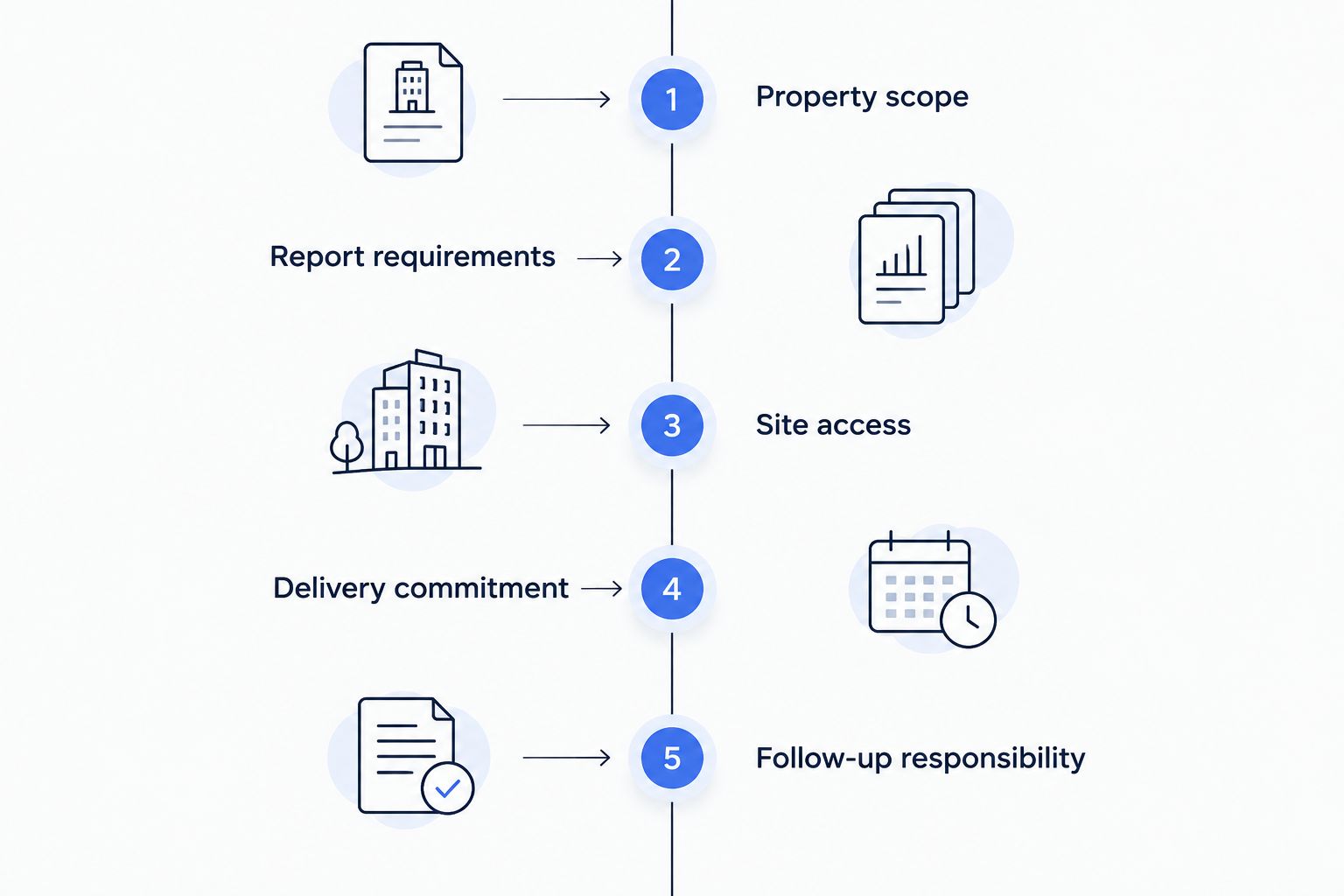
A useful 2026 comparison document records each provider's answer against these same requirements. Keep unresolved items visible rather than turning an incomplete response into an assumed capability.
Request a property-specific assessment quote
Define the property, due diligence requirements, and report deadline before commissioning the assessment.
Read the report around your investment decision
Selecting a provider is only part of the assignment. Your engagement should make clear how the resulting report will support negotiations, immediate repairs, and longer-term capital planning.
Ask for a clear distinction between observed conditions, information supplied by others, and issues requiring additional investigation. An observation about a building system is not the same as a verified diagnosis of its underlying cause.
For an acquisition, unresolved questions deserve an owner and a next action. Decide whether each question calls for seller documentation, improved site access, specialist review, or a change to the transaction assumptions.
For portfolio work, request consistent terminology and reporting organization across properties. Consistency helps your team compare findings without treating different descriptions as different levels of risk.
Do not interpret an assessment's exclusions as confirmation that the excluded conditions are acceptable. If an excluded issue matters to the investment, commission the appropriate work or resolve it through another documented source.
When staying with BDG is the right call
Stay with BDG when its written proposal meets the property's requirements, the intended report users accept the engagement, and the delivery commitment fits your transaction. A search for alternatives is not, by itself, a reason to change providers.
An established working relationship also has practical value when responsibilities and deliverables are already clear. Compare any replacement against that actual arrangement, not against a general promise of better service.
For 2026 procurement, the right decision is the provider with the suitable documented engagement. If BDG already offers that engagement, keep it on the shortlist.
FAQ
What's the best BDG alternative for commercial property due diligence?
C&J Property Assessments is a relevant BDG alternative for investor-focused property condition assessments, particularly in NC, SC, and VA. Select it when the written scope, location arrangements, and reporting commitment match your transaction.
Is a local assessment provider better than BDG?
A regional provider is better only when its proposed engagement better meets your property and transaction requirements. Compare site access, scope, report delivery, and follow-up rather than assuming geography determines quality.
Should I hire an engineer instead of a property assessment firm?
Hire an engineering specialist when you need a defined technical investigation beyond the assessment scope. Specialist work does not automatically replace a whole-property condition assessment.
Can I use any property condition assessment for my lender?
Confirm your lender's acceptance requirements before commissioning the assessment. Ask about provider eligibility, report scope, intended users, and reliance requirements.
Does a fast report mean the assessment covers everything?
No, report speed does not define assessment scope. Confirm what is inspected, what is excluded, and which findings require further investigation before relying on the report.
When should I stay with BDG rather than switch?
Stay with BDG when its written proposal satisfies the property scope, intended users, lender requirements, and delivery deadline. Switching providers is useful only when the replacement better addresses an actual requirement.
One last thing
Ask what remains unknown after the report is delivered. That question exposes scope limits more effectively than asking whether an assessment is thorough.
Before signing, require a clear explanation of inaccessible areas, excluded services, and the process for resolving material follow-up questions. The best assessment engagement makes both its findings and its boundaries usable in your investment decision.