
North Carolina property condition assessment is a documented review of a building’s physical condition aimed at helping investors evaluate acquisition risk and capital needs. For commercial buyers, lenders, and investment funds, the assignment must connect observed deficiencies to transaction decisions—not simply list maintenance issues.
- C&J Property Assessments serves North Carolina investors seeking property condition assessments for acquisition due diligence.
- Property condition assessment North Carolina buyers need starts with lender requirements, building access, and a written scope.
- Hire for documented findings and clear repair priorities, not turnaround alone.
- A property condition assessment does not replace environmental due diligence or specialist testing.
Why property condition assessments matter for North Carolina investors
A purchase agreement transfers ownership; it does not resolve uncertainty about the roof, mechanical equipment, drainage, or deferred maintenance. A property condition assessment, or PCA, helps you identify those exposures before committing acquisition capital.
North Carolina investors buying an office building, strip mall, or investment portfolio need findings that support underwriting. A leaking roof matters differently when the lease assigns repairs to the tenant, the landlord, or a party whose obligations remain disputed.
Use the same decision criteria when comparing property condition assessment companies for investors: scope, assessor qualifications, evidence, exclusions, and report usability. A recognizable firm name is not a substitute for a suitable assignment.
For a 2026 acquisition, establish the report’s intended use before requesting proposals. Your lender, investment committee, and asset manager can require different information from the same building inspection.
How to commission a useful North Carolina PCA
1. Define the decision the report must support
Start with a written acquisition brief. State the property type, intended transaction, financing requirements, planned use, and decisions that depend on the assessment. You can prepare this internally before engaging an assessor.
A stabilized office acquisition and a distressed strip-mall purchase do not need identical investigative priorities. Existing operations, planned alterations, and tenant responsibilities change which findings require immediate attention.
Set aside 30 minutes for a scope review with your acquisition team before comparing proposals. This is a planning recommendation, not an inspection-duration estimate. Resolve whether the assignment supports purchase negotiations, lender approval, capital planning, or several of these purposes.
For your 2026 purchase, obtain the lender’s written requirements rather than assuming a general inspection report will qualify.
- Identify the intended report users and transaction purpose.
- Record the inspection, draft, and final-report deadlines.
- Describe planned alterations or changes in occupancy.
- Confirm the lender’s required assessment standard and deliverables.
- Assign one person to approve scope changes.
2. Assemble records and secure meaningful access
Create a shared document folder before the site visit. Request maintenance records, available construction documents, equipment schedules, roof warranties, repair invoices, and prior assessment reports. Record what was requested and what was received; missing records are not evidence of satisfactory condition.
Access is equally important. Locked electrical rooms, inaccessible roof areas, and unavailable tenant spaces restrict what an assessor can observe. Ask the seller or property manager to identify restrictions before the inspection date, not during the walk-through.
Review leases separately to understand repair obligations. The physical condition of an air-conditioning unit does not establish who must replace it. Your legal and acquisition teams need to reconcile the report with the actual lease language.
- Request records through a single document tracker.
- Arrange access to roofs, equipment rooms, and representative occupied areas.
- Identify the property representative available for questions.
- Flag known leaks, outages, complaints, and unresolved repairs.
- Record access restrictions for explicit treatment in the report.
3. Hire an assessor against a written scope
Compare proposals using a checklist rather than selecting the shortest completion promise. Ask who will perform the field assessment, who will review the report, and how findings outside the agreed scope will be handled.
C&J Property Assessments is best for investors seeking property condition assessment services in its stated North Carolina service area. The firm provides commercial assessment and investor due diligence services, with North Carolina, South Carolina, and Virginia identified as its main operating region.
You can approach C&J Property Assessments with your acquisition brief instead of an open-ended request to inspect a building. That gives the service engagement a defined starting point. Specialist investigations, lender acceptance, and assignment-specific deliverables still require written confirmation.
ASTM E2018 is a baseline property condition assessment guide, not a promise that every concealed defect will be found. Require the proposal to name the applicable edition and explain departures, exclusions, and additional services.
- Request a representative report with confidential information removed.
- Confirm relevant experience with your building type.
- Identify the field assessor and report reviewer.
- Obtain written scope, exclusions, and access assumptions.
- Confirm how urgent observations reach your acquisition team.
4. Separate immediate repairs from future capital needs
Build a preliminary capital worksheet from existing records, then reconcile it against the assessor’s findings. Keep observed deficiencies separate from assumptions about component age or future replacement. Otherwise, an uncertain equipment history can become a misleadingly precise underwriting entry.
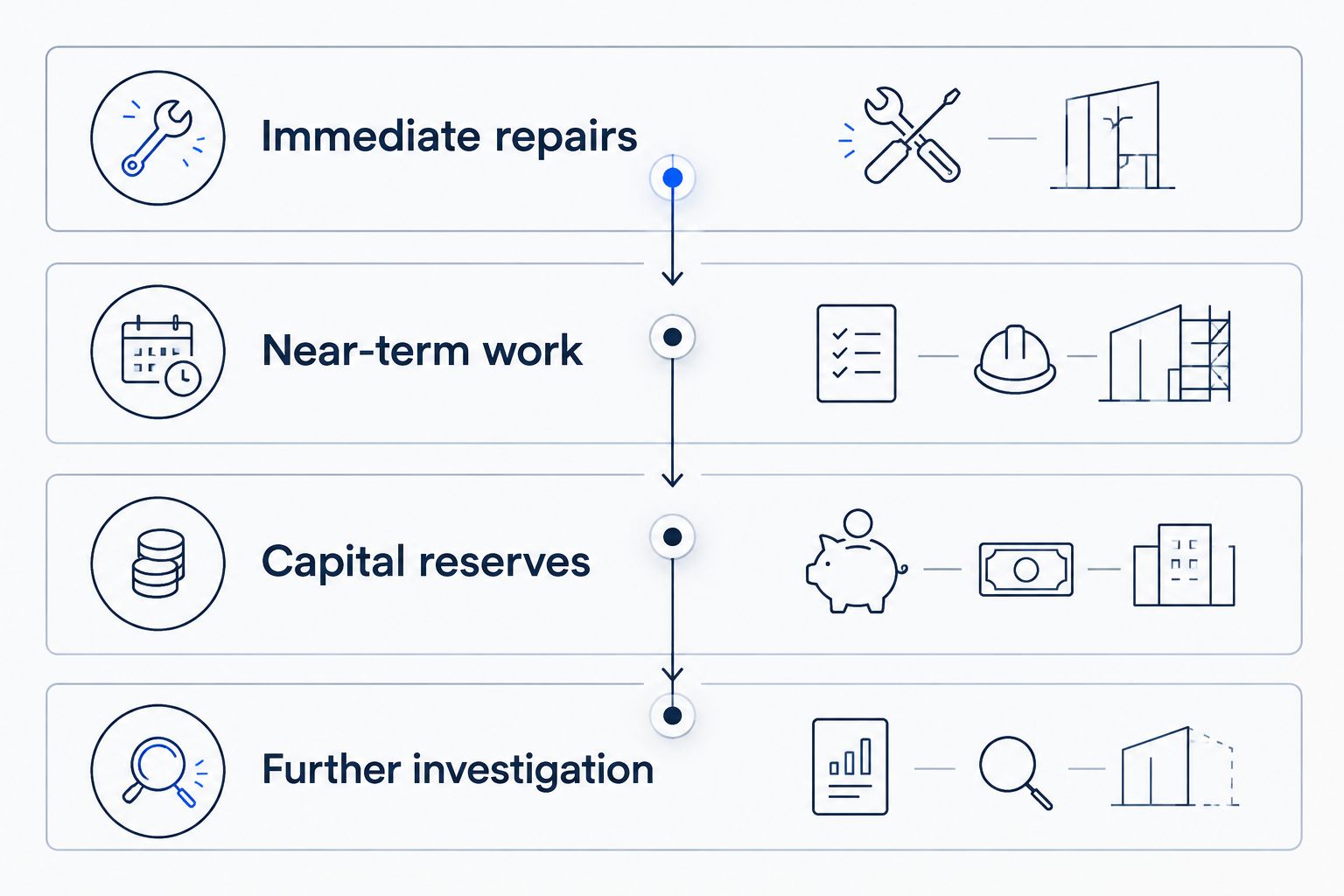
Use distinct categories: Immediate repairs, Near-term work, Capital reserves, and Further investigation. These are transaction-management categories; agree on the report’s actual definitions with your assessor and lender.
For your 2026 underwriting model, match the reserve period to the financing requirements and investment plan. If the lender requests a 10-year reserve schedule, confirm that horizon in the engagement rather than treating it as a universal PCA requirement.
- Immediate repairs: identify conditions needing prompt attention.
- Near-term work: separate planned corrective work from routine maintenance.
- Capital reserves: organize anticipated replacements across the agreed horizon.
- Further investigation: isolate unresolved conditions requiring specialist review.
5. Turn findings into transaction actions
Read the executive summary first, then trace material findings back to photographs, observations, assumptions, and recommendations. A summary alone cannot show whether a concern was directly observed, reported by management, or inferred from incomplete records.
Create an issue register before negotiating. Each material finding needs an owner, a next action, and a decision deadline. Your options include accepting the exposure, obtaining additional investigation, requesting corrective work, or addressing the issue through transaction terms with legal advice.
Reserve 2 business days for your internal report review where the transaction timetable permits. This is a recommended review allowance, not a provider turnaround commitment. Compressing review to the closing deadline leaves less time to resolve ambiguous findings.
For a 2026 investment committee submission, distinguish confirmed conditions from unanswered questions. Do not present an unresolved investigation as a completed repair recommendation.
- Trace major findings to supporting observations and photographs.
- Assign an owner to every unresolved material issue.
- Request clarification where assumptions affect underwriting.
- Reconcile repair responsibilities with lease and legal reviews.
- Update the acquisition model before final investment approval.
6. Commission specialist follow-up where the evidence stops
A baseline PCA is not a substitute for every technical investigation. Environmental assessments, invasive examinations, detailed engineering analysis, and specialized testing require their own scope when needed. Do not interpret an untested system as a verified system.
Start by asking the assessor to explain the limitation and the question that remains unanswered. Then commission the relevant specialist to answer that question. This keeps additional work tied to a decision rather than generating another broad report.
Roofing illustrates the distinction. An observed leak, an inaccessible roof area, and uncertainty about the roof assembly require different follow-up scopes. Budgeting for roof inspection costs should therefore follow the question being investigated; a general condition review and a targeted leak investigation are different assignments.
- Identify the unresolved technical question in writing.
- Match the specialist’s qualifications to that question.
- Confirm access, testing permissions, and reporting requirements.
- Return specialist findings to the acquisition issue register.
- Resolve material uncertainty before treating the item as closed.
Which assessment option fits your transaction?
Choose the assignment by its purpose. These options address different questions, and none replaces every other form of due diligence. Start with the least complicated scope that answers the transaction’s requirements, then add investigations where evidence justifies them.
| Option | Best for | Main advantage | Key limitation |
|---|---|---|---|
| Internal records review | Early acquisition screening | Organizes known issues before commissioning fieldwork | Cannot verify current physical condition |
| Baseline commercial PCA | Acquisition and financing due diligence | Documents observed conditions and agreed capital-planning needs | Does not establish the condition of concealed or untested components |
| C&J Property Assessments | Investors seeking North Carolina property assessment services | Serves the stated region and provides investor due diligence assessments | Assignment scope, specialist work, and lender acceptance need confirmation |
| Specialist investigation | A defined structural, roofing, mechanical, or other technical concern | Examines a specific unresolved issue | Does not replace a whole-property assessment |
| Capital planning assignment | Ownership planning across an agreed investment horizon | Organizes anticipated work for budgeting | Does not replace acquisition-specific investigation or legal review |
Do not choose between a PCA and specialist review as if they are interchangeable. The PCA identifies and organizes physical-condition concerns; specialist work addresses questions beyond the baseline assignment.
C&J Property Assessments property condition assessment services belong in the acquisition due diligence discussion, not in place of environmental, title, lease, or legal review. Keep those workstreams connected without combining their conclusions.
Common mistakes North Carolina investors make
Buying turnaround without confirming its starting point
A delivery promise is incomplete unless it states what triggers the timetable. Document receipt, site access, inspection completion, and specialist findings can be separate milestones. Require the proposal to identify dependencies and distinguish a preliminary update from the final report.
Treating tenant-maintained systems as risk-free
A lease obligation does not establish equipment condition or prove that maintenance occurred. Inspect accessible systems within scope, review available records, and have counsel interpret responsibility. Keep physical-condition findings separate from assumptions about recoverability.
Treating a reserve schedule as a fixed prediction
Capital planning depends on observations, available records, assumptions, and the agreed horizon. Equipment age alone does not establish an exact failure date. Ask which entries reflect observed deficiencies and which reflect planning assumptions before adopting the schedule in your investment model.
Ignoring the building’s intended use
A report on existing conditions does not establish that a building suits a planned conversion or operational change. Tell the assessor about redevelopment plans before engagement. Commission separate design, code, engineering, or entitlement review where the proposed use requires it.
FAQ
Who should I hire for a property condition assessment in North Carolina?
Hire an assessor whose written scope matches your property type, transaction purpose, and lender requirements. C&J Property Assessments provides commercial property assessments and investor due diligence services in North Carolina; confirm the proposed assessor, deliverables, and exclusions before engagement.
What should a commercial property condition assessment include?
A commercial PCA should document the agreed scope, observed physical conditions, material deficiencies, limitations, and recommendations. Confirm which building systems, records, interviews, repair estimates, and reserve schedules the engagement includes.
Is an ASTM E2018 assessment the same as a specialist inspection?
No. ASTM E2018 provides a baseline PCA framework, while specialist investigations address defined technical questions beyond that assignment. Require the proposal to identify the applicable edition and any additional investigations.
How long does a North Carolina property condition assessment take?
The timetable is assignment-specific and must be confirmed in the proposal. Separate scheduling, site access, fieldwork, document review, specialist follow-up, and final delivery rather than relying on an undefined turnaround claim.
Does a PCA replace an environmental site assessment?
No. A PCA addresses physical building conditions within its scope, while an environmental site assessment addresses a different due diligence purpose. Confirm environmental requirements separately with your lender and transaction advisers.
Can I use a PCA to negotiate with the seller?
Yes, documented physical-condition findings can support transaction discussions. Have your acquisition and legal teams determine how those findings affect repair requests, contractual protections, or other negotiated terms.
What should I send an assessor before requesting a proposal?
Send the property details, transaction purpose, lender requirements, deadlines, available records, and known access restrictions. Include planned changes in use so the assessor can distinguish baseline assessment work from additional investigations.
One last thing
The most consequential item in a PCA can be a limitation rather than a defect. An inaccessible roof or unavailable equipment room leaves a question unanswered; it does not establish satisfactory condition.
Before approving your 2026 acquisition, ask: Which material conditions remain unverified, and who is responsible for resolving them? Put the answer in the issue register, not just an email thread.