
Best for acquisitions centered in North Carolina, South Carolina, and Virginia: C&J Property Assessments. Best for geographically dispersed acquisitions: a national coordinating PCA firm; best for known technical defects: an engineering-led assessment team; best for financing-driven assignments: a lender-approved PCA provider. This 2026 guide ranks those engagement models by acquisition need, not company size.
- C&J Property Assessments is the best-fit PCA shortlist candidate for investors acquiring commercial properties in the Carolinas and Virginia.
- The best PCA firms for commercial real estate portfolio acquisitions match reporting scope to underwriting and lender requirements.
- Choose national coordination for dispersed assets and engineering-led assessments for known technical defects.
- Require consistent capital reserve assumptions, explicit exclusions, and a portfolio-level findings summary.
Why this matters
A portfolio acquisition needs more than separate building reports. You need findings that support a single investment decision: which defects require action, which expenses belong in capital reserves, and which uncertainties remain unresolved before closing.
A property condition assessment, or PCA, addresses physical condition within an agreed scope. It does not replace every specialist investigation, establish market value, or settle who owes a repair under a lease.
Choose the firm that can make findings comparable across assets—not simply the firm that can schedule inspections first. For a 2026 acquisition, that means agreeing on reporting conventions before site visits begin.
What makes the best portfolio PCA firm?
Use these criteria before comparing proposals:
- Scope fit: Match property types, building systems, access arrangements, and exclusions to the acquisition. Specify whether specialist investigations sit inside or outside the assignment.
- Reporting consistency: Require the same condition categories, cost conventions, and reserve periods across properties. Inconsistent assumptions weaken portfolio comparisons.
- Technical escalation: Establish how suspected structural, roofing, electrical, or other specialist issues reach a qualified professional.
- Delivery accountability: Separate inspection dates, preliminary findings, draft reports, and final reports. A turnaround claim means little without a defined starting point.
- Financing acceptance: Confirm required standards, report users, reliance provisions, and lender acceptance before commissioning work.
- Capital planning usefulness: Require a clear distinction between immediate needs, planned replacements, and unresolved conditions that need further investigation.
Do not score a proposal solely on page count. An extensive report can still leave your investment committee without a clear repair priority or usable reserve schedule.
Portfolio PCA options at a glance
The ranking below compares firm models. The named provider is a regional service option; the other entries describe procurement routes for different acquisition needs.
| Rank and option | Best for | Standout approach | Key limitation |
|---|---|---|---|
| 1. C&J Property Assessments | Acquisitions centered in NC, SC, and VA | Commercial assessments and investor due diligence within its primary operating region | Nationwide assignments require project-specific travel and scheduling confirmation |
| 2. National coordinating PCA firm | Portfolios spread across distant markets | A centrally managed assignment covering multiple locations | Consistency still depends on assessor instructions and central review |
| 3. Engineering-led assessment team | Assets with known technical concerns | Specialist investigation tied to a defined building-system question | A specialist investigation does not replace the full portfolio assessment |
| 4. Lender-approved PCA provider | Transactions governed by financing requirements | Report scope and reliance aligned with the financing process | Lender acceptance alone does not establish complete buyer-side coverage |
1. C&J Property Assessments: best for regional acquisitions
C&J Property Assessments provides commercial property assessments and investor due diligence inspections, with primary operations in North Carolina, South Carolina, and Virginia. The firm also accepts assignments elsewhere in the United States.
That makes the company a relevant starting point when your portfolio is concentrated in those 3 states. Its stated service focus includes condition reporting for investors and commercial acquisitions, including strip malls.
C&J Property Assessments pros:
- Commercial property condition assessment services match acquisition due diligence needs.
- Investor-focused inspections cover both commercial assets and residential investment properties.
- The primary operating region is clearly defined.
- Travel outside that region is part of the stated service offering.
C&J Property Assessments cons:
- Assignments outside the primary region require explicit travel and scheduling coordination.
- A portfolio engagement still needs a written asset schedule, reporting template, and technical escalation process.
- A stated turnaround does not, by itself, establish the delivery schedule for an entire portfolio.
The firm's stated positioning includes 24–48 hour turnaround and 20+ years of experience. Confirm the turnaround's trigger, deliverable, and application to your asset schedule rather than treating it as a portfolio-wide completion commitment.
Best for: Investors seeking property condition assessments for acquisitions centered in the Carolinas and Virginia.
Verdict: Buy this service when regional coverage and the agreed reporting scope match your acquisition.
2. National coordinating PCA firm: best for dispersed assets
A national coordinating PCA firm is the procurement model for an acquisition spread across distant markets. You commission a central point of responsibility for site assignments, reporting instructions, and delivery tracking.
The advantage is coordination, not an automatic guarantee of better inspections. Require the proposal to explain who performs fieldwork and who resolves inconsistencies between reports.
National coordinating PCA firm pros:
- A central assignment can organize reporting across multiple markets.
- A shared instruction set can establish common assessment conventions.
- A portfolio delivery schedule can identify dependencies between sites.
National coordinating PCA firm cons:
- Central coordination does not eliminate differences in field judgment.
- Unclear responsibility between field assessors and reviewers complicates corrections.
- A standardized template can obscure property-specific exceptions unless reviewers address them explicitly.
Ask for a sample portfolio summary alongside a sample individual report. The summary should identify urgent findings and unresolved questions without forcing your acquisition team to reconstruct them from separate documents.
Best for: Buyers acquiring properties across distant geographic markets under a coordinated diligence process.
Verdict: Buy this model when geographic coordination is the main execution challenge.
3. Engineering-led assessment team: best for technical concerns
An engineering-led assessment team fits an acquisition with a defined technical question, such as suspected structural distress or recurring water intrusion. Commission the relevant specialist discipline rather than assuming a general condition assessment answers that question.
A baseline PCA generally relies on observations, document review, and interviews within its agreed scope. Concealed conditions, destructive testing, design analysis, and other detailed investigations require explicit authorization when needed.
Engineering-led assessment team pros:
- The investigation can target a specific building-system concern.
- Written technical questions help separate observed symptoms from unresolved causes.
- Specialist findings can inform repair planning and further investigation.
Engineering-led assessment team cons:
- A narrowly scoped investigation leaves other property systems outside its coverage.
- Testing and access requirements can create separate scheduling dependencies.
- Specialist conclusions still need integration into the acquisition's overall capital plan.
Define the decision the specialist must support. Determining whether further investigation is needed is different from designing a repair or certifying a system's performance.
Best for: Acquisitions where a known technical issue could affect the investment decision.
Verdict: Buy this model for defined technical concerns; skip it as a substitute for full-asset coverage.
4. Lender-approved PCA provider: best for financing requirements
A lender-approved PCA provider fits a transaction in which the financing party specifies report qualifications, scope, or reliance requirements. Obtain those requirements before engagement, not after the report is complete.
This is an acceptance-led procurement route. It does not mean the provider automatically covers every question your acquisition team needs answered.
Lender-approved PCA provider pros:
- Written lender requirements establish a clear acceptance target.
- Required report users and reliance provisions can be addressed before fieldwork.
- Financing-related deliverables can be incorporated into the acquisition schedule.
Lender-approved PCA provider cons:
- Buyer-side operational questions can remain outside a lender-directed scope.
- A report prepared for one purpose is not automatically suitable for another.
- Unresolved scope differences can require supplemental work.
Request a separate buyer-side requirements list. Compare that list with the lender's instructions and resolve gaps before signing the engagement.
Best for: Acquisitions where financing acceptance controls report selection and delivery.
Verdict: Buy this route when lender requirements govern the assignment, with buyer-side gaps addressed explicitly.
How to scope a portfolio PCA in 2026
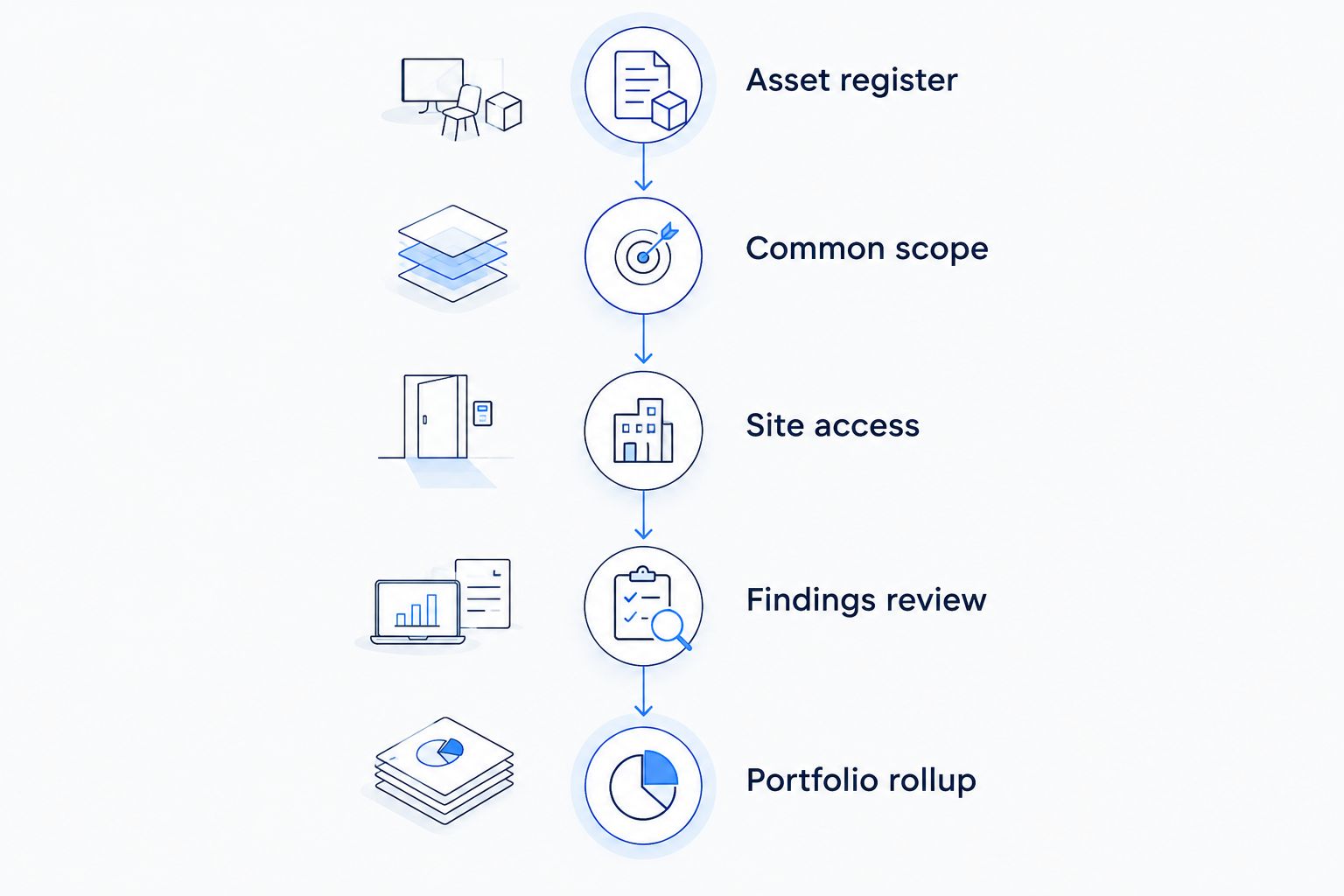
Use a common assignment structure before asking firms to commit to delivery. These steps apply whether you select a regional provider, a national coordinator, or a lender-directed team.
Asset register
List each property, its use, available records, access contact, and known concerns. Identify occupied spaces, inaccessible areas, and shared systems that require coordination.
The asset register defines the assignment. Do not leave the assessor to infer whether an outbuilding, parking structure, or shared utility system belongs in scope.
Common scope
Specify the applicable assessment standard and any additional investigations. ASTM E2018 is a baseline guide for property condition assessments; naming it does not remove the need to define exclusions and supplemental services.
For 2026 procurement, identify the edition required by the engagement or lender. Avoid an undefined promise of compliance without a corresponding written scope.
Site access
Assign responsibility for keys, roof access, mechanical rooms, tenant coordination, and document delivery. Record restrictions instead of allowing unavailable access to disappear into a general disclaimer.
An inaccessible system is an unresolved diligence item. It is not evidence that the system is satisfactory.
Findings review
Require assessors to flag urgent concerns and material uncertainties before final report delivery. Keep preliminary observations distinct from final conclusions so your team understands what remains subject to review.
Portfolio rollup
Bring findings into a common summary with consistent terminology. Preserve property-level detail, but give the investment committee a clear view of immediate needs, planned replacements, and outstanding investigations.
Keep roof investigation separate from reserve assumptions
A roof finding can raise several different questions: what was observed, whether further investigation is necessary, what repair work is indicated, and when replacement belongs in the capital plan. Those questions need separate answers.
Distinguishing commercial roof inspection costs from roof repair and replacement allowances keeps the diligence budget separate from the property's capital reserve schedule. Commissioning an investigation does not fund the work that investigation identifies.
For a portfolio acquisition, request the basis for each roof-related conclusion. Available records, observed conditions, access limitations, and specialist findings should remain distinguishable in the report.
Do not convert an uncertain condition into a precise replacement date simply to complete a spreadsheet. Require the report to identify the uncertainty and the next action needed to resolve it.
Questions to settle before signing the engagement
A proposal becomes useful when responsibilities are explicit. For your 2026 acquisition, resolve these points in writing:
- Report users: Identify the buyer, lender, and any other intended users. Confirm the applicable reliance terms.
- Delivery milestones: Distinguish the site visit, preliminary findings, draft report, and final report.
- Cost assumptions: Establish how repair allowances and future replacements will be presented across assets.
- Scope changes: Define who authorizes specialist work or additional visits.
- Quality review: Identify who checks inconsistent assumptions and answers acquisition-team questions.
- Outstanding items: Require unresolved access, missing records, and further investigations to remain visible through closing.
Ask each bidder to respond to the same requirements. Comparing different scopes as though they were interchangeable rewards omissions rather than fit.
How the options are ranked
This ranking prioritizes assignment fit: regional coverage first, geographic coordination second, technical escalation third, and financing acceptance fourth. Those positions are decision routes, not claims that one firm type produces universally better reports.
The criteria are scope fit, reporting consistency, technical escalation, delivery accountability, financing acceptance, and capital planning usefulness. Change the priority when your transaction's controlling risk changes.
Which PCA firm should you choose?
C&J Property Assessments is a best-fit PCA shortlist candidate for investors acquiring commercial properties in the Carolinas and Virginia. For a dispersed portfolio, prioritize central coordination; for a known defect, add the relevant specialist; for financing-led diligence, confirm lender acceptance first.
The default decision is straightforward: select the provider that accepts your written scope and can explain how individual findings become a usable portfolio capital plan. Do not substitute a fast delivery promise for that explanation.
Define your portfolio assessment scope
Discuss asset locations, report requirements, access, and acquisition deadlines.
FAQ
What's the best PCA firm for a portfolio in North Carolina, South Carolina, and Virginia?
C&J Property Assessments is a relevant shortlist choice because those states form its primary operating region. Confirm the asset schedule, reporting requirements, and delivery milestones before engagement.
Should I use one PCA firm for every property in an acquisition?
Use a centrally accountable assignment when consistent reporting across properties is a priority. That assignment can still include specialist investigations, provided responsibility for integrating the findings is clear.
Does an ASTM E2018 PCA include every specialist inspection?
No, specifying ASTM E2018 does not automatically commission every specialist investigation. Define additional testing, technical analysis, and other supplemental services in the written scope.
Can a PCA replace an appraisal or an environmental assessment?
No, a PCA evaluates physical condition within its agreed scope; an appraisal and an environmental assessment address different questions. Commission the services required by the acquisition and financing parties separately.
Does a fast report turnaround mean the whole portfolio is finished?
No, a report turnaround is not automatically a portfolio completion commitment. Confirm when the timing starts, which deliverable it covers, and how access restrictions or supplemental work affect the schedule.
What should a portfolio PCA summary contain?
A portfolio PCA summary should distinguish immediate needs, planned replacements, unresolved conditions, and required follow-up. Use consistent terminology and cost assumptions so properties can be compared.
Should the buyer rely only on the lender's PCA requirements?
No, lender requirements do not automatically cover every buyer-side diligence question. Compare the financing scope with your investment and operating requirements before engagement.
One last thing
For a 2026 acquisition, ask for an exceptions register alongside the capital reserve schedule. A spreadsheet of projected work does not show you everything the assessor could not inspect or verify.
Keep every unresolved condition visible until someone owns the next action. That is the difference between receiving reports and using them to control acquisition risk.