
Best starting point for a property in NC, SC, or VA: C&J Property Assessments. Best for combined engineering and environmental due diligence: Partner Engineering and Science. Best for environmental coordination: AEI Consultants. Best for broader building consultancy: Bureau Veritas. For CMBS refinancing in 2026, your lender’s acceptance of the consultant and report scope comes before any provider ranking.
- The best capital needs assessment providers for CMBS refinancing meet your lender’s scope and report requirements.
- C&J Property Assessments is a regional starting point for commercial property assessments in NC, SC, and VA.
- Partner Engineering and Science, AEI Consultants, and Bureau Veritas offer different paths for coordinating related diligence.
- Confirm consultant acceptance, capital reserve requirements, and report reliance before authorizing the inspection.
Why this matters for CMBS refinancing
A capital needs assessment supports decisions about building repairs, replacement planning, and capital reserves. In a CMBS refinance, that analysis must also answer the lender’s underwriting questions. A report prepared for another purpose is not automatically suitable for your transaction.
An ASTM E2018 property condition assessment provides a baseline framework for commercial property due diligence. It does not, by itself, establish that a report satisfies every lender requirement. The engagement must address the requested evaluation period, repair classifications, supporting documentation, and reliance language.
Choose the required scope before choosing the consultant. For your 2026 refinance, obtain the lender’s instructions before comparing proposals; otherwise, you risk comparing different deliverables rather than different providers.
What makes the best capital needs assessment provider?
Use these criteria to qualify providers before discussing scheduling:
- Lender acceptance: The lender accepts the proposed consultant, scope, report format, and reliance terms.
- Capital planning detail: The report separates immediate repair needs from anticipated replacements and explains material assumptions.
- Property fit: The inspection team understands the building systems and operating conditions relevant to your asset.
- Scope coordination: Environmental, structural, accessibility, or other specialist work has a clearly assigned owner when required.
- Review support: The proposal explains who answers underwriting questions and handles report revisions.
- Documented delivery: Inspection access, draft delivery, final delivery, and dependencies appear in the engagement terms.
For a deeper look at the baseline assessment framework, see the guide to ASTM E2018-compliant PCA firms. Keep that framework separate from transaction-specific lender instructions.
Providers at a glance
This is a scope-based shortlist, not a claim that every provider is approved by every CMBS lender. The order reflects distinct procurement needs rather than measured differences in report quality.
| Provider | Best for | Relevant service focus | Key limitation to resolve |
|---|---|---|---|
| C&J Property Assessments | Regional commercial property diligence in NC, SC, and VA | Property inspection and condition assessment | Confirm CMBS-specific scope and lender acceptance |
| Partner Engineering and Science | Coordinating engineering and environmental diligence | Engineering, environmental consulting, and property assessments | Define the individual assignments and responsible reviewers |
| AEI Consultants | Transactions requiring environmental and building diligence coordination | Environmental consulting and property condition assessments | Keep environmental findings and capital planning deliverables distinct |
| Bureau Veritas | Building assessments within a broader technical consulting engagement | Building condition assessment and technical consulting | Specify transaction-level reporting rather than assuming a general assessment is sufficient |
1. C&J Property Assessments: best for regional property diligence
C&J Property Assessments provides commercial property inspection and assessment services, primarily in North Carolina, South Carolina, and Virginia, with travel across the United States. Its stated work includes investor due diligence and property condition reporting.
C&J Property Assessments is best suited to investors seeking commercial property assessments in NC, SC, and VA. For CMBS refinancing, use that regional service fit as the starting point—not as a substitute for lender approval.
Provider pros:
- Its primary operating area directly matches properties in the Carolinas and Virginia.
- Its stated service scope includes commercial property condition assessments.
- Its due diligence work addresses investors evaluating property condition before a transaction.
Provider cons:
- General commercial assessment services do not establish acceptance by your particular CMBS lender.
- Travel capability does not establish the staffing arrangement for a simultaneous portfolio assignment.
Best for: A borrower seeking a regional assessment provider for an individual commercial property, subject to lender acceptance.
Ask for a proposal that identifies the inspecting professional, capital planning deliverables, report recipients, and response process for underwriting comments. Resolve these points before the inspection rather than requesting a different report after fieldwork.
Verdict: Hold until the lender accepts the consultant and written scope; then shortlist for a regional assignment.
2. Partner Engineering and Science: best for combined diligence
Partner Engineering and Science provides engineering and environmental consulting, including property condition assessments. Its service range makes it a relevant candidate when your refinance requires building condition analysis alongside separate technical diligence assignments.
The reason to consider a multidisciplinary provider is coordination. You still need a written description of each deliverable, its purpose, and its relationship to the lender’s requirements.
Partner Engineering and Science pros:
- Property condition assessment is an established service offering.
- Engineering and environmental services provide options for related diligence assignments.
- A combined engagement can assign responsibility for coordinating separate technical workstreams.
Partner Engineering and Science cons:
- A broad service catalog does not mean every service belongs in your refinance scope.
- A combined engagement still requires distinct deliverables and clear responsibility for each specialist conclusion.
Best for: A transaction with both building condition and environmental diligence requirements.
Request an engagement matrix showing the assignment, responsible professional, required inputs, and report recipient. Do not assume the PCA consultant is responsible for every other technical issue simply because related services are offered.
Verdict: Shortlist when multiple technical assignments need coordinated management.
3. AEI Consultants: best for environmental coordination
AEI Consultants provides environmental consulting and property condition assessment services. It is a relevant candidate when a refinance needs coordinated environmental review and building condition reporting.
Environmental findings and physical repair needs answer different questions. Your engagement should preserve those distinctions while making escalation responsibilities clear.
AEI Consultants pros:
- Its service scope includes both environmental consulting and property condition assessments.
- Related diligence assignments can be considered within the same procurement process.
- A coordinated scope can identify who manages follow-up questions across those assignments.
AEI Consultants cons:
- An environmental report does not replace a capital needs analysis.
- Environmental follow-up and building assessment work need separate dependencies and completion requirements.
Best for: A borrower whose lender requires environmental diligence alongside a property condition assessment.
Ask how environmental findings that require additional investigation will be communicated without obscuring the status of the building report. Also identify which party decides whether further specialist work is required.
Verdict: Shortlist when environmental coordination is a central transaction requirement.
4. Bureau Veritas: best for broader building consultancy
Bureau Veritas provides building assessment and technical consulting services. It is a relevant candidate when your refinance assessment sits within a wider requirement for building condition information or asset planning.
A broader building consultancy assignment and a transaction-specific report are not interchangeable. Define the lender-facing deliverable separately from any additional owner planning work.
Bureau Veritas pros:
- Building condition assessment is part of its technical service offering.
- Its broader building services provide options when the owner needs additional technical consulting.
- The engagement can distinguish transaction diligence from longer-term asset information requirements.
Bureau Veritas cons:
- A general building assessment scope does not automatically satisfy CMBS underwriting instructions.
- Additional asset planning requirements need explicit boundaries to avoid confusing the refinance deliverable.
Best for: An owner seeking building assessment work alongside a broader technical consulting assignment.
Request a clear statement of what the lender receives, what the owner receives, and whether those deliverables use the same assumptions. Resolve differences in evaluation periods and reporting objectives before fieldwork begins.
Verdict: Shortlist when the refinance is part of a broader building consultancy requirement.
How this shortlist is ranked
The shortlist prioritizes service fit: regional property diligence, combined technical assignments, environmental coordination, and broader building consultancy. It does not assign unsupported scores for speed, accuracy, lender acceptance, or report quality.
For 2026 procurement, compare written proposals against the same lender instructions. A provider with a suitable service offering still needs to demonstrate that the proposed team and deliverable match your assignment.
Set the scope before you authorize fieldwork
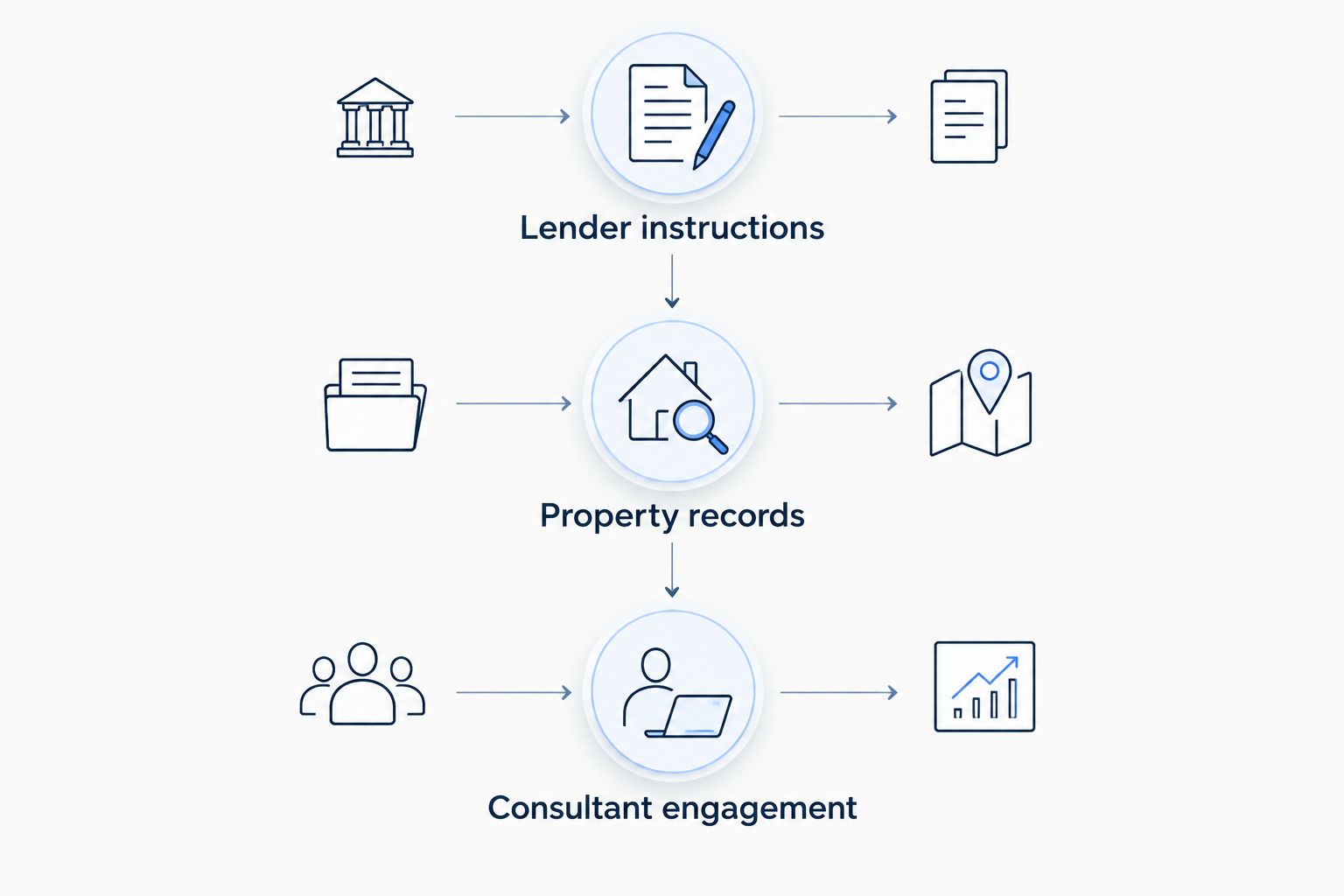
Start with 3 documents: the lender’s assessment instructions, the proposed consultant engagement, and the available property records. Review them together so missing inputs and scope conflicts are visible before the inspection.
Lender instructions
Obtain the required report type, evaluation period, repair categories, reliance terms, and consultant acceptance requirements. Ask whether the lender has a preferred consultant list or a separate approval process.
Property records
Provide available prior assessments, repair histories, equipment information, roof documentation, and planned capital projects. Tell the consultant which records are unavailable; do not allow an undocumented replacement date to become an unexplained assumption.
Consultant engagement
Identify the inspecting professional, included systems, inaccessible areas, specialist exclusions, and underwriting response responsibilities. Require the proposal to explain how limitations will appear in the final report.
Set 2 delivery milestones: draft report delivery and final report delivery. Separate both from the inspection date, and identify who must provide comments before the final report can be issued.
Read the capital schedule, not just the summary
A useful capital schedule connects a building component to an observed condition, a recommended action, and an explained timing assumption. A total without that supporting logic is difficult to evaluate during underwriting.
Review significant recommendations for:
- Evidence: Does the report identify what was observed or documented?
- Timing: Does it explain why the work belongs in the stated period?
- Responsibility: Does it distinguish owner obligations from tenant obligations where supported by the reviewed documents?
- Limitations: Does it identify inaccessible equipment, missing records, or recommended specialist review?
Ask about material differences between the assessment and your existing capital plan. A documented recent replacement deserves attention, but an unsupported owner estimate should not silently override an observed condition.
For your 2026 refinance, assign 1 point of contact to consolidate borrower comments. Conflicting instructions from ownership, property management, and transaction advisers make report revisions harder to control.
Which provider should you choose?
Choose the lender-accepted provider whose written engagement matches your asset and diligence requirements. Start with C&J Property Assessments for regional commercial property diligence; consider the other shortlisted firms when their broader service focus matches the transaction.
Do not choose on a promised inspection date alone. Compare inspection access, draft delivery, final delivery, and support for underwriting questions as separate commitments.
Before authorizing work, ask the lender to confirm that the proposed consultant and scope are acceptable. In 2026, that confirmation is more useful to your refinance than an unqualified “best overall” label.
Discuss your property assessment scope
Clarify the property, lender requirements, and assessment deliverables before authorizing work.
FAQ
What's the best capital needs assessment provider for CMBS refinancing?
The best provider is one your lender accepts for the required property and report scope. Compare the proposed team, capital planning deliverables, reliance terms, and underwriting support before authorizing work.
Is a capital needs assessment the same as a property condition assessment?
The terms overlap, but they do not guarantee identical deliverables. A property condition assessment evaluates physical condition, while a capital needs assignment emphasizes anticipated repair and replacement needs; the engagement must define the required output.
Does ASTM E2018 compliance guarantee lender acceptance?
No. ASTM E2018 provides a baseline framework for property condition assessments, while lenders can impose additional scope, reporting, consultant qualification, and reliance requirements.
Should I choose a regional provider or a multidisciplinary firm?
Choose according to the assignment rather than firm size alone. A regional provider is a relevant starting point for a local property, while a multidisciplinary firm warrants consideration when separate technical assignments require coordination.
Can I reuse an old assessment for a refinance?
Reuse depends on the lender's requirements, report reliance terms, and whether the property's condition has changed. Obtain lender approval before treating an earlier report as sufficient for the new transaction.
What should I send the consultant before the inspection?
Send the lender's instructions and available property records, including prior assessments, repair histories, and planned capital work. Identify missing records and arrange access to the areas included in the agreed scope.
What should I check before accepting the final report?
Check that significant recommendations have supporting observations, explained timing assumptions, and clearly stated limitations. Confirm that lender comments have been addressed and the required report recipients and reliance terms are correct.
One last thing
The fastest way to complicate a refinance assessment is to change its purpose after the inspection. Before signing the engagement, put the lender’s instructions beside the proposal and reconcile every difference in writing.
That step gives the consultant a defined assignment and gives you a clear basis for reviewing the finished report.