
Vertex Engineering brings engineering and technical consulting to property-related assignments, but a broad technical offering does not replace a transaction-specific inspection scope. For an acquisition, the deciding question is whether the engagement answers your property-condition, capital-planning, and lender requirements. The best Vertex Engineering alternative in 2026 is C&J Property Assessments for investor-focused property condition assessments, particularly in NC, SC, and VA; an independent structural engineer is the better fit for a defined structural concern.
- C&J Property Assessments leads these Vertex Engineering alternatives for investor-focused property condition assessments in NC, SC, and VA.
- Choose a structural engineer when the assignment requires structural analysis rather than a general condition assessment.
- Choose an environmental consultant for contamination-related due diligence; a PCA does not replace that investigation.
- Compare written scope, report acceptance, site access, and delivery milestones before appointing any provider.
Why this matters
A commercial acquisition does not need the broadest proposal. It needs the right evidence before your inspection contingency expires. A roof replacement concern, suspected structural movement, and a potential contamination issue require different investigations.
For your 2026 acquisition, separate the property condition assessment from specialist assignments before comparing providers. Otherwise, you risk comparing proposals that appear similar but answer different questions. A short proposal can omit necessary work; a lengthy proposal can include services unrelated to your purchase decision.
The useful comparison is therefore not simply firm against firm. It is PCA provider versus structural specialist versus environmental specialist, with Vertex Engineering retained as the benchmark for the engagement you are considering.
Vertex Engineering alternatives at a glance
These options are different service routes, not interchangeable substitutes. Use the table to identify the assignment first, then compare written proposals for that assignment.
| Provider or service route | Best for | Defining role | How to compare with Vertex Engineering |
|---|---|---|---|
| Vertex Engineering | Buyers considering an engineering and technical consulting engagement | Engineering-led technical consulting | Use the proposed scope as the benchmark, not the company name alone |
| C&J Property Assessments | Investors and lenders seeking commercial property condition assessments | Investor due diligence, with a primary operating focus in NC, SC, and VA | Compare PCA deliverables, report timing, geographic arrangements, and acceptance requirements |
| Independent structural engineer | Buyers investigating a defined structural concern | Structural evaluation within an agreed engineering scope | Compare the exact structural question, investigation methods, and deliverable |
| Environmental consultant | Buyers investigating environmental conditions or contamination concerns | Environmental due diligence under a separate scope | Compare the environmental assignment rather than treating it as a substitute PCA |
Best-fit rule: appoint the provider whose written assignment matches the decision you must make. Do not buy a general assessment expecting it to resolve an excluded specialist question.
1. C&J Property Assessments: best for investor-focused PCAs
C&J Property Assessments provides property condition assessments for commercial real estate and due diligence inspections for investors, hedge funds, and other acquisition buyers. Its primary operating area covers 3 states: North Carolina, South Carolina, and Virginia, with travel across the United States also offered.
That makes the firm a relevant alternative when your core requirement is a condition report supporting an acquisition, rather than a broader technical consulting engagement. Its stated positioning includes 24–48 hour turnaround, 20+ years of experience, licensed appraisers, CCPIA certification, and ASTM E2018 compliance. Confirm the assignment-specific schedule and scope in writing.
Where the firm shines
- Investment-oriented assignments: the business serves buyers assessing property condition before committing capital.
- Regional relevance: NC, SC, and VA are its main operating markets.
- Commercial acquisition focus: the stated service range includes due diligence for assets such as strip malls.
- Timing emphasis: the stated turnaround gives you a specific delivery expectation to discuss before appointment.
Where the firm falls short
- A PCA is not every technical investigation. Do not assume the appointment includes structural calculations, invasive testing, or environmental investigation.
- Travel requires coordination. An assignment outside the primary operating region needs an agreed inspection schedule and access plan.
- Fast delivery does not establish lender acceptance. Obtain agreement on report scope, reliance, and intended users before authorizing work.
These are important boundaries, not reasons to reject the service. A clearly bounded PCA is more useful than a proposal that leaves you guessing about what the report will answer.
Head-to-head: the PCA decision
| Dimension | This alternative | Vertex Engineering comparison point |
|---|---|---|
| Assignment focus | Investor-oriented property condition assessments | Compare the specific assessment scope offered |
| Geographic planning | Primary focus in NC, SC, and VA; nationwide travel offered | Confirm assignment location and scheduling arrangements |
| Delivery | Stated 24–48 hour turnaround positioning | Compare the same delivery milestone in both proposals |
| Technical boundaries | Confirm specialist investigations separately | Identify included investigations and exclusions in the proposal |
Best for: acquisition teams seeking a commercial PCA, particularly for properties in the firm's primary operating region.
Verdict: Buy a clearly scoped PCA when property-condition due diligence is the assignment; commission additional specialist work when the findings require it.
2. Independent structural engineer: best for a structural concern
An independent structural engineer is the right alternative when your unresolved question concerns structural behavior, capacity, or a specific defect. Examples include visible movement, concerns about load-bearing elements, or a proposed change that requires engineering evaluation.
This is a narrower appointment than a whole-property condition assessment. Define the question precisely: documenting visible conditions is not the same assignment as evaluating capacity or designing a repair.
Where this route shines
- Focused technical questions: you can commission an evaluation of the particular structural issue affecting the transaction.
- Defined engineering deliverables: the scope can specify analysis, investigation, or repair recommendations as needed.
- Specialist follow-up: the appointment can address a concern identified during broader acquisition due diligence.
Where this route falls short
- It is not automatically a whole-property review. Roof coverings, mechanical equipment, paving, and other components require their own agreed coverage.
- Investigation boundaries matter. Concealed conditions and restricted access can limit conclusions unless further work is authorized.
- It does not replace environmental due diligence. Structural expertise answers a different acquisition question.
For a Vertex Engineering comparison, ask both candidates to define the structural problem, proposed investigation, exclusions, and final deliverable. Comparing firm size tells you less than comparing those commitments.
Best for: buyers whose transaction depends on resolving a specific structural concern.
Verdict: Buy a structural engineering engagement for a structural decision; skip it as a substitute for whole-property condition reporting.
3. Environmental consultant: best for environmental due diligence
An environmental consultant is the appropriate service route when the acquisition question concerns environmental conditions, potential contamination, or related investigation. Keep this assignment distinct from a PCA even when you coordinate both during the same inspection period.
A building can have acceptable physical condition and still require environmental investigation. Conversely, environmental findings do not tell you the condition of the roof or the replacement needs of mechanical systems.
Where this route shines
- Environmental scope: the appointment addresses environmental questions rather than general building condition.
- Separate decision trail: environmental findings remain identifiable in your acquisition review.
- Targeted follow-up: additional investigation can be commissioned against the environmental question requiring resolution.
Where this route falls short
- It does not replace a PCA. You still need appropriate assessment of building components and site improvements.
- Scope levels differ. Records review, site reconnaissance, sampling, and further investigation are not interchangeable assignments.
- Separate appointments need coordination. Your acquisition team must reconcile findings and follow-up requests before closing.
When comparing this route with Vertex Engineering, compare the environmental scope itself. Do not compare an environmental proposal against a PCA proposal and treat the difference as a measure of provider quality.
Best for: acquisitions requiring environmental due diligence alongside, or separately from, property-condition reporting.
Verdict: Buy environmental expertise for environmental questions; skip it as a replacement for physical-condition assessment.
How to choose the right engagement in 2026
Use the following sequence before accepting any proposal. It keeps the provider comparison tied to your transaction instead of a generic ranking.
Scope review
Start with the acquisition decision and intended report users. State whether you need a PCA, structural evaluation, environmental assessment, or coordinated assignments. Give the provider the lender's requirements before the scope is finalized, not after the report arrives.
Ask for explicit inclusions and exclusions. A reference to ASTM E2018 provides a framework for a PCA; it does not make every investigation part of the engagement.
Site access
Identify occupied spaces, locked rooms, roof-access arrangements, and records available from ownership. Confirm who will coordinate access and answer operational questions. An agreed appointment date is not the same thing as access to every relevant area.
Require the proposal to explain how access limitations will be documented. You need to distinguish an assessed component from one that could not be observed.
Specialist review
Agree on how specialist concerns will be escalated. Ask who authorizes additional work and whether the transaction schedule allows time for it. Do not leave a potentially material structural or environmental question inside a general recommendation to investigate later.
Report acceptance
Confirm the delivery milestone, intended users, reliance arrangements, and required format. For any stated turnaround, clarify whether the clock begins at appointment, site inspection, or receipt of necessary records. Also distinguish an initial report from a final deliverable incorporating agreed follow-up.
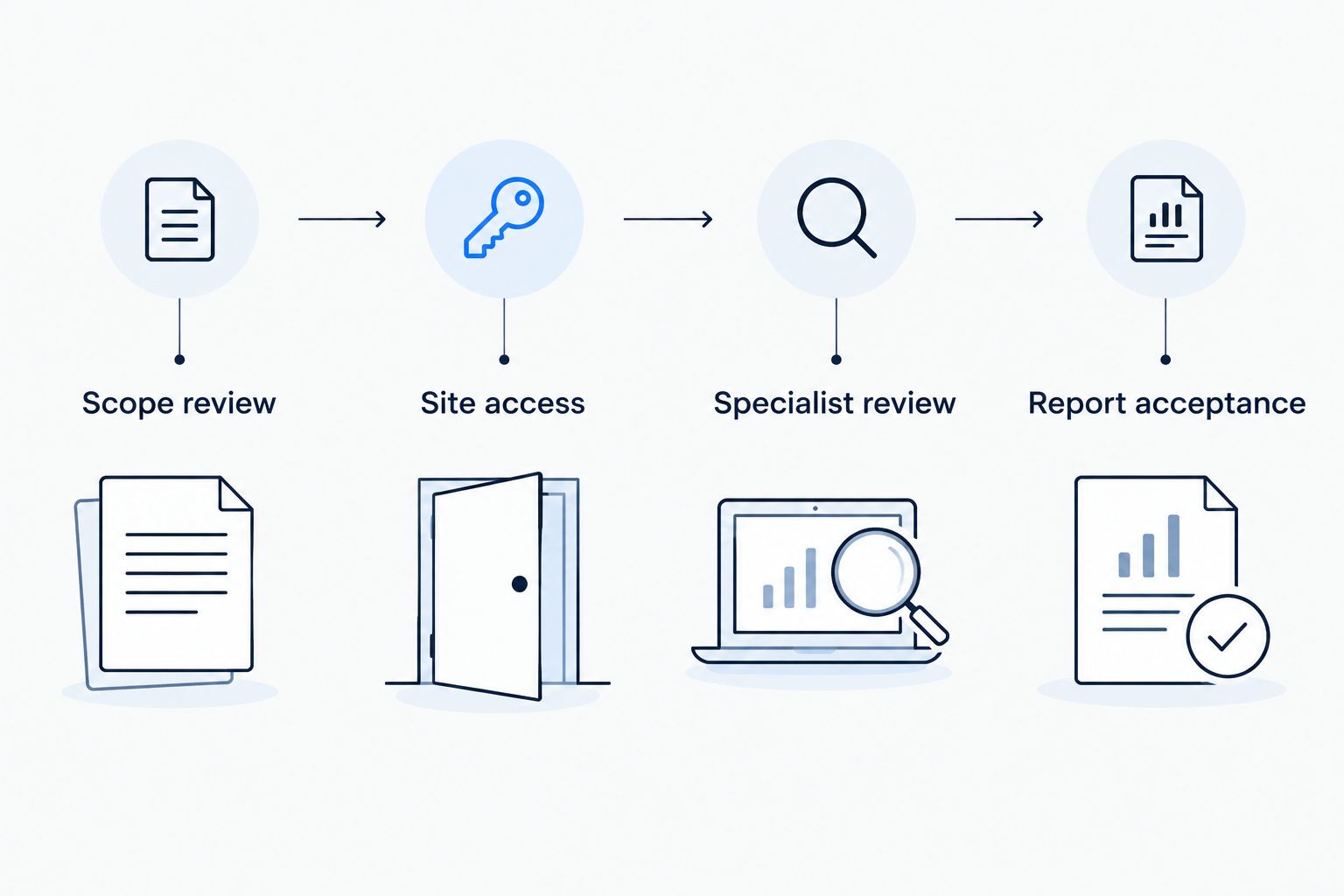
The practical output is a written appointment that connects the property, inspection scope, access arrangements, and reporting deadline. Compare that appointment across providers before making your 2026 selection. A familiar name cannot correct a mismatch between the contracted work and your lender's requirements.
Why switch from Vertex Engineering?
Switch when another provider offers a better match to the defined assignment. That is a procurement decision, not evidence that Vertex Engineering performs poorly. Avoid substituting assumptions about firm size for a review of the actual proposal.
For a 2026 acquisition, the following are valid reasons to change providers when the proposals establish them:
- Scope mismatch: the proposed work does not answer the property-condition or specialist question driving your purchase decision.
- Schedule mismatch: the proposed inspection or report milestone does not meet your contractual deadline.
- Acceptance mismatch: the engagement does not satisfy the intended lender's scope or reliance requirements.
- Coordination mismatch: access, records, or follow-up responsibilities remain unresolved before appointment.
Do not switch solely because another provider advertises speed. A faster initial report is not a better outcome if a material concern remains outside the assignment. Compare equivalent deliverables and identify who owns each unresolved issue.
When staying with Vertex Engineering is the right call
Stay with Vertex Engineering when its written proposal fits your required scope, technical questions, delivery milestones, and report-use requirements. Switching providers adds no value if the existing appointment already answers the transaction's needs.
This is especially important when several technical assignments must be coordinated. Evaluate how the proposal handles those assignments rather than assuming that either a larger firm or a focused provider is automatically better. Keep the provider that offers the right documented engagement—not the one with the strongest generic ranking.
FAQ
What's the best Vertex Engineering alternative in 2026?
C&J Property Assessments is the best fit here for investor-focused commercial property condition assessments, particularly in NC, SC, and VA. Choose a structural or environmental specialist when the transaction requires that separate expertise.
Should I hire a PCA provider or a structural engineer?
Hire a PCA provider for broad property-condition due diligence and a structural engineer for a defined structural question. Commission both when the acquisition requires both types of evidence.
Does a property condition assessment include environmental due diligence?
Do not treat a property condition assessment as environmental due diligence. Specify the environmental assignment separately and coordinate its findings with the physical-condition review.
What should I confirm about a 24–48 hour turnaround?
Confirm when the turnaround clock starts and which deliverable it covers. Establish whether access limitations, outstanding records, or specialist follow-up affect final delivery.
Does ASTM E2018 compliance guarantee lender acceptance?
ASTM E2018 compliance does not by itself guarantee lender acceptance. Confirm the lender's scope, report-use, and reliance requirements before commissioning the assessment.
Is a regional PCA provider suitable for a property outside its main market?
A regional provider is suitable when it accepts the location and agrees to the required scope, access arrangements, and schedule. Confirm travel and inspection coordination before appointment.
When should I stay with Vertex Engineering?
Stay with Vertex Engineering when its proposal satisfies your technical scope, schedule, and report-use requirements. A provider change should solve a documented engagement problem rather than follow a ranking alone.
One last thing
Ask every shortlisted provider to identify what the report will not answer. That question exposes scope gaps more directly than asking whether a firm provides due diligence.
Before appointing C&J Property Assessments for property condition assessments, put those exclusions beside your acquisition decision list. Assign each unresolved issue to the appropriate specialist or resolve it through the agreed scope. The most useful report is one whose boundaries you understand before closing.