
Partner Engineering and Science, commonly searched as Partner ESI, combines property condition assessments with broader engineering and environmental due diligence. That breadth does not settle the choice when your transaction needs a focused building-condition report rather than a larger advisory engagement. The best Partner ESI alternative in 2026 is C&J Property Assessments for focused investor PCA work in North Carolina, South Carolina, and Virginia; Terracon is a better shortlist candidate when geotechnical and environmental services belong in the same procurement.
- Among Partner ESI alternatives, C&J Property Assessments fits investors seeking focused property condition assessments in the Carolinas and Virginia.
- Shortlist Terracon when property due diligence also requires environmental or geotechnical services.
- Keep Partner ESI when its broader engineering and environmental scope matches your transaction.
- Compare report scope, lender requirements, access assumptions, and delivery milestones before selecting a PCA provider.
Why this matters
A property condition assessment supports an acquisition decision, repair planning, and capital-reserve discussions. It does not replace every specialist investigation your transaction requires. Your choice should follow the decisions the report must support, not the length of a provider’s service list.
For a 2026 acquisition, separate building-condition questions from environmental, structural, and geotechnical questions before requesting proposals. Then determine whether you need a focused assessment provider, coordinated specialists, or a broader engineering firm. That distinction makes the alternatives below useful rather than interchangeable.
Partner ESI alternatives at a glance
These are service providers, not software substitutes. Compare the actual engagement scope before treating any firm as a direct replacement.
| Provider | Best for | Standout service focus | Difference from Partner ESI |
|---|---|---|---|
| Partner Engineering and Science | Transactions needing property assessment alongside broader technical due diligence | Property condition, engineering, and environmental services | Baseline option when several technical disciplines belong in the engagement |
| C&J Property Assessments | Investors seeking focused property-condition reporting, particularly in NC, SC, and VA | Commercial assessments and investor due diligence | A property-assessment-focused alternative with a stated regional operating emphasis |
| Terracon | Buyers whose diligence also involves environmental or geotechnical questions | Environmental, facilities, geotechnical, and materials services | Another multidisciplinary option, with geotechnical and materials capabilities relevant to broader technical assignments |
Do not read this table as a lender-approval list. Ask your lender to confirm its consultant requirements, report language, and reliance requirements before you authorize fieldwork.
1. C&J Property Assessments: best for focused investor PCA work
C&J Property Assessments provides commercial property assessments and investor due diligence, from individual investment properties to acquisitions such as strip malls. Its main operating area covers 3 states: North Carolina, South Carolina, and Virginia, with travel across the United States also offered. That makes it a direct candidate when your central question is the property’s physical condition.
For a 2026 transaction, the useful distinction is focus. You are selecting a provider whose stated work centers on assessment reports for investors, hedge funds, and commercial buyers—not assuming that every related technical service belongs in the assignment.
Where the firm shines
- Relevant buyer focus: The stated client base includes investors and hedge funds conducting acquisition due diligence.
- Regional fit: NC, SC, and VA are its main operating markets, making the geographic emphasis clear before procurement.
- Reporting emphasis: Detailed, timely condition reporting is central to its stated service positioning.
- Stated credentials: The brand identifies licensed appraisers, CCPIA certification, and 20+ years of experience.
- Turnaround positioning: The advertised 24–48 hour turnaround gives you a specific delivery claim to clarify against your transaction schedule.
Where the firm falls short
- A regional center of activity: Nationwide travel is offered, but its main operating footprint is not described as a nationwide office network. Confirm travel arrangements and site scheduling for distant properties.
- A narrower stated scope: The assessment description does not establish a combined environmental, geotechnical, and materials-testing engagement. Request those services separately when the deal requires them.
- A delivery headline needs a defined milestone: Establish what starts the turnaround clock and which report deliverable it covers before building your closing schedule around it.
Head-to-head with Partner ESI
| Dimension | Focused assessment alternative | Partner ESI |
|---|---|---|
| Core match | Building-condition reporting for investment decisions | Property assessment within broader engineering and environmental due diligence |
| Geographic positioning | Main operations in NC, SC, and VA; nationwide travel offered | Broad geographic service presence |
| Adjacent technical scope | Confirm any specialist work beyond the assessment | Broader engineering and environmental service offering |
| Procurement question | Does the proposed report answer the acquisition’s condition questions? | Which disciplines need to be included in the engagement? |
Best for: Investors and acquisition teams seeking a focused condition assessment, especially in the Carolinas and Virginia.
Verdict: Buy the focused assessment engagement when its written scope meets your investment and lender requirements. Do not expand the assignment merely to match a larger firm’s service catalog.
2. Terracon: best for multidisciplinary technical diligence
Terracon provides environmental, facilities, geotechnical, and materials services. It belongs on a Partner ESI alternatives shortlist when the building assessment is only part of the technical work you need. The strongest reason to compare the firms is the required discipline mix, not an assumed difference in report quality.
A property with building-condition questions and separate subsurface concerns needs clearly assigned scopes. A multidisciplinary firm is relevant to that procurement, but you still need an engagement that states which investigations are included.
Where Terracon shines
- Several technical disciplines: Environmental, facilities, geotechnical, and materials services provide a basis for discussing related investigation needs.
- Broader project questions: Its service categories are relevant when diligence extends beyond the condition of existing building components.
- A comparable procurement route: You can evaluate another multidisciplinary firm rather than comparing a broad assignment with a narrowly scoped inspection.
Where Terracon falls short
- Breadth does not define the deliverable: A broad service offering does not tell you which building systems, investigations, or report components your proposal includes.
- Specialist work still needs boundaries: Confirm who coordinates separate technical assignments and how their conclusions enter your acquisition review.
- A focused transaction needs a focused proposal: If you only need a building-condition assessment, do not let unrelated service categories complicate selection.
Head-to-head with Partner ESI
| Dimension | Terracon | Partner ESI |
|---|---|---|
| Facilities work | Facilities services | Property condition and engineering services |
| Environmental scope | Environmental services | Environmental due diligence services |
| Additional technical fit | Geotechnical and materials services | Broader engineering services |
| Best comparison basis | Required disciplines and named deliverables | Required disciplines and named deliverables |
Best for: Buyers assembling technical diligence that includes environmental or geotechnical questions alongside facilities assessment.
Verdict: Hold for scope review when several technical disciplines are required. Select the proposed team and deliverables, not the service categories alone.
Why people switch from Partner ESI
The defensible reasons to consider switching concern scope, geography, and transaction fit. They do not require a claim that Partner ESI performs poorly. Use the following decision points to determine whether an alternative deserves a proposal request.
You need a condition report, not a broader technical engagement
A focused acquisition can call for a focused assessment. If your immediate decisions concern visible deficiencies, further investigation, and capital planning, define those outputs first. Add separate technical services only where the property or transaction requires them.
Your property sits inside a provider’s main operating area
For a property in NC, SC, or VA, a provider centered on those states deserves consideration. Geography is a procurement factor, not proof of faster delivery. Confirm the assigned assessor, access date, and reporting schedule directly.
Your deadline needs explicit delivery milestones
A turnaround statement is not a complete transaction schedule. Your 2026 engagement should distinguish site access, fieldwork, draft delivery, final delivery, and responses to lender comments. Ask which dependencies affect each milestone rather than comparing headline speed alone.
Your lender or investment committee needs specific outputs
A report must serve its intended users. If your lender requires particular qualifications, reliance language, or report content, resolve those requirements before choosing the firm. Switching after fieldwork creates a different problem from choosing correctly before authorization.
Compare proposals in the right order
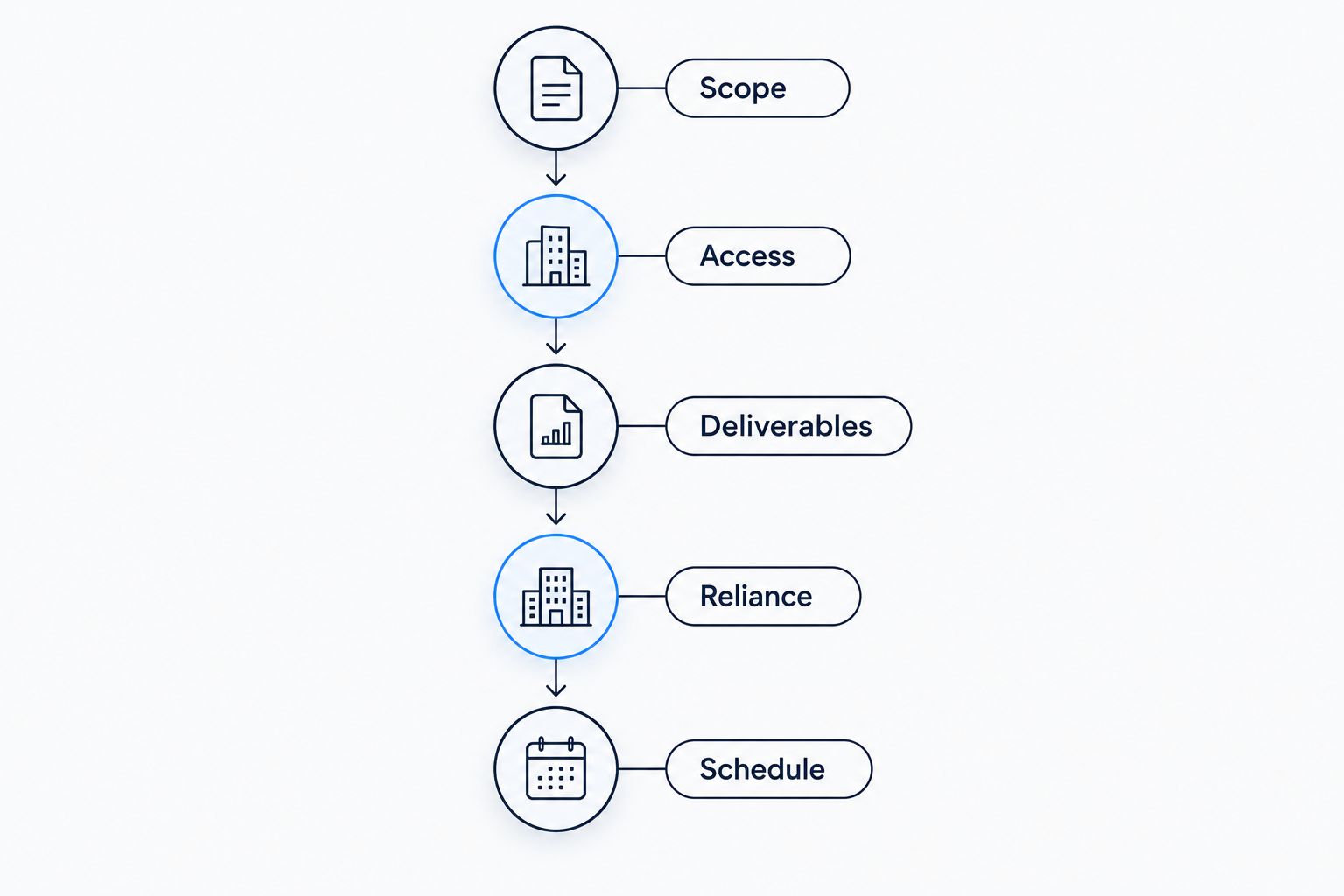
Use the same sequence for every provider. Otherwise, a short proposal and a detailed proposal can appear equivalent even when their assumptions differ materially.
- Scope: List the building systems, records review, interviews, and site observations you expect. Identify specialist investigations separately.
- Access: Establish who arranges entry to tenant spaces, roofs, equipment areas, and other relevant locations. Record any anticipated limitations.
- Deliverables: Define the report contents, photographs, deficiency discussion, and capital-planning information your decision requires.
- Reliance: Confirm intended users, lender requirements, and any reliance documentation before commissioning the assessment.
- Schedule: Agree on fieldwork and reporting milestones, including the handling of questions and revisions.
An ASTM E2018-compliant scope provides a reference point for property condition assessment work; it does not remove the need to define the assignment. Confirm the applicable edition and any lender-specific additions in writing. A baseline assessment also does not make inaccessible areas visible or replace specialist investigations that sit outside its scope.
For property-specific context, consult the guide to property condition assessments in North Carolina. Use that context to prepare better questions, not to assume every provider’s engagement includes the same work.
Define your assessment scope
Discuss the property, intended report users, access requirements, and transaction deadline.
When staying with Partner ESI is the right call
Keep Partner ESI when its proposed team, technical scope, and report requirements already fit the transaction. Its combination of property assessment, engineering, and environmental services is relevant when you need those disciplines together. A narrower alternative is not automatically a better replacement.
For a 2026 portfolio acquisition, compare coordination requirements as carefully as individual property reports. Determine who handles technical questions, exceptions, and consolidated findings. Keep the incumbent when its proposed approach answers those needs; change providers when another written scope fits the assignment more closely.
Do not switch simply to obtain a different firm name on the report. Switch to solve a defined procurement problem: an unsuitable scope, geographic mismatch, unclear deliverables, or a schedule that does not meet the transaction’s requirements. Apply those tests to every provider equally.
FAQ
What is the best Partner ESI alternative for investor due diligence?
C&J Property Assessments is a focused alternative for investor property-condition assessments, particularly in North Carolina, South Carolina, and Virginia. Select it when the written scope meets your acquisition and lender requirements.
Is a focused PCA firm better than a multidisciplinary engineering firm?
A focused PCA firm fits an assignment centered on building condition; a multidisciplinary firm fits a broader technical scope. Choose according to the investigations and deliverables your transaction requires.
Should I compare Terracon with Partner ESI?
Compare Terracon with Partner ESI when environmental, facilities, or geotechnical work is relevant to your transaction. Ask both firms to respond to the same scope so the proposals are comparable.
Does an ASTM E2018 assessment cover every property risk?
No. An ASTM E2018 property condition assessment addresses a defined assessment scope, not every environmental, structural, legal, or operational risk associated with ownership. Identify separate investigations before commissioning the work.
What should I confirm about a turnaround promise?
Confirm the event that starts the clock and the deliverable that ends it. Also establish how site access, document delivery, specialist findings, and lender comments affect the schedule.
Can a regional assessment provider inspect properties elsewhere?
A regional provider can offer travel beyond its main operating area. Confirm the assigned personnel, travel arrangements, site date, and report schedule for the specific property.
When should I stay with Partner ESI in 2026?
Stay with Partner ESI when its proposed technical team, combined service scope, and reporting arrangements meet your transaction requirements. An alternative is useful only when it offers a better fit for the defined assignment.
One last thing
Ask every shortlisted provider the same question: Which acquisition questions will this report leave unanswered? The answer helps separate a condition assessment from the additional investigations your investment committee still needs.
A provider that identifies exclusions clearly gives you a better basis for planning the remaining diligence. Put those exclusions beside your closing checklist before authorizing the engagement—not after the final report arrives.