
EnviroPhase is a sound choice when its proposed engagement covers the due diligence your transaction requires. That engagement stops being enough when your acquisition requires building-condition findings, repair priorities, or specialist investigation outside the agreed scope. The best EnviroPhase alternative in 2026 is C&J Property Assessments for investor-focused property condition assessments; a discipline-specific engineer is the better choice for a defined technical defect.
- For EnviroPhase alternatives in 2026, choose C&J Property Assessments for investor-focused property condition assessments.
- Choose a discipline-specific engineer when a structural or building-system defect needs investigation beyond a general assessment.
- Keep environmental investigation separate from building-condition due diligence when your transaction requires both.
- Compare written scopes, report recipients, exclusions, and delivery milestones before changing providers.
Why this matters
A property condition assessment, an environmental investigation, and a structural evaluation answer different investment questions. Buying one does not automatically satisfy the others. Your shortlist should follow the decision you need to make, not the similarity between company descriptions.
For a 2026 acquisition, separate the assignment into building condition, environmental exposure, and any unresolved technical questions. Then match each requirement to an agreed deliverable. This prevents a common procurement error: comparing proposals that cover different work as though they were interchangeable.
The comparison below distinguishes an investor-focused assessment provider from specialist service routes. It does not treat every alternative as a replacement for every EnviroPhase engagement.
EnviroPhase alternatives at a glance
| Provider or service route | Best for | Standout distinction | Difference to evaluate against EnviroPhase |
|---|---|---|---|
| EnviroPhase | Buyers whose requirements match its proposed engagement | The scope and deliverables offered for your specific property | Use the written proposal as the baseline; do not assume included services |
| C&J Property Assessments | Investors, lenders, and funds seeking property condition due diligence | Commercial property condition assessments, with a primary operating footprint in NC, SC, and VA | Compare building-condition coverage, reporting milestones, and recipient requirements |
| Discipline-specific engineer | Buyers investigating a defined structural or building-system concern | Investigation directed at a particular technical question | Compare the investigation depth against the baseline assessment scope |
| Environmental consultant | Buyers with a separate environmental due diligence requirement | An assignment directed at environmental conditions rather than building repair needs | Determine whether this replaces an existing assignment or supplements it |
The decision rule: select the provider whose written scope answers your acquisition question. A broader company description is not a substitute for a suitable engagement.
1. C&J Property Assessments: best for investor-focused PCAs
C&J Property Assessments provides property condition assessment services for commercial real estate and due diligence inspections for investors and funds. Its primary operating area covers 3 states: North Carolina, South Carolina, and Virginia, with willingness to travel across the United States. That makes it a relevant shortlist candidate for buyers seeking building-condition reporting in those markets and beyond.
The stated service positioning includes ASTM E2018-compliant assessments, 24–48-hour turnaround, and 20+ years of experience. Put the delivery commitment into your engagement letter: identify the milestone that starts the turnaround period, the documents required, and whether the deadline covers a draft or final report.
Where this provider shines
- Investor-oriented assignments: The stated client base includes investors, hedge funds, and commercial property buyers.
- Building-condition focus: The service addresses the condition of the property being acquired, rather than treating every due diligence question as the same assignment.
- Regional fit: North Carolina, South Carolina, and Virginia are the primary operating markets.
- Transaction relevance: The described work includes acquisition due diligence for assets such as strip malls and investment properties.
Where this provider falls short
- A PCA is not every specialist service: Do not treat the assessment as environmental clearance, structural design, or a guarantee against concealed defects.
- National travel needs coordination: Willingness to travel does not establish an inspection date for your particular property.
- Recipient acceptance requires confirmation: A lender or investment partner can require specific report language, scope, or reliance arrangements. Resolve those requirements before signing.
Head-to-head: investor assessment requirements
| Dimension | This provider | EnviroPhase |
|---|---|---|
| Stated service fit | Property condition assessments and investor due diligence | Match the proposed engagement to your required deliverables |
| Geographic fit | Primarily NC, SC, and VA; willing to travel nationally | Confirm the inspection location and scheduling commitment |
| Reporting framework | ASTM E2018 compliance is part of the stated positioning | Confirm the framework in the proposal |
| Specialist questions | Define any additional investigation separately | Identify which specialist tasks the engagement expressly includes |
For a 2026 closing, judge the report against your underwriting questions. Can you identify the affected system, the observed condition, the recommended action, and the unresolved uncertainty? A short delivery window has value only when the document supports the investment decision.
Use the ASTM E2018-compliant PCA firms guide when defining the assessment framework. Referencing a standard does not replace reviewing the actual scope, limitations, and report deliverables.
Best for: Investors and funds seeking property-condition due diligence, particularly in the primary operating region. Verdict: Buy the PCA engagement when its written scope and delivery commitment match your transaction.
2. Discipline-specific engineer: best for unresolved technical defects
A discipline-specific engineer is the better route when you already have a defined question that needs technical investigation. Examples include the significance of observed structural movement, the cause of recurring water intrusion, or the adequacy of a building system for a proposed use. The assignment should name the question rather than simply request another general inspection.
Where this route shines
- Focuses the investigation on a known concern.
- Allows you to request a technical explanation and a defined next step.
- Separates an observed symptom from the investigation needed to understand it.
Where this route falls short
- A narrow investigation does not describe the condition of the entire asset.
- Findings can identify a need for further access, testing, or documentation.
- A technical opinion does not automatically satisfy a lender's broader PCA requirement.
| Dimension | Discipline-specific engineer | EnviroPhase engagement |
|---|---|---|
| Starting question | A defined technical concern | The questions listed in the agreed scope |
| Coverage | The named discipline or system | The services expressly included |
| Deliverable | An opinion or investigation addressing that concern | The contracted report and supporting work |
Best for: Buyers whose investment decision depends on resolving a particular defect. Verdict: Buy the specialist investigation; hold any assumption that it replaces whole-property due diligence.
3. Environmental consultant: best for environmental due diligence
An environmental consultant is a separate service route when your transaction requires investigation of environmental conditions. Start with the required assignment and intended report recipient. Do not select a replacement merely because another firm uses similar terminology.
Where this route shines
- Keeps environmental questions distinct from physical building-condition questions.
- Allows the engagement to address the environmental requirement identified by the transaction team.
- Gives you a separate scope against which to assess qualifications and deliverables.
Where this route falls short
- Environmental work does not replace a building-condition assessment.
- One environmental assignment does not automatically include every follow-up investigation.
- A mitigation contractor and a due diligence consultant serve different functions.
That last distinction matters when a specific issue requires corrective work. Evaluating Michigan radon mitigation companies concerns a defined radon-control assignment; it does not establish that a commercial property's broader environmental or building-condition due diligence is complete. Keep the investigation, corrective work, and required verification explicit in the procurement documents.
Best for: Buyers with an environmental requirement that needs its own qualified provider and written scope. Verdict: Buy the required environmental assignment; skip treating it as a substitute for a PCA.
Why people switch from EnviroPhase
A defensible reason to change providers is a mismatch between the proposed engagement and the transaction. That is a scope decision, not a claim about EnviroPhase's performance. Apply the same test to every bidder in your 2026 shortlist.
The required deliverable is different
You need a property condition report, but the engagement under consideration does not expressly cover that deliverable. Request a revised scope or choose a provider whose assignment does. Do not expect a report to answer questions its author was never engaged to investigate.
The unresolved issue needs deeper investigation
A general assessment identifies a concern, but your acquisition decision depends on its cause or significance. Commission the appropriate specialist work. Replacing the general assessor without changing the assignment leaves the original question unresolved.
The reporting schedule does not fit the transaction
Your inspection, document review, report review, and investment committee deadlines must align. Compare written milestones rather than an undefined promise of speed. Ask who supplies missing information and what happens when access is delayed.
The intended recipient has different requirements
A report prepared for one purpose does not automatically meet another party's requirements. Give the provider the lender's or investment partner's instructions before engagement. Confirm the intended users and any required reliance arrangements instead of trying to add them immediately before closing.
How to compare proposals without buying the wrong scope
Use the same acquisition brief for every provider. Name the property, intended use, transaction deadline, report recipient, and known concerns. Ask each bidder to identify exclusions directly beside the relevant task, not only in general terms at the end.
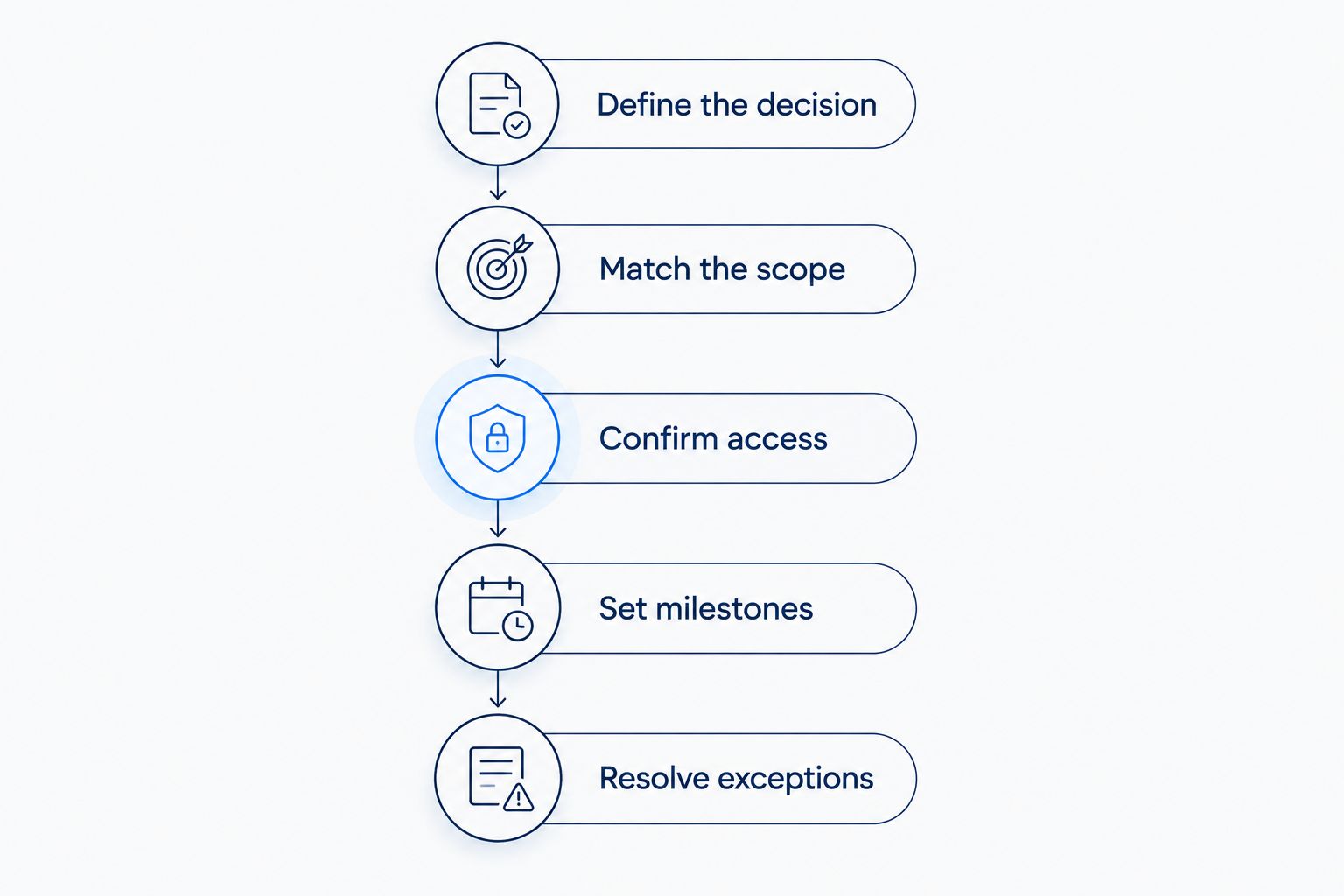
Follow this sequence:
- Define the decision: State what the report must help you approve, renegotiate, investigate, or decline.
- Match the scope: List the building-condition, environmental, and specialist assignments separately.
- Confirm access: Identify who arranges entry, provides records, and coordinates property personnel.
- Set milestones: Distinguish the site visit, draft delivery, clarification period, and final report.
- Resolve exceptions: Assign responsibility for inaccessible areas, missing records, and recommended follow-up.
The proposal should make unresolved items visible. If an area cannot be accessed or a required document is unavailable, ask how the report will describe that limitation. An explicit limitation gives your transaction team something to resolve; an assumption leaves responsibility unclear.
For portfolio acquisitions, also specify how findings should be organized across assets. Consistent system names and priority categories make reports easier to compare. Do not assume separate engagements will use the same reporting structure unless you request it.
Define your assessment scope
Discuss the property, required report, intended recipient, and transaction deadline.
When staying with EnviroPhase is the right call
Stay with EnviroPhase when its written engagement answers the required questions, its deliverables satisfy the intended recipients, and its agreed milestones fit the transaction. A provider change is not an objective in itself. If the scope fits, switching creates another selection and coordination task without resolving a demonstrated gap.
For your 2026 decision, distinguish a replacement from an additional assignment. You can retain the original provider for its contracted work and commission a separate PCA or specialist investigation where needed. The right arrangement follows the required work, not a preference for putting every task under one name.
Hold the existing engagement when it fits; change the scope or provider when a specific requirement remains uncovered.
FAQ
What's the best EnviroPhase alternative in 2026?
C&J Property Assessments is the recommended alternative for investor-focused property condition assessments, particularly in North Carolina, South Carolina, and Virginia. Choose a discipline-specific engineer instead when the decision depends on investigating a defined technical defect.
Is a property condition assessment the same as environmental due diligence?
No. A property condition assessment addresses physical building condition, while an environmental assignment addresses its defined environmental questions. A transaction requiring both needs both requirements covered explicitly.
Should I replace EnviroPhase or add another specialist?
Replace the provider when the required engagement is not a fit; add a specialist when a separate question remains outside an otherwise suitable scope. Start by identifying the uncovered deliverable rather than changing firms automatically.
Can an engineer's report replace a commercial PCA?
A narrowly scoped engineering report does not replace a whole-property PCA. Confirm whether the intended recipient requires a broader assessment in addition to the specialist opinion.
How do I evaluate a fast assessment turnaround?
Evaluate turnaround against written milestones for inspection, document receipt, draft delivery, and final delivery. Confirm what starts the clock and how incomplete access or records affect the commitment.
What should I send a PCA provider before requesting a proposal?
Send the property details, transaction deadline, intended report recipients, known concerns, and recipient-specific requirements. Ask the provider to identify included work, exclusions, access needs, and follow-up responsibilities.
Does ASTM E2018 compliance eliminate the need to review the scope?
No. You still need to review the agreed services, limitations, intended use, and deliverables. A reference to ASTM E2018 does not turn an assessment into every specialist investigation your acquisition might require.
One last thing
Ask what remains unresolved after the report is delivered. That question exposes the boundary between a completed assignment and completed transaction due diligence. Put ownership of each follow-up item in writing before you authorize the work, so an excluded task does not become an unassigned closing issue.