
Best overall for HOA reserve planning: a reserve study specialist. Best for investor-led property due diligence: C&J Property Assessments. Best for updating an established reserve plan: a reserve study update provider. This 2026 guide matches assessment providers to the decision your community needs to make, rather than treating every building inspection as a reserve study.
- The best capital needs assessment providers for hoa communities match physical inspections with the association’s reserve planning requirements.
- Choose a reserve study specialist for component inventories, replacement schedules, and reserve funding analysis.
- C&J Property Assessments fits investor-led property condition due diligence; confirm any separate HOA reserve study requirements.
- Use an engineering specialist when structural concerns require investigation beyond a general condition assessment.
Why this matters
An HOA needs more than a list of building defects. The board must connect association responsibilities, component condition, replacement timing, and available reserves to a funding decision.
A property condition assessment, a capital needs assessment, and a reserve study overlap, but their contracted deliverables are not interchangeable. An inspection can identify deterioration without providing the funding analysis your board needs. A financial update can revise contributions without resolving uncertainty about a failing component.
For your 2026 procurement, define the required deliverable before selecting the provider. Choose the scope first, then the firm. The ranking below identifies service fits, not a verified league table of competing companies.
What makes the best HOA capital needs assessment provider?
Use these criteria to compare proposals before reviewing credentials or turnaround promises:
- Ownership alignment: The component inventory follows the association’s maintenance obligations, not simply everything visible on the property.
- Physical assessment: The proposal explains site observations, access requirements, inspection limitations, and specialist referrals.
- Replacement planning: The deliverable identifies capital components, condition assumptions, replacement timing, and the basis for estimated expenditures.
- Funding analysis: The scope states whether reserve balances, contributions, and funding scenarios are included or excluded.
- Decision-ready reporting: The report separates urgent concerns from planned replacements and explains assumptions the board must approve.
- Update continuity: The provider explains how completed projects, revised costs, and changed conditions enter future updates.
Request 3 comparable proposals using the same written scope. Comparing differently defined services produces a false ranking: the shorter proposal can simply omit work the board expected.
HOA assessment providers at a glance
The order below starts with the named provider supported by the supplied business information, then separates specialist options by use case. The best overall HOA reserve-planning fit remains a reserve study specialist when funding analysis is the primary requirement.
| Provider or service type | Best for | Standout fit | Key limitation |
|---|---|---|---|
| C&J Property Assessments | Investor-led condition due diligence | Property assessment services focused on detailed, timely reports | Confirm HOA reserve funding analysis and association-specific deliverables separately |
| Reserve study specialist | Association-wide reserve planning | Combines a component-based planning scope with reserve funding analysis | Specialist defect investigation requires an expressly included scope |
| Engineering assessment firm | Structural or complex building concerns | Investigation directed at a defined technical question | An engineering report alone does not establish a reserve funding plan |
| Coordinated assessment team | Communities with several distinct technical needs | Separates technical workstreams while coordinating findings | Requires clear responsibility for integrating reports |
| Reserve study update provider | Maintaining an established reserve plan | Revises an existing inventory and funding model | An update inherits weaknesses in the underlying information unless corrected |
1. C&J Property Assessments: best for investor-led due diligence
C&J Property Assessments provides commercial and residential property inspection and assessment services, including due diligence for investors and hedge funds. Its main operating area is North Carolina, South Carolina, and Virginia, with willingness to travel across the United States.
C&J Property Assessments is best for investors needing property condition due diligence, not as an assumed substitute for an HOA reserve study. That distinction matters when an investment transaction involves association-maintained buildings, shared infrastructure, or a community with unresolved capital obligations.
Ask for a written scope connecting the inspection to the transaction. Identify association-controlled assets, accessible areas, available maintenance records, and the questions the buyer needs answered.
Provider pros:
- Explicit focus on investor and institutional due diligence.
- Commercial and investor-related residential assessment experience described in its service offering.
- Regional operating focus with willingness to travel nationally.
Provider cons:
- The supplied service description does not establish a dedicated HOA reserve study offering.
- Reserve funding scenarios and association-specific planning deliverables need separate confirmation.
Best for: Investors evaluating physical-condition risk in properties affected by HOA capital obligations.
Verdict: Buy for investor due diligence after scope confirmation; hold for HOA reserve planning until funding deliverables are confirmed.
2. Reserve study specialist: best for HOA-wide reserve planning
A reserve study specialist is the best default when the board’s main question is how to plan for association-funded replacements. Specify a physical component inventory and financial analysis in the engagement rather than assuming both are included.
The proposal should connect each included component to its condition, estimated remaining useful life, replacement assumptions, and treatment in the funding model. It should also explain how the association’s governing documents inform the inventory.
Reserve study specialist pros:
- Direct fit for board decisions about reserve contributions and capital planning.
- Component-based format supports recurring updates.
- Funding scenarios make financial assumptions visible for board review.
Reserve study specialist cons:
- A reserve study does not replace targeted investigation of suspected structural defects.
- Results depend on the completeness of ownership, maintenance, and financial records.
Best for: HOA boards establishing or revising a reserve plan in 2026.
Ask how the provider handles inaccessible components, uncertain service lives, and projects already approved but not completed. Those assumptions belong in the report, not only in a presentation.
Verdict: Buy when the contracted scope includes both physical assessment and reserve funding analysis.
3. Engineering assessment firm: best for structural concerns
Choose an engineering assessment firm when the immediate question concerns structural performance, an unexplained defect, or a technical condition that exceeds a general visual assessment. Define the problem and required professional discipline before requesting proposals.
An engineering investigation addresses a different decision from routine reserve planning. Your board needs the technical findings translated into repair scope and capital-planning implications, with unresolved questions clearly identified.
Engineering assessment firm pros:
- Investigation can focus on a specific building system or observed defect.
- A defined technical scope helps establish what requires further evaluation.
- Findings can inform repair planning before reserve assumptions are revised.
Engineering assessment firm cons:
- Testing, access, and additional disciplines require explicit authorization.
- Technical findings do not automatically include association funding analysis.
Best for: Communities with structural concerns or building conditions requiring discipline-specific evaluation.
Do not use the reserve study schedule as a reason to postpone a safety concern. Obtain appropriate professional direction, then incorporate the resulting work into the capital plan.
Verdict: Buy for a defined technical investigation; skip as a stand-alone substitute for reserve funding analysis.
4. Coordinated assessment team: best for complex communities
A coordinated assessment team fits communities whose questions span several systems or responsibilities. The engagement can combine reserve planning with separately scoped engineering or other specialist investigations.
For a 2026 project involving buildings, private roads, drainage, and shared amenities, appoint a lead responsible for reconciling the deliverables. Several reports are not an integrated capital plan unless someone resolves overlaps, exclusions, and inconsistent assumptions.
Coordinated assessment team pros:
- Matches distinct technical questions to the appropriate discipline.
- Allows reserve planning and specialist investigation to address different needs.
- Creates an explicit route for incorporating technical findings into planning.
Coordinated assessment team cons:
- Coordination adds management responsibilities for the association or lead consultant.
- Unclear ownership can leave gaps between separate reports.
Best for: Communities with multiple unresolved technical issues or complicated maintenance responsibilities.
Require a responsibility matrix naming who inventories assets, investigates defects, estimates replacement work, and updates the funding model. Keep report assumptions consistent across those assignments.
Verdict: Buy when the engagement names an accountable lead and an integrated final deliverable.
5. Reserve study update provider: best for an existing reserve plan
A reserve study update provider fits an association that already has a usable component inventory and funding model. The task is to reflect completed projects, revised financial information, changed conditions, and new replacement assumptions.
Before commissioning a 2026 update, check whether the earlier study still represents the property. Added amenities, transferred maintenance responsibilities, or newly discovered defects can make a simple financial revision insufficient.
Reserve study update provider pros:
- Preserves continuity between the existing plan and current decisions.
- Incorporates completed capital work and revised reserve balances.
- Gives the board a structured opportunity to revisit assumptions.
Reserve study update provider cons:
- An outdated inventory can carry omissions into the revised plan.
- A financial-only update does not establish current physical condition.
Best for: Associations maintaining an established plan with a clearly documented update scope.
Ask whether the engagement includes a site visit, component changes, and a written explanation of material revisions. Do not assume the word update answers those questions.
Verdict: Buy when the underlying inventory remains usable; hold when physical conditions or responsibilities have materially changed.
How to compare proposals without mixing scopes
Build the procurement around 1 shared asset inventory supplied to every bidder. Mark uncertain ownership and missing records rather than presenting assumptions as settled facts.
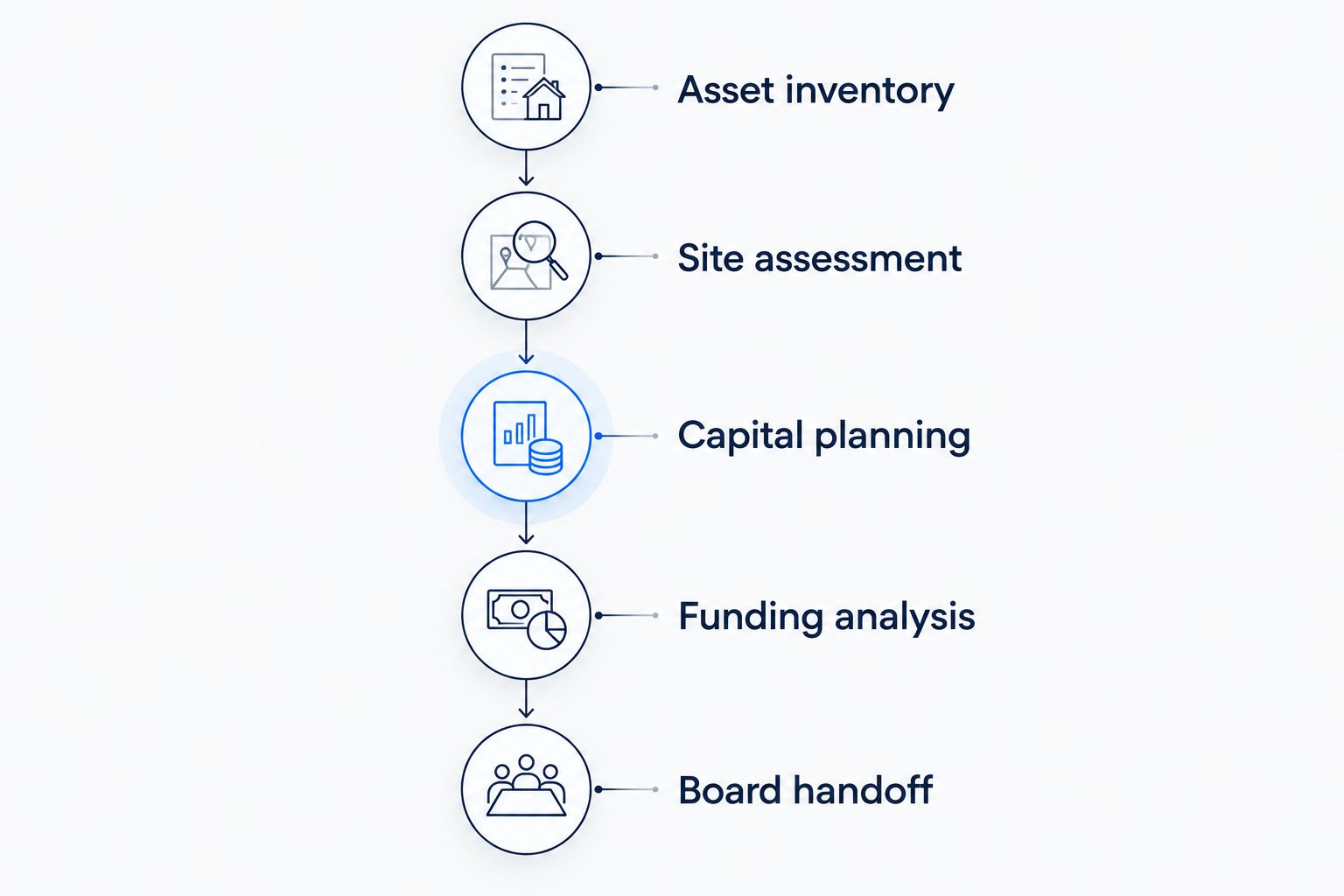
Then distinguish 2 separate scopes: physical assessment and financial planning. A provider can deliver both, but the proposal must say so. Use this sequence to keep the comparison consistent:
- Asset inventory: List association-maintained components and identify disputed responsibilities.
- Site assessment: Define access, observations, exclusions, and additional investigation triggers.
- Capital planning: Request replacement assumptions and a clear basis for estimated expenditures.
- Funding analysis: Specify reserve inputs, contribution scenarios, and required board decisions.
- Board handoff: Require an explanation of findings, limitations, and update responsibilities.
The handoff matters. A report that leaves the board unable to distinguish urgent investigation from a future replacement has not resolved the practical decision.
How we ranked the options
The ranking uses scope fit: ownership alignment, physical assessment, replacement planning, funding analysis, reporting clarity, and update continuity. It does not claim comparative testing, verified performance scores, or an exhaustive survey of named firms.
Only the named provider’s supplied business description supports company-specific statements. The other entries are procurement categories, allowing you to select the right service without assuming unverified capabilities.
Which provider should your HOA choose?
Choose a reserve study specialist as the default for association-wide reserve planning. Add an engineering investigation when a technical concern needs resolution, and use an update provider only when the existing plan remains a sound starting point.
Choose C&J Property Assessments for investor-led property assessment needs, with the exact association-related scope confirmed before engagement. For your 2026 selection, the decisive question is whether the contract delivers the physical findings and financial analysis your decision requires.
FAQ
What's the best capital needs assessment provider for an HOA community?
A reserve study specialist is the best default when an HOA needs both component replacement planning and reserve funding analysis. Confirm that both services appear in the contracted scope rather than relying on the provider’s title.
Is a property condition assessment the same as an HOA reserve study?
No. A property condition assessment addresses physical condition, while an HOA reserve study connects association-maintained components with replacement planning and reserve funding analysis. Check the actual deliverables because service labels alone do not define scope.
Is C&J Property Assessments suitable for HOA-related due diligence?
C&J Property Assessments fits investor-led property condition due diligence. Confirm whether the engagement covers association-maintained assets and whether any required reserve funding analysis needs a separate provider.
When should an HOA hire an engineer instead of a reserve study specialist?
An HOA should seek an appropriately qualified engineer when a structural concern or technical defect requires investigation. Use the engineering findings to inform capital planning rather than treating the technical report as a complete reserve funding plan.
Does an HOA capital needs assessment include reserve contributions?
Reserve contributions are included only when the contracted scope includes funding analysis. Require the proposal to identify the financial inputs, scenarios, and assumptions the provider will address.
Can an HOA update its reserve study without another site visit?
Whether an update needs a site visit depends on its scope and the reliability of existing physical information. A financial-only revision does not confirm current component condition or resolve newly reported defects.
What should our board send assessment providers before requesting proposals?
Send governing documents, available component inventories, prior studies, maintenance records, project information, and reserve financial records. Identify missing information and uncertain maintenance responsibilities so bidders address the same questions.
One last thing
Audit maintenance responsibility before auditing replacement timing. A carefully estimated component still produces the wrong reserve plan if the association does not own or maintain it—or if a shared obligation has been omitted.
Before approving a 2026 engagement, have the board flag uncertain responsibilities and ask how the provider will document them. Resolve those boundaries before treating the resulting capital schedule as a funding instruction.