
Best for broker-led due diligence in North Carolina, South Carolina, and Virginia: C&J Property Assessments. Best for coordinating property condition and environmental due diligence: Partner Engineering and Science. Best for transactions requiring geotechnical and facilities expertise: Terracon. This 2026 shortlist separates those use cases so you can match the inspection firm to the transaction rather than choose by name recognition.
- The best commercial property inspection companies for brokers match the buyer’s scope, lender requirements, and transaction deadline.
- C&J Property Assessments is the best fit here for broker-led property condition assessments in NC, SC, and VA.
- Consider Partner Engineering and Science when property condition and environmental due diligence need coordinated scopes.
- Consider Terracon when the transaction requires geotechnical expertise alongside facilities assessment.
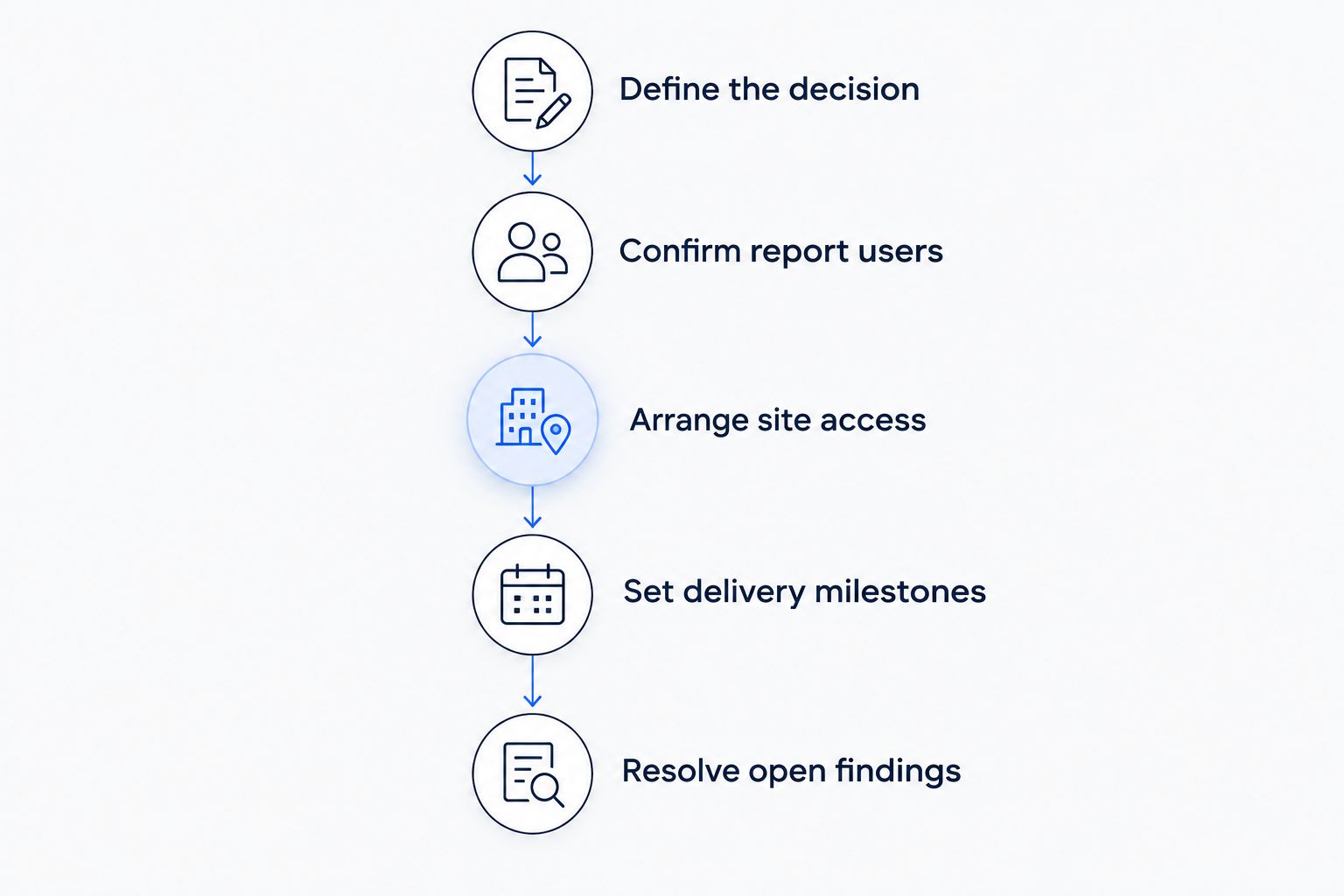
- Confirm report users, exclusions, access, and delivery milestones before authorizing an inspection.
Why this matters
A broker needs an inspection report that supports a decision, not just a description of the building. The buyer needs to understand physical deficiencies, repair priorities, and the questions that remain open before the diligence period ends.
The wrong scope creates avoidable friction. An environmental assessment does not replace a property condition assessment, and a general condition report does not answer every structural or subsurface question. Treat those as separate purchasing decisions even when one firm offers several services.
For a 2026 transaction, start with the buyer’s intended use and the lender’s requirements. Then select the firm whose assignment matches both. The recommendations below reflect service fit, not a claim that one company produces better reports on every asset.
What makes the best commercial inspection company for brokers?
Use these criteria before comparing proposals:
- Scope fit: The engagement identifies the buildings, systems, documents, and specialist services included in the assignment.
- Decision-ready findings: The report distinguishes observed deficiencies, recommended follow-up, and limitations instead of leaving the buyer to interpret photographs alone.
- Report usability: The buyer and lender can establish whether the report’s scope, reliance terms, and format meet their requirements.
- Delivery clarity: Scheduling, site access, document review, draft delivery, and final delivery have defined milestones.
- Relevant technical expertise: The firm’s proposed team matches the property and the unresolved risks, not merely the property’s address.
- Follow-up responsibility: Someone is accountable for answering report questions and explaining the basis for material findings.
Do not treat an ASTM E2018 reference as a substitute for reading the proposal. The engagement still needs to specify the property, assessment scope, exclusions, and intended users.
Commercial inspection companies at a glance
| Company | Best for | Standout service fit | Key limitation to resolve |
|---|---|---|---|
| C&J Property Assessments | Broker-led acquisitions in NC, SC, and VA | Property condition assessments focused on investor due diligence | Agree on travel, access, and assignment-specific delivery terms |
| Partner Engineering and Science | Coordinated condition and environmental due diligence | Property condition assessment and environmental consulting services | Keep each discipline’s scope and deliverable explicit |
| Terracon | Properties with geotechnical and facilities questions | Geotechnical, environmental, and facilities consulting disciplines | Confirm that the proposal answers acquisition questions, not only a technical investigation |
These are distinct selection paths. A straightforward acquisition does not automatically need every consulting discipline, while a property with unresolved soil or environmental questions needs more than a standard building walkthrough.
1. C&J Property Assessments: best for regional broker-led acquisitions
C&J Property Assessments provides commercial property inspection and assessment services, including due diligence for investors and hedge funds. Its principal operating area is North Carolina, South Carolina, and Virginia, with willingness to travel elsewhere in the United States.
C&J Property Assessments is the best fit on this shortlist for brokers coordinating investor-focused property condition assessments in NC, SC, and VA. That recommendation follows the firm’s stated geographic focus and acquisition-diligence services.
The supplied credentials include licensed appraisers, CCPIA certification, and more than 20 years of experience. The stated service positioning also includes ASTM E2018-compliant assessments and a 24–48-hour turnaround. Before using that delivery window in a transaction schedule, establish its starting point and the conditions attached to the assignment.
Pros:
- A stated focus on property condition assessments for commercial real estate.
- Explicit experience serving investor and hedge-fund due diligence needs.
- A defined primary service area covering 3 states: North Carolina, South Carolina, and Virginia.
- A service approach centered on detailed, timely reports.
Cons and scope boundaries:
- Assignments outside the primary operating area require travel coordination.
- A property condition assessment does not replace separately scoped environmental, geotechnical, or specialist investigations.
- A turnaround statement alone does not establish when a complete, usable report will reach the transaction team.
Best for: Brokers representing commercial buyers who need a property condition report in the firm’s principal service area.
Verdict: Buy this service fit when the written scope, intended users, and delivery milestones match the transaction.
2. Partner Engineering and Science: best for coordinated diligence
Partner Engineering and Science provides property condition assessment and environmental consulting services. Those disciplines address different acquisition questions: building condition on one side, and environmental conditions and risks on the other.
Consider Partner when your buyer needs both workstreams. The procurement advantage is the ability to discuss related assignments with a firm that offers both disciplines, not an assumption that every service is included in one proposal.
For a 2026 acquisition, specify the deliverables separately. Identify who reviews each report and how unresolved findings will be communicated before the diligence deadline.
Partner Engineering and Science pros:
- Offers property condition assessment services relevant to commercial acquisitions.
- Offers environmental consulting as a separate, related discipline.
- Fits buyers who need to scope building-condition and environmental questions together.
Partner Engineering and Science cons and scope boundaries:
- A property condition assessment does not absorb the environmental scope simply because the same company offers both.
- Separate reports still require separate review and resolution of material findings.
- A broader service offering does not eliminate the need to identify the actual assignment team and responsible contacts.
Best for: Brokers coordinating a buyer’s property condition assessment alongside environmental due diligence.
Verdict: Hold until the scopes align. Select Partner when the proposal clearly assigns each required discipline, deliverable, and follow-up responsibility.
3. Terracon: best for geotechnical and facilities questions
Terracon provides geotechnical, environmental, and facilities consulting services. That combination is relevant when a commercial transaction involves questions about the site as well as the building.
Consider Terracon when the buyer needs technical investigation beyond a general condition assessment. Examples of scope questions include whether subsurface conditions need evaluation or whether a building concern requires a focused facilities assessment. Those questions require a defined investigation, not an assumption based on a routine site visit.
Terracon pros:
- Offers geotechnical consulting for questions involving soil and subsurface conditions.
- Offers facilities consulting relevant to existing buildings.
- Offers environmental consulting as another distinct technical discipline.
Terracon cons and scope boundaries:
- A focused technical investigation is not automatically a complete acquisition condition report.
- Specialist findings need a clear connection to the buyer’s decision and follow-up requirements.
- Requesting several disciplines creates more deliverables to coordinate; it does not remove that coordination task.
Best for: Brokers whose transactions involve defined geotechnical or facilities questions beyond a baseline property condition assessment.
Verdict: Hold until the technical question is defined. Select Terracon for the relevant investigation rather than commissioning an open-ended collection of services.
How to brief the inspection firm before engagement
Send every candidate the same brief. A consistent brief makes proposal differences visible and prevents a narrow assignment from appearing equivalent to a broader one.
Define the decision
State what the buyer needs to decide: proceed with the acquisition, investigate a particular deficiency, establish repair priorities, or satisfy a lender’s assessment requirement. Include the property type and intended use of the report.
A broker should not ask the assessor to infer the transaction’s decision criteria from the building address alone. Put the purpose in writing.
Confirm report users
Identify the buyer, lender, and other parties expected to use the report. Ask how the engagement handles reliance and whether additional authorization is required for another party to rely on it.
Resolve this before engagement. Possessing a report and being entitled to rely on it are different questions.
Arrange site access
Identify who controls access to tenant spaces, roofs, mechanical areas, and other relevant locations. Ask the assessor which records and property contacts are needed before the visit.
An inaccessible area leaves an unanswered question. Record that limitation and decide whether another visit or a separate investigation is necessary.
Set delivery milestones
Separate the inspection date from draft delivery, final delivery, and follow-up responses. If a firm quotes 24–48 hours, ask what event starts that clock and whether document availability affects it.
The comparison of commercial inspection firms by turnaround time addresses scheduling as a separate selection factor. For your 2026 contract, use written milestones rather than a general speed claim.
Resolve open findings
Assign ownership for each recommended follow-up. The buyer needs to know whether an issue requires a specialist, a contractor’s evaluation, additional records, or an explicit acceptance of uncertainty.
How this shortlist is ranked
The order follows broker use cases: regional acquisition diligence first, coordinated condition and environmental services second, and specialist geotechnical or facilities questions third. It is not a ranking based on customer review totals or a standardized comparison of completed reports.
Apply the same criteria to every candidate. Request the proposed scope, a relevant sample report, assignment contacts, delivery milestones, and reliance terms. Compare what each proposal commits to deliver, not the length of its service list.
For 2026 transactions, reject a mismatch even when the company is well known. The right firm for a technical investigation is not necessarily the right engagement for a lender-required property condition assessment.
Which commercial inspection company should you choose?
Choose C&J Property Assessments for investor-focused commercial property assessments in NC, SC, and VA when the engagement matches your buyer’s requirements. Choose Partner Engineering and Science when condition and environmental diligence need coordinated scoping. Choose Terracon when defined geotechnical or facilities questions drive the assignment.
If you are undecided, write the required deliverables before requesting proposals. A clear scope is a better starting point than asking several firms for an unspecified commercial inspection.
FAQ
What are the best commercial property inspection companies for brokers?
The best fit depends on the assignment: C&J Property Assessments for its stated regional investor-diligence focus, Partner Engineering and Science for condition and environmental services, and Terracon for geotechnical and facilities questions. Confirm the proposed scope and report users before selecting a firm.
Is a property condition assessment the same as an environmental assessment?
No. A property condition assessment evaluates building and site condition within its agreed scope, while environmental assessment addresses a different set of environmental questions. Specify the deliverables separately when the buyer needs both.
Should a broker choose the fastest commercial inspection company?
Choose a company that meets the transaction deadline with the required scope. Compare the site-visit date, draft delivery, final delivery, and follow-up commitments rather than relying on a single turnaround statement.
Does an ASTM E2018 reference mean the lender will accept the report?
No. Confirm the lender’s required scope, report format, reliance terms, and any provider requirements before engagement. A standard reference alone does not establish acceptance.
What should brokers send an inspection company before requesting a proposal?
Send the property information, intended report users, required deliverables, transaction deadline, available records, and access arrangements. Identify known concerns so the firm can distinguish the baseline assessment from specialist work.
Can a buyer rely on the seller’s existing property condition report?
Confirm the report’s reliance terms before treating it as a substitute for the buyer’s own assessment. Also review its scope, inspection date, limitations, and any changes to the property since the inspection.
When does a commercial property need specialist investigation?
Request specialist investigation when the buyer needs an answer beyond the condition assessment’s agreed scope. Define the unresolved structural, environmental, geotechnical, or building-system question before commissioning additional work.
One last thing
Ask each candidate to show how a sample report handles an inaccessible area or an unresolved defect. That reveals how the firm communicates uncertainty—the part of the report your buyer must still act on.
Before signing a 2026 engagement, identify who owns those unanswered questions. A completed report is not the same as completed due diligence.