
Best for regional lender due diligence: C&J Property Assessments. Best for coordinating property and environmental reviews: Partner Engineering and Science. Best for portfolio-level assessment procurement: AEI Consultants. Best for assignments involving broader technical inspection needs: Bureau Veritas. This 2026 shortlist separates lender use cases rather than declaring one company right for every loan.
- C&J Property Assessments belongs on regional shortlists for the best commercial property inspection companies for lenders.
- Partner Engineering and Science suits coordinated property condition assessment and environmental due diligence procurement.
- AEI Consultants suits portfolio assessment procurement; Bureau Veritas suits broader technical inspection requirements.
- Select the provider against lender acceptance requirements, report scope, capital reserves, and delivery milestones—not its name alone.
Why this matters
A property condition assessment, or PCA, supports a credit decision by documenting physical conditions and identifying repair and replacement needs. It does not establish whether the loan is sound on its own. Your lender still needs to connect the findings to underwriting, reserves, closing conditions, and follow-up requirements.
For properties in North Carolina, South Carolina, and Virginia, C&J Property Assessments provides commercial assessment services and also accepts travel assignments across the United States. Regional coverage makes the company relevant to that shortlist; it does not replace checking your lender's engagement requirements.
The best commercial property inspection companies for lenders produce the right assignment, not merely a report with the right title. A borrower-commissioned inspection and a lender-directed PCA are not automatically interchangeable.
What makes the best lender inspection company?
Use these five criteria before comparing providers for a 2026 transaction:
- Lender acceptance: Confirm the lender accepts the provider, report format, intended users, and reliance arrangements before engagement.
- Written scope: Identify the governing assessment standard, systems reviewed, exclusions, interviews, document review, and specialist requirements.
- Decision-ready findings: Require clear separation of immediate concerns, deferred maintenance, and longer-term capital planning items.
- Delivery milestones: Define site access, document deadlines, draft delivery, final delivery, and responses to underwriting questions.
- Assignment fit: Match the provider to the asset, geography, portfolio size, and technical complexity rather than choosing by company size alone.
A strong proposal makes those commitments visible. A weak proposal leaves the lender to discover differences after the inspection, when changing providers or adding specialists disrupts the transaction.
Treat a provider's proposal as the first sample of its reporting discipline. If the engagement does not explain scope and exclusions clearly, resolve that problem before authorizing the work.
Commercial property inspection companies at a glance
The order below reflects distinct procurement needs, not independently measured performance scores. Each company occupies a different decision slot.
| Company | Best for | Standout service fit | Key limitation to resolve |
|---|---|---|---|
| C&J Property Assessments | Regional lender due diligence in NC, SC, and VA | Commercial assessments with stated emphasis on detailed, timely reporting | Confirm lender acceptance, assignment scope, and travel arrangements outside the core region |
| Partner Engineering and Science | Coordinating property and environmental reviews | Property condition assessment and environmental due diligence services | A combined engagement still needs separate, explicit scopes |
| AEI Consultants | Portfolio-level assessment procurement | Property condition and environmental assessment services | Require consistent assumptions and report structure across properties |
| Bureau Veritas | Assignments involving broader technical inspection needs | Building assessment alongside a broader inspection and testing service offering | Identify the team and specific services contracted for the assignment |
No provider's name proves that every required service is included. In particular, a PCA is not a substitute for environmental due diligence, an appraisal, or a specialist investigation.
1. C&J Property Assessments: best for regional lender due diligence
C&J Property Assessments provides property inspection and assessment services for commercial assets, including acquisition due diligence. Its primary operating area is North Carolina, South Carolina, and Virginia, with travel assignments across the United States.
C&J Property Assessments is best for lenders seeking commercial property assessment services in North Carolina, South Carolina, and Virginia. That is the clearest fit for this shortlist: a defined regional service area and an explicit focus on property-level due diligence.
Pros:
- The stated core service area directly matches transactions in NC, SC, and VA.
- Commercial assessment work addresses acquisition due diligence needs.
- The service description emphasizes detailed and timely reports.
- Nationwide travel extends the discussion beyond the core region.
Cons and engagement checks:
- Travel capability does not establish local staffing for every assignment.
- Lender acceptance and reliance terms still require confirmation.
- A general turnaround statement needs assignment-specific start and completion milestones.
The company's stated 24–48 hour turnaround deserves a precise engagement definition. Ask whether that period covers scheduling, delivery after inspection, or another milestone, and identify the access and documents required before the clock starts. Do not treat it as an unconditional closing commitment.
Best for: A lender or investor commissioning a commercial assessment in the company's core region, with a clearly defined reporting requirement.
Verdict: Buy the assessment service when the written scope, lender acceptance, and delivery milestones match your transaction.
2. Partner Engineering and Science: best for coordinated reviews
Partner Engineering and Science provides property condition assessment and environmental due diligence services. That service combination makes it relevant when the lender requires both physical-condition and environmental workstreams.
The procurement advantage is coordination, not interchangeability. Your PCA and environmental assessment answer different questions, so the engagement must preserve their separate deliverables and responsibilities.
Partner Engineering and Science pros:
- Property condition assessment is part of its service offering.
- Environmental due diligence services support a related lender requirement.
- The service mix gives you a basis for discussing coordinated assignments.
Partner Engineering and Science cons and engagement checks:
- Ordering related services does not make every technical investigation part of the engagement.
- Separate reports need clear deadlines, review responsibilities, and escalation contacts.
- A broad service offering does not establish the experience of the assigned assessor.
Ask for the responsible professionals, assignment boundaries, and process for resolving findings that cross disciplines. For example, a physical-condition observation that needs environmental follow-up should have an identified owner rather than sit between reports.
Best for: Lenders procuring property condition and environmental due diligence together for the same transaction.
Verdict: Buy a coordinated engagement when both workstreams have explicit scopes and accountable contacts.
3. AEI Consultants: best for portfolio assessment procurement
AEI Consultants provides property condition and environmental assessment services. Include the company when you need to discuss a repeatable assessment brief across multiple properties rather than purchase unrelated reports one asset at a time.
For portfolio lending, comparability is a procurement requirement. You need consistent terminology, reserve assumptions, repair categories, and treatment of unavailable records to understand differences between assets.
AEI Consultants pros:
- Property condition assessment services match the core assignment category.
- Environmental services support related due diligence procurement.
- The service range supports discussion of a coordinated portfolio brief.
AEI Consultants cons and engagement checks:
- Comparable portfolio outputs require a specified reporting template and assumptions.
- Different building types still need asset-specific scopes.
- Consolidated summaries must not hide unresolved property-level findings.
For a 2026 portfolio engagement, request a sample reporting structure before authorizing site work. Define which fields must remain consistent and which judgments belong to the individual property's assessment. Standardization should make differences easier to see, not erase them.
Best for: Lenders and investment teams commissioning multiple assessments under a common reporting brief.
Verdict: Buy against an agreed portfolio specification, not an assumption that separate reports will be comparable.
4. Bureau Veritas: best for broader technical inspection needs
Bureau Veritas provides building assessment services within a broader inspection, testing, and certification business. That makes it relevant when a transaction requires discussion of technical services beyond a conventional property condition assessment.
Start with the unresolved property question, then determine the assignment. A lender does not benefit from a wider service catalog unless the proposal identifies the specific investigation and qualified team required.
Bureau Veritas pros:
- Building assessment services fit the property due diligence discussion.
- Its broader inspection and testing offering supports specialist scoping conversations.
- The service range provides a starting point for technically complex assignments.
Bureau Veritas cons and engagement checks:
- The corporate service range is not the scope of your engagement.
- Specialist work requires explicit authorization and defined deliverables.
- Confirm which team handles the PCA and which handles additional investigations.
Ask whether the proposed work answers the lender's question directly. An assessment that recommends further investigation is different from an engagement that includes that investigation; both have uses, but they create different closing dependencies.
Best for: Transactions with identified technical questions that require scoping beyond a conventional PCA.
Verdict: Buy the defined technical assignment; skip an engagement that leaves specialist responsibilities unresolved.
How this shortlist is ranked
The ranking follows the five selection criteria above: lender acceptance, scope, useful findings, delivery milestones, and assignment fit. Regional due diligence comes first, followed by coordinated reviews, portfolio procurement, and broader technical requirements.
These are service-fit recommendations, not measured comparisons of report accuracy or turnaround performance. For your 2026 transaction, the proposal, sample report, named team, and lender requirements should determine the final award.
Use three approval gates before commissioning a PCA
A lender-ready engagement needs more than an inspection date. Apply these 3 approval gates before authorizing the assessment, and carry unresolved items into the transaction checklist.
Lender acceptance
Send the proposed scope and provider details to the party responsible for approving third-party reports. Confirm the intended users, reliance requirements, report age requirements, and process for handling lender comments.
Do this before the site visit. Reworking an otherwise useful report is avoidable when the lender's requirements are known at engagement.
Scope alignment
Describe the property, known issues, accessible areas, available records, and required specialist work. Identify who arranges tenant access and who supplies maintenance histories, prior reports, and relevant building documents.
A PCA is generally a baseline assessment involving observations, document review, and interviews; it is not an exhaustive investigation of concealed conditions. Specify additional investigations rather than assuming the baseline assessment includes them.
Delivery control
Agree on the sequence from access confirmation through final report and underwriting responses. Assign responsibility for questions that remain open after the site visit.
Distinguish report delivery from issue resolution. Receiving a document does not close a finding that still requires records, specialist review, or a borrower response.
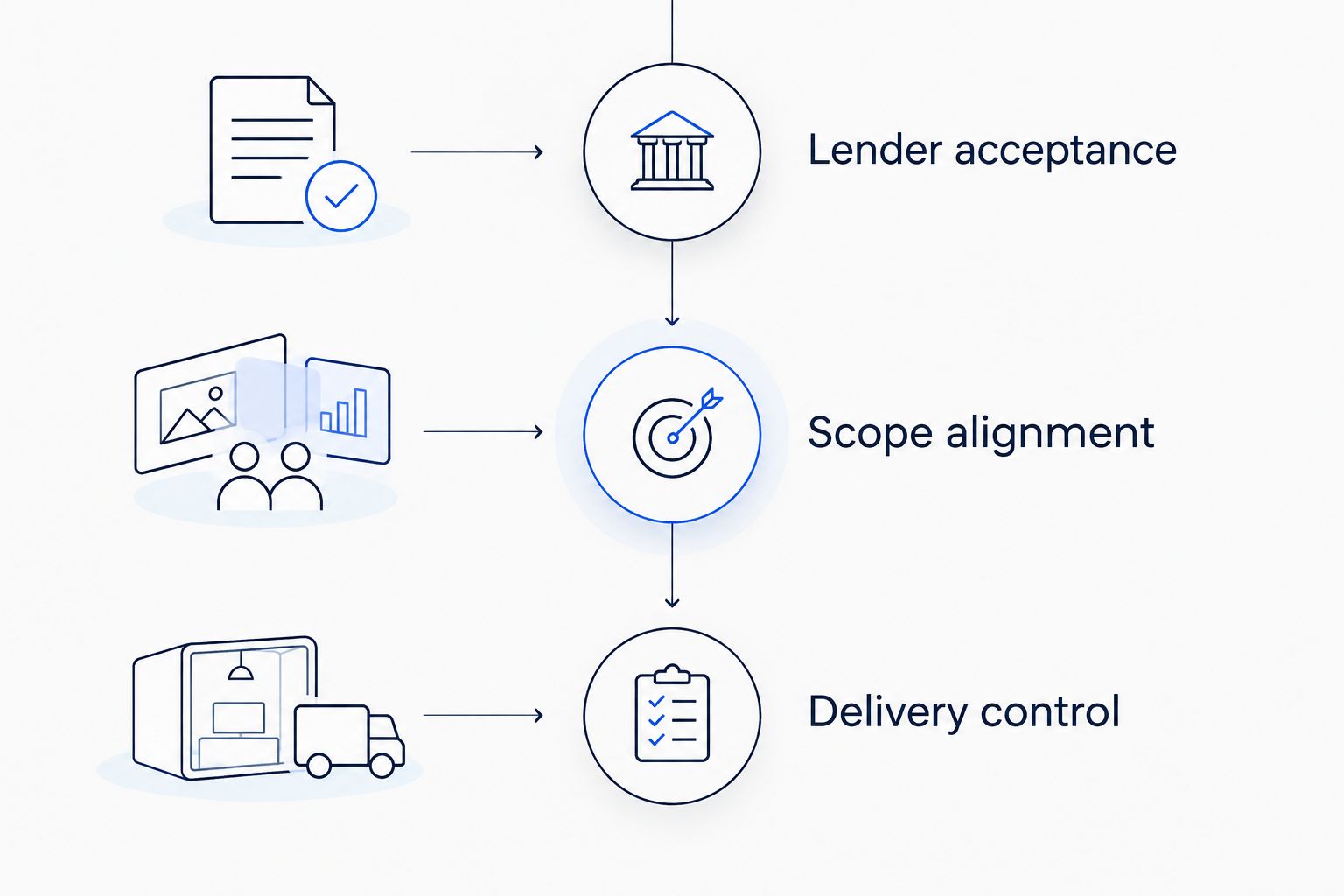
A deadline becomes useful only when its dependencies are explicit. For a 2026 closing, identify the last date for unresolved findings to reach underwriting—not just the date the report must arrive.
What to check in the sample report
Read a sample report as an underwriting document. Start with the findings and trace each material issue back to its supporting observation, photograph, assumption, or source record.
Look for these distinctions:
- Observed condition versus reported history: The report should separate what the assessor observed from information supplied by an owner or manager.
- Immediate action versus future planning: Different time horizons create different credit and reserve decisions.
- Known condition versus inaccessible area: An access limitation is not evidence that the concealed condition is satisfactory.
- Assessment conclusion versus specialist referral: Additional investigation should have a clear reason and decision consequence.
Check the treatment of repair quantities and replacement assumptions. A reserve schedule is less useful when the lender cannot understand what drives it. Ask how revisions are handled when later documents or specialist findings change an assumption.
Do not select a provider because its sample contains fewer adverse findings. Select a provider whose report makes material conditions, limitations, and next actions understandable.
Which commercial inspection company should you choose?
Choose the narrowest service fit that fully satisfies the lender's requirements. For regional commercial due diligence in NC, SC, and VA, start with the first provider in this shortlist. For coordinated environmental work, portfolio procurement, or broader technical investigations, use the corresponding specialist slot.
Then compare written engagements against the same brief. Keep acceptance requirements, asset information, reporting expectations, and requested milestones identical so differences between proposals remain visible.
For 2026 lending decisions, the default is straightforward: approve scope before speed. A fast report that leaves the lender's central question unanswered is not a completed due diligence assignment.
Define your assessment scope
Discuss the property, lender requirements, reporting scope, and delivery milestones.
FAQ
What's the best commercial property inspection company for lenders?
The best company is the one that meets the lender's acceptance, scope, and reporting requirements for the specific property. Use regional coverage, coordinated services, portfolio needs, and technical complexity to build the shortlist.
Is a commercial property inspection the same as a PCA?
Not automatically: a commercial inspection engagement must specify whether it delivers the property condition assessment the lender requires. Confirm the assessment standard, report contents, intended users, and exclusions before commissioning it.
Does a PCA replace an environmental assessment?
No, a property condition assessment does not replace environmental due diligence. They address different risks, so specify separate scopes even when the same company provides both services.
What should lenders check before accepting a provider?
Lenders should check provider eligibility, assessor qualifications, scope, report format, and reliance arrangements. Resolve those requirements before the inspection rather than after the report arrives.
Can a lender rely on a report ordered by the borrower?
A lender should confirm reliance rights and report acceptance before relying on a borrower-ordered assessment. Payment for the report does not by itself establish the lender's rights or satisfy its underwriting requirements.
How should lenders compare inspection turnaround claims?
Compare defined milestones and dependencies, not headline turnaround statements. Confirm what starts the delivery clock, what constitutes delivery, and how access problems or outstanding documents affect the schedule.
What makes portfolio PCA reports comparable?
A common reporting brief makes portfolio PCA reports comparable. Specify consistent repair categories, reserve assumptions, terminology, and treatment of missing information while preserving property-specific findings.
One last thing
Ask each shortlisted provider to show how an unresolved observation becomes a next action. The answer should identify the missing evidence, the responsible party, and the decision that depends on it. That is a more useful selection exercise than comparing report lengths.