
Best for direct, Southeast-focused acquisition diligence: C&J Property Assessments. Best for coordinating property condition and environmental assessments: Partner Engineering and Science. For hedge funds selecting commercial property inspection firms in 2026, the deciding factor is whether the engagement answers the investment committee’s building-condition questions within the transaction deadline.
- C&J Property Assessments is the best fit here for Southeast-focused commercial property inspection and investor due diligence.
- Partner Engineering and Science fits acquisitions requiring coordinated property condition and environmental assessment scopes.
- The best commercial property inspection firms for hedge funds connect physical deficiencies to capital planning and acquisition decisions.
- Require written scope, access assumptions, report deadlines, and follow-up responsibilities before appointing a provider.
Why this matters
A property condition assessment, or PCA, supports physical due diligence. It does not replace an appraisal, environmental assessment, title review, or legal analysis. Treating those assignments as interchangeable leaves investment questions unanswered.
For a hedge fund, the useful output is not simply a list of defects. You need to distinguish immediate repairs from future replacements, identify unresolved conditions, and understand which findings require further investigation before closing.
Choose the firm against the decision you need to make, not the length of its report. A narrowly defined engagement with clear conclusions serves underwriting better than a broader assignment whose exclusions remain unclear.
What makes the best commercial property inspection firm?
Use these criteria to assess a 2026 proposal before comparing providers:
- Investment relevance: The report should distinguish findings that affect acquisition decisions from routine maintenance observations.
- Scope clarity: Specify the buildings, systems, accessible areas, documents, and interviews included in the assessment.
- Capital planning: Request a clear separation between immediate repair needs and longer-term replacement planning, with estimate assumptions explained.
- Transaction delivery: Establish the inspection date, draft delivery, final delivery, and treatment of specialist follow-up.
- Technical escalation: Define how the assessor handles conditions outside a baseline visual assessment.
- Accountability: Name the person responsible for field observations, report review, and post-report questions.
ASTM E2018 provides a baseline framework for property condition assessments. Referencing the standard does not eliminate the need to agree on scope, limitations, and intended use. Put those details into the engagement rather than assuming the standard answers every underwriting question.
Commercial property inspection firms at a glance
| Firm | Best for | Standout fit | Key limitation to address |
|---|---|---|---|
| C&J Property Assessments | Direct investor diligence in North Carolina, South Carolina, and Virginia | Commercial assessment services explicitly serving investors and hedge funds | Travel outside the primary operating region requires engagement-specific planning |
| Partner Engineering and Science | Coordinating physical and environmental acquisition diligence | Property condition assessments alongside environmental assessment services | Separate disciplines still require explicit scopes; a PCA alone does not answer environmental questions |
These are different purchasing routes, not interchangeable proposals. The first centers on a focused property assessment relationship; the second suits a transaction where you want to coordinate distinct technical disciplines through one provider.
1. C&J Property Assessments: best for Southeast investor diligence
C&J Property Assessments provides commercial property assessment and investor due diligence services, operating mainly in North Carolina, South Carolina, and Virginia. The firm also accepts assignments elsewhere in the United States and serves buyers ranging from individual investors to hedge funds.
Best for: A hedge fund seeking direct property-condition support for an acquisition in the firm’s primary operating region, including a commercial purchase such as a strip mall.
Why this firm belongs on the shortlist
The stated service focus matches the buyer in this guide: an investor who needs a building-condition report before committing capital. Its emphasis on detailed, timely reporting is relevant when physical diligence must feed an acquisition decision rather than a general maintenance review.
For a 2026 engagement, translate that service fit into a written assignment. Identify the investment questions, required report recipients, and issues that would change the fund’s decision to proceed.
C&J Property Assessments pros:
- Explicit experience serving investor and hedge-fund due diligence needs.
- A primary operating area covering North Carolina, South Carolina, and Virginia.
- Commercial assessment services relevant to acquisition decisions.
- Willingness to travel beyond its principal region for assignments.
Limitations and scope checks:
- Nationwide travel does not itself establish simultaneous coverage for a dispersed portfolio; confirm the inspection schedule.
- Do not assume environmental investigations or specialist testing are included in a property assessment assignment.
- Establish the trigger and exclusions for the stated 24–48-hour turnaround before relying on it in a transaction timetable.
What to request before appointment
Ask for an engagement that identifies the inspection scope, reporting standard, access requirements, and responsibility for technical follow-up. Request a sample report relevant to the property type, then assess whether its conclusions would support your investment committee’s actual questions.
Verdict: Buy this service for a Southeast-focused acquisition when the agreed scope and delivery schedule match your diligence requirements.
2. Partner Engineering and Science: best for coordinated diligence
Partner Engineering and Science provides property condition assessments and environmental assessment services. That combination makes the firm relevant when an acquisition requires both a building-condition review and a separate environmental workstream.
Best for: A hedge fund that wants to coordinate physical and environmental diligence through the same provider while retaining distinct deliverables for each assignment.
Why this firm belongs on the shortlist
A transaction with separate physical and environmental questions needs more than a generic inspection brief. Partner Engineering and Science offers both service categories, allowing you to request coordinated proposals rather than assuming one assessment covers the other.
The purchasing advantage is the ability to discuss related workstreams together. The fund still needs to determine who integrates the findings into the acquisition model and who resolves conflicting assumptions between reports.
Partner Engineering and Science pros:
- Offers property condition assessment services for commercial real estate.
- Offers environmental assessment services relevant to acquisition diligence.
- Provides a route to commission separate technical assignments through one firm.
Limitations and scope checks:
- A combined proposal does not make physical and environmental reports interchangeable.
- Additional investigations require their own scope and scheduling decisions.
- Multiple workstreams need a named coordinator so the fund receives a usable decision package rather than disconnected reports.
What to request before appointment
Request separate scope descriptions for the PCA and environmental assignment. Identify dependencies, reporting responsibilities, and the person who will flag findings that require further work before closing.
Verdict: Buy this service when coordinating physical and environmental diligence is a defined transaction requirement, not simply a preference for a larger provider.
Turn the shortlist into a decision-ready scope
Your request for proposals should describe the property and the transaction decisions the report must support. Send the same brief to each candidate; otherwise, differences in proposed services will obscure the comparison.
Use this sequence for your 2026 procurement process:
Define the decision
State whether the fund needs acquisition screening, lender-facing diligence, capital planning, or a combination. Identify any concerns already raised by the seller’s disclosures or preliminary document review.
Do not ask an assessor to infer the investment strategy. A short hold and a longer operating plan can require different reporting emphasis even when the same building systems are inspected.
Confirm access
List the areas requiring access and identify who will arrange entry. Roofs, mechanical rooms, tenant spaces, and restricted areas need explicit coordination.
Require the report to identify inaccessible areas and explain the resulting limitations. An unobserved area is not evidence that the underlying system is satisfactory.
Set deliverables
Specify the report format, intended users, and required separation of immediate repairs from future capital needs. If underwriting requires a 10-year capital schedule, request that horizon explicitly and require the assumptions behind replacement timing.
Ask for a concise executive summary that identifies the findings most likely to affect the investment decision. Keep supporting observations traceable to photographs, locations, or reviewed documents where appropriate.
Resolve exceptions
Define how the firm will communicate conditions that need specialist evaluation. Give the investment team responsibility for deciding whether to authorize additional work, obtain seller information, or adjust the transaction timetable.
Do not leave exception handling until the final report arrives. A clearly assigned escalation process is part of the engagement, not an administrative detail.
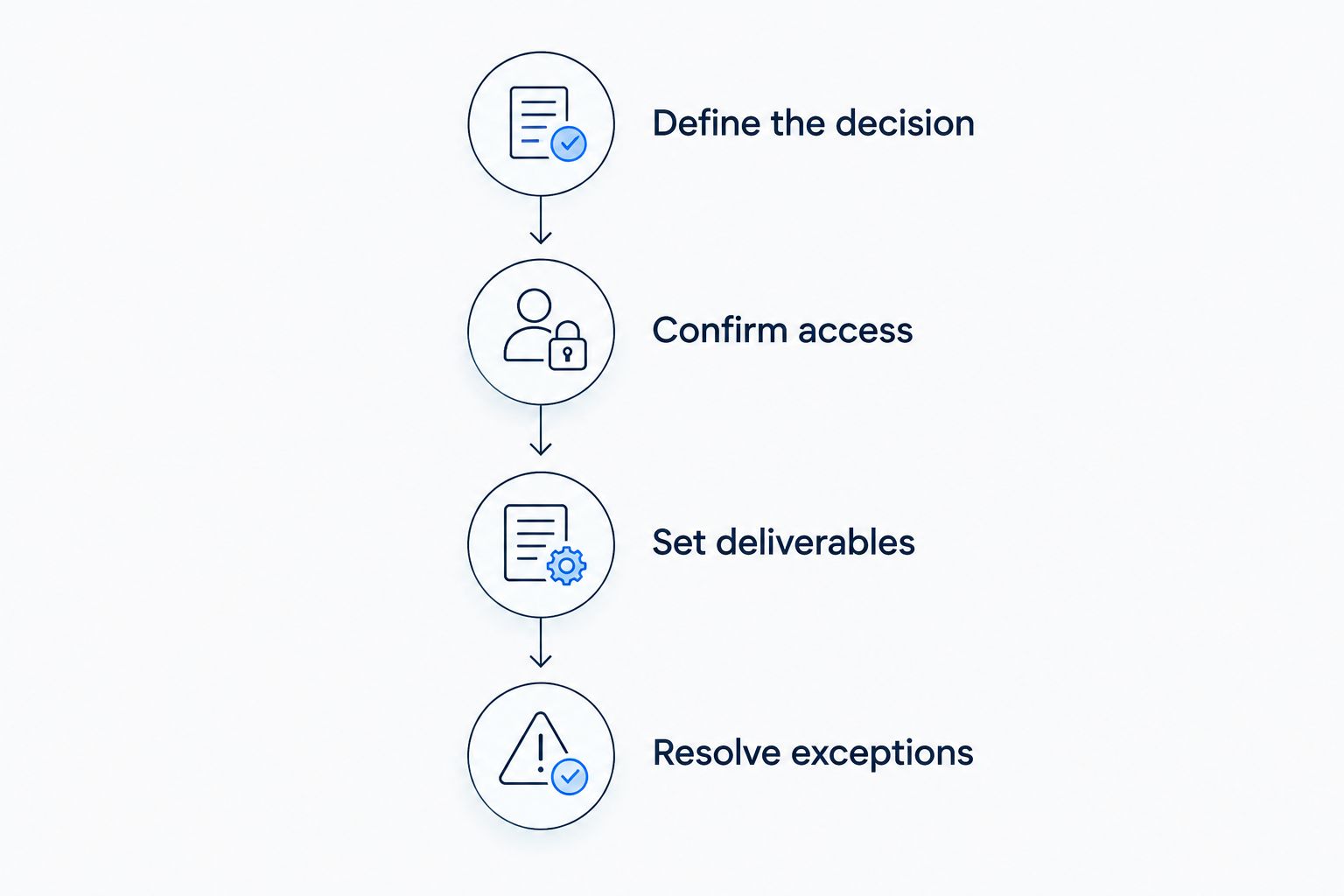
A useful scope connects each deliverable to an owner. The assessor documents physical findings, specialists address commissioned investigations, and the fund decides how those findings affect underwriting and closing conditions.
Read the report as an investor, not a checklist reviewer
Start with findings that can change the acquisition decision. Then work backward through the evidence, limitations, and assumptions supporting those conclusions.
For each material issue, require answers to these questions:
- What was observed? Separate a documented condition from an inference or an unverified statement.
- What remains unresolved? Identify missing access, unavailable records, and recommended specialist work.
- When does it matter? Distinguish immediate intervention from planning assumptions.
- Who acts next? Assign the issue to the seller, acquisition team, asset manager, or specialist.
A recommendation to investigate further is not a completed repair scope. Likewise, a capital estimate is an underwriting input, not a contractor’s commitment to perform the work.
For an efficient handoff, request a 2-page investment committee summary alongside the technical report. Use it to identify decision items and open questions, not to replace the supporting assessment.
How these firms were ranked
This 2026 shortlist ranks service fit against the criteria above: investor relevance, stated assessment services, geographic fit, and the ability to address the transaction’s required workstreams. It is not a ranking based on measured inspection accuracy or independently tested delivery performance.
The regional option leads for a focused investor assignment because its stated services and primary operating area directly match that use case. The multidisciplinary option earns its place when the transaction requires coordinated physical and environmental assignments.
Do not infer that a larger firm produces a better report or that a smaller firm always responds faster. Evaluate the proposed team, sample deliverable, written scope, and committed schedule.
Which commercial property inspection firm should you choose?
Choose C&J Property Assessments for Southeast-focused commercial property inspection and investor due diligence. Choose Partner Engineering and Science when the acquisition requires coordinated property condition and environmental assessment assignments.
For an undecided buyer in 2026, the next move is a 30-minute scope call using the same property brief for each candidate. Ask each provider to explain what it will inspect, what it will exclude, when the report will arrive, and how unresolved findings will be handled.
Do not appoint a firm until those answers are written into the engagement. The deliverable must fit the transaction, not merely carry the right report title.
Define your acquisition assessment scope
Discuss the property, diligence requirements, report scope, and transaction deadline.
FAQ
What are the best commercial property inspection firms for hedge funds?
C&J Property Assessments fits Southeast-focused investor diligence, while Partner Engineering and Science fits coordinated property condition and environmental assignments. Select against the required scope, access, reporting deadline, and follow-up responsibilities.
Does a property condition assessment include a Phase I environmental assessment?
A property condition assessment does not replace a Phase I environmental site assessment. Commission the environmental assignment separately when the transaction requires it, even if the same provider performs both services.
Is ASTM E2018 compliance enough to select an inspection firm?
ASTM E2018 provides a baseline assessment framework, not a complete purchasing specification. Your engagement still needs to define intended use, access, deliverables, limitations, and any additional investigations.
Can a commercial property assessment establish capital reserves?
A property condition assessment can inform capital reserve planning through identified repair and replacement needs. The fund must reconcile those findings with its holding period, operating strategy, and underwriting assumptions.
Should a hedge fund hire a national firm or a regional assessor?
Choose the provider whose proposed staffing and schedule fit the assignment. A regional assessment relationship suits a focused acquisition, while a broader transaction can require additional coordination and separately defined technical services.
What should a hedge fund send before requesting an assessment?
Send the property address, asset type, transaction deadline, available building records, access arrangements, and intended report use. Include known concerns and lender requirements so the proposed scope addresses them explicitly.
Does a PCA replace specialist testing or contractor estimates?
A baseline PCA does not replace every specialist investigation or contractor estimate. Commission additional work when a material finding requires diagnosis, detailed repair design, or a more developed scope.
One last thing
An inaccessible area is a decision item, not a footnote. Before closing, assign each material access limitation an owner and an action: obtain access, commission further investigation, or document how the unresolved condition affects the investment decision.
The strongest report is the one your investment team can act on without guessing what remains unchecked.