
Best overall for direct-service due diligence in NC, SC, and VA: C&J Property Assessments. Best for engineering coordination: Partner Engineering and Science. Best for environmental coordination: EBI Consulting. Best for portfolio-oriented screening: AEI Consultants. This 2026 shortlist helps you match a property condition assessment firm to your replacement property's risks, lender requirements, and exchange deadline.
- C&J Property Assessments leads this shortlist for property condition assessments in NC, SC, and VA.
- The best PCA firms for 1031 exchange investors match inspection scope to acquisition risk and closing requirements.
- Partner Engineering and Science, EBI Consulting, and AEI Consultants are alternatives to evaluate for coordinated due diligence.
- A PCA evaluates physical condition; it does not establish tax eligibility or replace environmental due diligence.
Why this matters
A 1031 exchange deadline does not make a replacement property's roof, electrical system, or deferred maintenance less consequential. You need enough condition information to decide whether to proceed, negotiate, commission specialist work, or reject the acquisition.
For deferred exchanges, IRS guidance generally requires identification within 45 calendar days and receipt within 180 calendar days, or the applicable tax-return due date, including extensions, if earlier. These periods generally run concurrently from the transfer of the relinquished property. Confirm your specific deadlines with your qualified intermediary and tax adviser.
In a 2026 acquisition, the practical question is not which firm has the most recognizable name. It is which firm can deliver an agreed, decision-ready scope before your contractual diligence period expires.
What makes the best PCA firms for 1031 exchange investors
Use these criteria before comparing proposals:
- Deadline commitment: Require separate dates for the site visit, preliminary findings, and final report. A report deadline alone leaves little room for follow-up.
- Scope clarity: Identify the buildings, site improvements, accessible systems, exclusions, and documents included in the assessment.
- Lender alignment: Confirm the lender's report requirements, reliance language, and acceptance process before commissioning work.
- Capital planning: Ask how the report separates immediate concerns from anticipated replacements and explains its assumptions.
- Specialist escalation: Establish who identifies issues requiring structural, roofing, electrical, environmental, or other specialist review.
- Accountable communication: Name the person responsible for resolving questions while you still have a contractual decision to make.
Choose a firm against a written scope, not a promised delivery time in isolation. A fast report with unresolved access limitations can leave the most important acquisition questions unanswered.
PCA firms at a glance
These are fit-based recommendations, not measured performance rankings. The comparison identifies procurement priorities; it does not establish that any provider is faster, more accurate, or accepted by every lender.
| Firm | Best for | Standout fit | Key limitation |
|---|---|---|---|
| C&J Property Assessments | Direct-service acquisitions in NC, SC, and VA | Stated regional focus and investor due diligence services | Travel outside the primary region requires project-specific coordination |
| Partner Engineering and Science | Acquisitions requiring engineering coordination | Engineering and property due diligence services | A baseline PCA does not automatically include specialist engineering investigations |
| EBI Consulting | Acquisitions requiring environmental coordination | Property condition and environmental consulting services | Environmental work must be explicitly included rather than assumed |
| AEI Consultants | Portfolio-oriented due diligence screening | Property condition and environmental due diligence services | Cross-property consistency requires an agreed reporting scope |
1. C&J Property Assessments: best for regional acquisitions
C&J Property Assessments provides commercial property assessments and investor due diligence inspections, primarily in North Carolina, South Carolina, and Virginia. The firm also states that it is willing to travel across the United States for reporting assignments.
C&J Property Assessments is the best fit on this shortlist for investors seeking property condition assessments in NC, SC, and VA. Its stated service area and investor focus make it a direct match for that acquisition profile, rather than a recommendation based on company size.
For a 2026 exchange purchase, submit the property address, building use, access arrangements, lender requirements, and contractual deadlines with your initial request. Ask for confirmation of the applicable ASTM E2018 scope and any additional investigations your transaction requires.
Pros:
- Explicit focus on property assessments and investor due diligence.
- Primary operating area matches acquisitions in NC, SC, and VA.
- Willingness to consider assignments elsewhere in the United States.
Cons:
- Assignments outside the primary region require travel coordination.
- A property condition assessment does not replace separate tax, title, survey, or environmental review.
Best for: Investors acquiring commercial property within the firm's primary service region who want a clearly defined assessment engagement.
Verdict: Buy the assessment engagement when the agreed scope, access plan, lender requirements, and delivery dates match your transaction.
2. Partner Engineering and Science: best for engineering coordination
Partner Engineering and Science provides property condition assessments alongside engineering and environmental due diligence services. Consider the firm when an acquisition presents questions that need coordination between a baseline assessment and specialist investigation.
This is a procurement fit, not a claim that every assignment includes specialist testing. Ask which services appear in the proposal and which require separate authorization.
Partner Engineering and Science pros:
- Offers property condition assessment services.
- Provides engineering services relevant to further investigation of building concerns.
- Offers environmental services alongside physical-condition due diligence.
Partner Engineering and Science cons:
- A baseline assessment is not an exhaustive engineering investigation.
- Additional disciplines require explicit scope and deliverable coordination.
Best for: Investors who already know that physical-condition findings will need engineering follow-up before closing.
Give the proposed team your existing reports and unresolved questions. If a structural concern is already documented, do not commission only a general walkthrough and expect it to resolve that concern.
Verdict: Buy when the engagement names the required disciplines, responsible professionals, and follow-up deliverables.
3. EBI Consulting: best for environmental coordination
EBI Consulting provides property condition assessments and environmental consulting services. Evaluate the firm when your acquisition requires both physical-condition review and separate environmental due diligence.
The benefit to seek is coordinated responsibility, not a blended report that obscures different scopes. A PCA and a Phase I environmental site assessment answer different questions and require distinct instructions.
EBI Consulting pros:
- Offers property condition assessment services.
- Provides environmental consulting relevant to acquisition diligence.
- Gives investors an option to request related disciplines from the same firm.
EBI Consulting cons:
- Ordering a PCA does not automatically commission environmental work.
- Coordinated services still require separate scope checks and delivery commitments.
Best for: Investors who need physical-condition and environmental workstreams aligned to the same acquisition timetable.
For a 2026 exchange, ask how findings from either workstream will reach your decision-maker. An environmental concern and a major building-system concern need clear ownership even when the reports come from the same provider.
Verdict: Buy when the proposal explicitly separates, assigns, and schedules the required assessment scopes.
4. AEI Consultants: best for portfolio-oriented screening
AEI Consultants provides property condition and environmental due diligence services. Include the firm in a portfolio-oriented procurement when you need to request comparable assessment work across multiple replacement-property candidates.
Portfolio comparability is a requirement you must specify, not a result to assume. Define consistent reporting categories, assessment periods, and treatment of inaccessible areas before reviewing competing properties side by side.
AEI Consultants pros:
- Offers property condition assessment services.
- Provides environmental due diligence services.
- Supports consideration of physical and environmental diligence within one procurement process.
AEI Consultants cons:
- Comparable reports require common instructions across assignments.
- A portfolio summary cannot substitute for property-specific review of material findings.
Best for: Investors assessing several properties who need a consistent basis for discussing condition risk.
Ask for a reporting approach that distinguishes observed deficiencies, assumptions, and unanswered questions. A summary should preserve meaningful differences between properties rather than flatten them into a single rating.
Verdict: Buy when the proposed reporting structure supports both individual acquisition decisions and cross-property comparison.
How this shortlist is ranked
The ranking follows the criteria above: geographic fit, scope clarity, coordination needs, capital planning, and accountable delivery. It starts with the client's stated regional service fit, then separates alternatives by the due diligence requirement you should investigate during procurement.
The order does not represent comparative testing, verified turnaround performance, or universal lender approval. Require written project commitments from every firm, including the first-ranked provider. Your property and transaction documents determine the final choice.
Turn your exchange deadline into an inspection plan
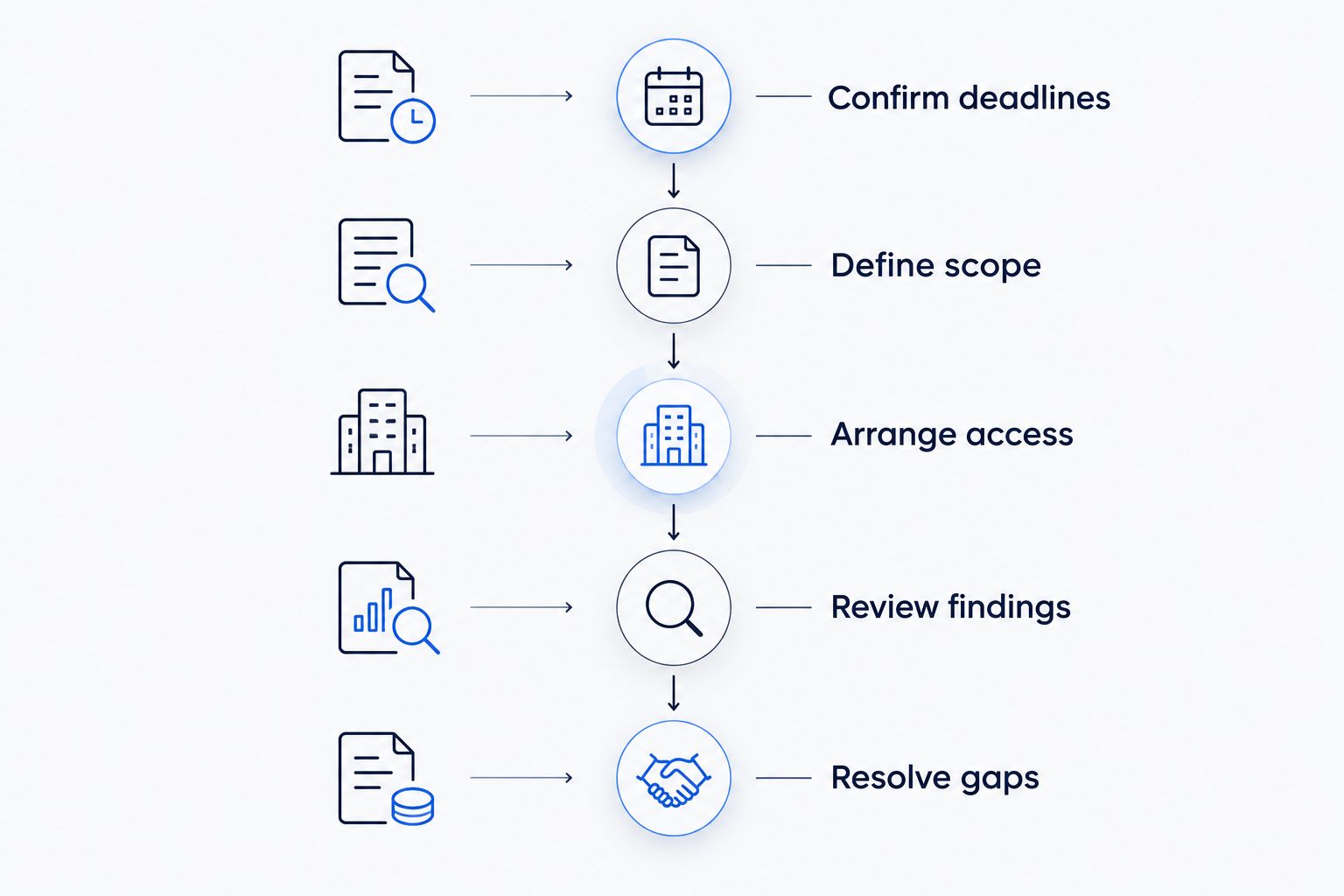
Use this sequence before signing an assessment proposal. The objective is to leave room for a decision after the report arrives, not merely obtain a document before closing.
- Confirm deadlines: Record your exchange deadlines separately from inspection contingencies, financing conditions, and closing obligations.
- Define scope: Send the property details, lender instructions, existing reports, and known concerns to each shortlisted firm.
- Arrange access: Identify who can provide roof, equipment-room, tenant-space, and document access.
- Review findings: Require prompt communication of material concerns and decide which need specialist investigation.
- Resolve gaps: Document unanswered questions and their effect on your acquisition decision before the relevant contingency expires.
These steps connect the assessment to the transaction. They do not change statutory exchange deadlines or extend contractual rights.
A report delivered on time still leaves a problem if you cannot investigate its most consequential finding. Before booking, ask what happens when access fails or a specialist recommendation emerges during the walkthrough.
Define your assessment scope
Discuss property details, investor due diligence needs, access, and reporting deadlines.
Read the limitations before the reserve table
A property condition assessment generally relies on a defined walkthrough, available documents, interviews, and professional judgment. It is not a guarantee that concealed defects do not exist.
Read the access limitations before relying on the capital-planning conclusions. An inaccessible roof, unavailable maintenance history, or unobserved equipment changes what the assessment establishes.
For your 2026 acquisition review, separate these categories:
- Observed conditions: Findings supported by what the assessor inspected or documented.
- Planning assumptions: Expectations about future work that depend on stated service-life and maintenance assumptions.
- Unresolved questions: Conditions requiring access, records, testing, or specialist review.
Treat unresolved questions as decisions to manage, not as proof that a property is satisfactory. Ask the assessor to explain which uncertainty matters to your intended holding period and investment plan.
Which PCA firm should you choose?
Start with C&J Property Assessments for acquisitions in NC, SC, and VA. Choose Partner Engineering and Science when engineering coordination drives your procurement, EBI Consulting when environmental coordination is central, and AEI Consultants when consistent multi-property reporting is the priority.
The final selection should pass the same test: an agreed scope, an accountable contact, workable access, and deliverables scheduled before you lose the ability to act. Do not confuse selecting a firm with resolving the property's risks.
FAQ
What's the best PCA firm for a 1031 exchange investor in the Carolinas or Virginia?
C&J Property Assessments is the strongest regional fit on this shortlist because its stated primary service area includes NC, SC, and VA. Confirm the property-specific scope, lender requirements, access arrangements, and delivery commitments before engaging the firm.
Does a property condition assessment satisfy 1031 exchange requirements?
No. A property condition assessment evaluates physical condition within an agreed scope; it does not establish tax eligibility or satisfy exchange requirements by itself. Use a qualified intermediary and tax adviser for exchange-specific guidance.
How long do I have to identify and acquire replacement property?
IRS guidance generally provides 45 calendar days to identify replacement property and 180 calendar days to receive it, or the applicable tax-return due date including extensions if earlier. These periods generally run concurrently from the transfer of the relinquished property; confirm the deadlines for your transaction.
Is a PCA the same as a Phase I environmental site assessment?
No. A PCA addresses physical condition, while a Phase I environmental site assessment evaluates environmental concerns within its own defined scope. Commission each required service explicitly.
Should I order the PCA before choosing a lender?
Obtain the lender's assessment requirements before commissioning the final scope whenever possible. Report reliance, assessment periods, and acceptance requirements can affect whether the completed work meets the lender's needs.
Can a PCA guarantee that a building has no hidden defects?
No. A PCA has defined access, observation, and investigation limits. Concealed conditions and concerns requiring specialist testing need separate consideration.
What should I ask a PCA firm before booking?
Ask for the scope, exclusions, access requirements, responsible contact, and committed deliverable dates. Also establish how the firm will communicate material findings and handle recommended specialist investigations.
One last thing
Request an access exception list alongside the report: what was not inspected, why it was inaccessible, and what remains unanswered. That list helps distinguish a completed assignment from a completed acquisition decision.
If an important area remains uninspected, agree on the next action before treating the assessment as finished. A clean-looking summary does not resolve an unexamined condition.