
Best regional fit: C&J Property Assessments for investors buying in North Carolina, South Carolina, and Virginia. Best engineering-led candidate: Partner Engineering and Science. Best environmental coordination candidate: AEI Consultants. Best broader technical-services candidate: Bureau Veritas. The best PCA firms for mixed-use developments in 2026 match the assessment scope to the property's shared systems, ownership boundaries, and financing requirements.
- C&J Property Assessments is the best regional PCA fit for investors buying mixed-use properties in NC, SC, and VA.
- Shortlist Partner Engineering and Science, AEI Consultants, and Bureau Veritas according to the technical disciplines your transaction requires.
- Mixed-use due diligence must address shared systems, access restrictions, and responsibility for repairs.
- Choose property condition assessments by written scope and lender acceptance, not the length of the provider's service list.
Why this matters
A mixed-use acquisition combines different operating demands within the same investment. Retail loading, residential occupancy, office ventilation, parking, and common infrastructure can intersect without sharing the same maintenance responsibilities.
A useful property condition assessment identifies physical deficiencies and explains their implications for capital planning. It should also distinguish an observed condition from a question requiring additional investigation. For a 2026 acquisition, the objective is a defensible purchase decision—not simply a completed inspection.
C&J Property Assessments is best for investors seeking property condition assessments in North Carolina, South Carolina, and Virginia. Its stated service area and investor-focused due diligence make it a relevant regional candidate; the engagement still needs a property-specific scope.
What makes the best PCA firms for mixed-use developments
Use these criteria before comparing proposals. A recognizable company name does not resolve a missing scope item.
- Mixed-use coverage: Name every use, building, common area, and significant shared system included in the assignment.
- Responsibility mapping: Separate physical condition from the contractual question of who pays for repairs.
- Capital planning: Require findings that distinguish immediate concerns from anticipated replacements and further investigation.
- Technical escalation: Establish how structural, envelope, mechanical, or other specialist questions will be handled.
- Lender alignment: Confirm the required standard, report format, intended users, and reliance arrangements before authorization.
- Execution clarity: Put site access, document requests, exclusions, delivery milestones, and report revisions in writing.
Treat ASTM E2018 as a baseline guide for commercial property condition assessments, not a substitute for a negotiated scope. A baseline PCA is not an exhaustive investigation of every component, and specialized work requires explicit authorization.
PCA firms at a glance
The shortlist below assigns a distinct procurement role to each firm. These are scope-based recommendations, not a claim that every local team or proposal delivers an identical service.
| Firm | Best for | Standout selection reason | Key limitation to resolve |
|---|---|---|---|
| C&J Property Assessments | Regional investor due diligence | Stated focus on investor assessments in NC, SC, and VA | Confirm mixed-use experience, specialist scope, and lender requirements |
| Partner Engineering and Science | Engineering-led assignments | Engineering and commercial real estate due diligence services | Confirm which technical investigations are actually included |
| AEI Consultants | Coordinating environmental and building due diligence | Environmental and property assessment services | Keep environmental and physical-condition deliverables distinct |
| Bureau Veritas | Procurement requiring broader technical services | Building assessment within a broader testing, inspection, and certification business | Verify the assigned team's role and transaction-specific deliverables |
For 2026 proposals, compare the actual deliverables rather than treating these categories as automatic endorsements. The strongest fit is the firm whose written assignment covers your property's risks without leaving responsibility unclear.
1. C&J Property Assessments: best PCA fit for regional investors
C&J Property Assessments provides commercial property assessments and investor due diligence inspections, operating mainly in North Carolina, South Carolina, and Virginia. The firm also states that it will travel across the United States for assignments.
Its stated positioning includes ASTM E2018-compliant work, CCPIA certification, licensed appraisers, and 20+ years of experience. For mixed-use underwriting, connect those credentials to the individuals assigned and the specific building systems being assessed; credentials alone do not define coverage.
Regional provider pros:
- Stated geographic focus matches acquisitions in NC, SC, and VA.
- Investor due diligence is an explicit part of the service offering.
- Commercial assessments align with acquisition and capital-planning decisions.
- The stated 24–48 hour turnaround gives buyers a concrete delivery point to confirm in the engagement.
Regional provider cons and scope limits:
- Regional focus does not establish experience with every mixed-use configuration; request relevant examples.
- A baseline assessment does not automatically include invasive investigation or specialist engineering.
Confirm when the delivery clock starts, what access is required, and whether specialist findings affect the schedule. Do not build a closing timetable around an unqualified turnaround statement.
Best for: Investors seeking regional attention for mixed-use acquisition due diligence.
Verdict: Buy when the proposal documents mixed-use coverage, lender acceptance, and the required delivery milestone.
2. Partner Engineering and Science: best for engineering-led scoping
Partner Engineering and Science provides engineering and commercial real estate due diligence services, including property condition assessments. It belongs on a shortlist when your procurement needs to connect a baseline assessment with clearly defined technical questions.
Start with the building concern, not the firm's wider service catalog. If your investment decision depends on a structural condition or a recurring envelope problem, ask how that issue will be investigated and reported.
Partner Engineering and Science pros:
- Property condition assessments are part of its commercial real estate services.
- Engineering services make it a relevant candidate for technically complex assignments.
- Its service mix supports a discussion about separating baseline review from specialist work.
Partner Engineering and Science cons and scope limits:
- Access to engineering services does not mean every engineering discipline is included in a PCA proposal.
- Separate investigations need their own deliverables, authorization, and scheduling agreement.
Best for: Buyers whose mixed-use acquisition has a defined engineering question beyond routine condition documentation.
Verdict: Buy when the proposal connects the relevant technical discipline to a specific deliverable. Hold if specialist involvement remains unspecified.
3. AEI Consultants: best for coordinating environmental due diligence
AEI Consultants provides environmental consulting and property assessment services. It is a relevant candidate when a mixed-use transaction requires both physical-condition review and environmental due diligence.
These assignments answer different questions. A PCA addresses building condition within its agreed scope; environmental due diligence addresses environmental concerns under its own scope and applicable standards. Neither report should be treated as a replacement for the other.
AEI Consultants pros:
- Offers both environmental and property assessment services.
- Provides a relevant procurement option when the transaction needs both workstreams.
- Allows buyers to ask for coordinated document requests and clearly separated findings.
AEI Consultants cons and scope limits:
- Environmental services are not automatically included with a property condition assessment.
- Coordinated procurement still requires separate scope boundaries and delivery expectations.
Best for: Buyers coordinating environmental and building-condition diligence within the same acquisition.
Verdict: Buy when both scopes are explicit and the delivery plan supports the transaction. Skip a bundled proposal that leaves either assignment undefined.
4. Bureau Veritas: best for broader technical-services procurement
Bureau Veritas operates in testing, inspection, and certification and offers building assessment services. It is a candidate when your procurement extends beyond a standalone property condition report.
For a mixed-use acquisition, narrow the conversation to the actual assignment. Identify who conducts the assessment, who reviews the findings, and which additional services require separate engagement.
Bureau Veritas pros:
- Building assessments sit within a broader technical-services business.
- Provides a candidate for buyers considering assessment alongside other technical requirements.
- Offers a basis for discussing distinct inspection and assessment work packages.
Bureau Veritas cons and scope limits:
- A broad service catalog does not establish the experience of the assigned assessment team.
- Additional testing or inspection services are not automatically part of a baseline PCA.
Best for: Buyers procuring building assessments alongside clearly defined additional technical services.
Verdict: Buy when the assigned team and deliverables fit the acquisition. Hold if the proposal emphasizes corporate capabilities without defining the property-level work.
How to scope a mixed-use PCA before you appoint a firm
For a 2026 transaction, give each shortlisted provider the same scope brief. Otherwise, proposal differences can reflect omitted work rather than a better assessment approach.
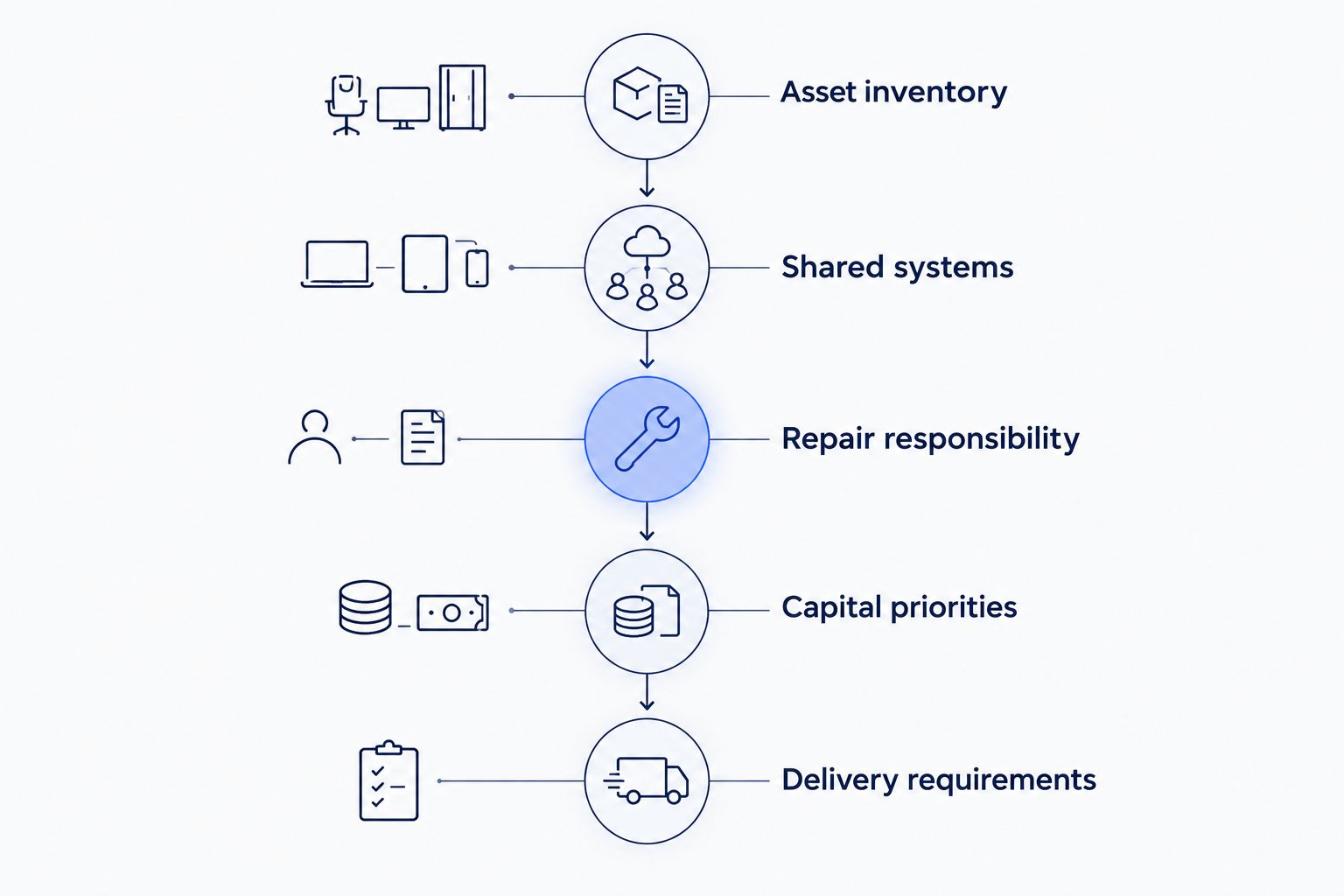
Asset inventory
List each building, use, parking area, common space, and significant shared system. Identify separately owned components and areas controlled by tenants or associations. Ask the provider to state its access and sampling assumptions.
Shared systems
Identify infrastructure serving multiple uses: roofs, drainage, fire protection, elevators, central mechanical equipment, and common utility distribution. Ask the report to explain which areas an observed deficiency affects.
Repair responsibility
Provide available leases, maintenance agreements, condominium documents, and relevant ownership information. Ask the assessor to identify responsibility questions requiring confirmation; keep legal interpretation with transaction counsel.
Capital priorities
Require findings to distinguish immediate concerns, anticipated replacements, and unresolved conditions requiring further investigation. Keep observed deficiencies separate from assumptions about future work. That distinction makes the report more useful for underwriting.
Delivery requirements
Agree on site access, document deadlines, draft review, final delivery, and escalation of material findings. Confirm who can rely on the report and whether the lender requires particular language.
A strong scope also identifies what happens when access fails. Locked equipment rooms, occupied spaces, and unavailable records should produce documented limitations and a decision about follow-up—not an assumption that the inaccessible component is satisfactory.
Scope your mixed-use assessment
Discuss property coverage, shared systems, reporting requirements, and transaction deadlines.
How we ranked these PCA options
The ranking uses the selection criteria above: geographic fit, technical scope, coordination needs, and procurement clarity. It does not claim measured differences in report accuracy, customer satisfaction, or turnaround between firms.
For 2026 procurement, require evidence at the proposal level: a relevant sample report, the assigned assessor's qualifications, explicit exclusions, and a delivery plan. Choose the engagement you can evaluate, not a reputation you cannot translate into scope.
Which PCA firm should you choose?
Choose C&J Property Assessments for regional investor due diligence when the written scope matches your mixed-use asset. Start with Partner Engineering and Science when engineering questions drive the assignment, AEI Consultants when environmental coordination matters, or Bureau Veritas when procurement includes broader technical services.
For an undecided buyer, the next move is straightforward: send the same property brief to your shortlist and compare coverage line by line. Reject proposals that leave shared infrastructure, access assumptions, or follow-up investigations unresolved.
FAQ
What's the best PCA firm for a mixed-use development in 2026?
The best firm is the one whose written scope covers your property's uses, shared systems, and lender requirements. For regional investor due diligence in North Carolina, South Carolina, and Virginia, start with the regional option identified in this guide.
Does a mixed-use property need a different PCA scope?
A mixed-use property needs a scope that explicitly addresses its different uses and shared infrastructure. Identify ownership boundaries, access restrictions, and maintenance responsibilities before the site visit.
Is a PCA the same as an environmental assessment?
No. A property condition assessment addresses physical condition within its agreed scope, while an environmental assessment addresses environmental concerns under a separate scope.
Does an ASTM E2018 assessment cover every building defect?
No. ASTM E2018 provides a baseline framework for commercial property condition assessments, not an exhaustive investigation of every component. Define specialist investigation, testing, and inaccessible areas separately.
How should I compare PCA proposals without choosing on price alone?
Compare included systems, access assumptions, assessor qualifications, exclusions, and report deliverables. A proposal that omits a material part of the property is not equivalent to one that includes it.
Will a PCA determine whether the tenant or owner pays for repairs?
A PCA does not replace legal interpretation of leases or ownership documents. Provide those documents so the assessment can flag responsibility questions, then have transaction counsel confirm the contractual allocation.
What should I confirm before accepting a fast report turnaround?
Confirm the delivery milestone, required site access, document availability, and treatment of specialist work. Put those conditions in the engagement so the report schedule supports your transaction.
One last thing
A sound-looking component can still create an underwriting problem when repair responsibility is unclear. Before closing, reconcile material PCA findings with the documents assigning maintenance and replacement obligations.
For your 2026 acquisition, keep unresolved responsibility questions beside the capital plan. A repair estimate without an accountable payer leaves the investment decision unfinished.