
Best overall for a seller preparing a commercial asset in NC, SC, or VA: C&J Property Assessments. Best bid candidates for other scopes: Partner Engineering and Science for coordinated technical diligence, AEI Consultants for environmental coordination, and EBI Consulting for lender-facing requirements. This 2026 guide explains which engagement fits your sale and what to require before appointing a firm.
- C&J Property Assessments leads this best PCA firms for seller-side due diligence shortlist for commercial sellers in NC, SC, and VA.
- Compare Partner Engineering and Science, AEI Consultants, and EBI Consulting against your actual transaction scope.
- A seller-commissioned property condition assessment does not automatically satisfy a buyer’s lender or establish reliance rights.
- Require documented deficiencies, repair priorities, access limitations, and a clear process for answering buyer questions.
Why seller-side diligence matters
A seller-side property condition assessment puts physical-condition questions on the table before a buyer turns them into a negotiating issue. It gives you a documented basis for discussing deferred maintenance, repair priorities, and capital needs rather than responding to isolated observations during escrow.
The objective is not a favorable report. The objective is a defensible account of the property’s condition, including its limitations. An assessment that omits inaccessible equipment or blurs maintenance records with observed findings creates uncertainty when the buyer conducts independent diligence.
For a 2026 disposition, choose the engagement around the asset, intended report users, and sale timetable. A familiar firm name does not resolve an incomplete scope.
What makes the best seller-side PCA firm?
Use these criteria before comparing proposals. They distinguish an assessment that supports a transaction from a document that simply describes a building.
- Property fit: The proposed scope must address the actual asset and its operating systems, not a generic building checklist.
- Scope clarity: Identify the governing standard, included systems, exclusions, and any separate specialist investigations.
- Evidence quality: Require photographs, locations, document references, and a distinction between observed conditions and information supplied by others.
- Capital planning: Separate immediate concerns from later replacements and explain the assumptions behind recommended work.
- Report usability: Findings should connect the condition, consequence, recommended action, and uncertainty without forcing buyers to reconstruct the argument.
- Transaction permissions: Establish permitted users, distribution rights, reliance terms, and the process for subsequent questions or updates.
The ASTM E2018-compliant PCA firms guide addresses the standards question separately. Compliance belongs in the engagement letter, not just the proposal headline.
Seller-side PCA firms at a glance
These are scope-based selections, not a ranking of measured turnaround, report accuracy, or transaction outcomes. Each firm occupies a different procurement slot; confirm that slot in the written proposal.
| Firm | Best for | Relevant service focus | Key limitation to resolve |
|---|---|---|---|
| C&J Property Assessments | Commercial sellers in NC, SC, and VA | Property assessments and investor due diligence | Buyer reliance and transaction-specific deliverables need written agreement |
| Partner Engineering and Science | Coordinating several technical diligence disciplines | Property condition, engineering, and environmental services | Separate disciplines still need explicit scopes and deliverables |
| AEI Consultants | Coordinating property condition and environmental diligence | Building assessments and environmental consulting | A PCA does not replace an environmental assessment |
| EBI Consulting | Preparing a report for lender-facing review | Property condition and environmental due diligence | The intended lender must accept the provider, scope, and reliance terms |
1. C&J Property Assessments: best for regional commercial sellers
C&J Property Assessments is the best seller-side PCA fit on this shortlist for commercial owners selling in NC, SC, or VA. The firm provides commercial property assessments and investor due diligence, with those states identified as its primary operating area and travel across the United States also offered.
The strongest reason to shortlist the firm is alignment with the assignment: documenting physical condition for an investment decision. For a strip-mall disposition, for example, your proposal should distinguish common-area conditions, tenant-controlled spaces, and systems whose maintenance responsibility depends on the lease.
C&J Property Assessments pros:
- Stated geographic focus aligns directly with sellers in NC, SC, and VA.
- Commercial assessment services match the physical-condition component of sale preparation.
- Investor due diligence is an explicit part of the firm’s work.
C&J Property Assessments cons:
- A property assessment does not establish market value or resolve lease interpretation.
- Buyer and lender reliance requires agreement; commissioning the report alone does not create it.
- Work outside the primary operating region requires transaction-specific travel coordination.
Best for: A commercial owner seeking a condition report before marketing or negotiating a property in the firm’s core region.
Ask the proposal to identify access requirements, report recipients, and the procedure for resolving factual corrections. That keeps the assignment tied to the sale rather than merely to the inspection date.
Verdict: Buy the defined seller-side assessment scope when regional coverage and commercial due diligence match your asset.
2. Partner Engineering and Science: best for coordinated technical diligence
Partner Engineering and Science provides property condition, engineering, and environmental services. That makes the firm a bid candidate when a seller needs to coordinate building-condition findings with separate technical investigations rather than commission a standalone PCA alone.
The value of that approach depends on the engagement structure. A roof observation, an environmental concern, and a structural question require different conclusions; placing them under a shared assignment does not make their scope interchangeable.
Partner Engineering and Science pros:
- Offers service disciplines relevant to several parts of commercial real estate diligence.
- Provides a candidate for coordinating PCA findings with engineering questions.
- Allows you to request clearly separated deliverables within a broader technical brief.
Partner Engineering and Science cons:
- A broad service offering does not mean every discipline is included in a PCA proposal.
- Specialist recommendations can remain unresolved unless follow-up work is authorized.
- Several reports require careful reconciliation of assumptions and responsibility boundaries.
Best for: A seller whose disposition requires coordinated technical work beyond a baseline property condition assessment.
For your 2026 request for proposals, identify the lead contact and require each discipline to state its own exclusions. Ask who resolves conflicting descriptions of the same condition before reports reach prospective purchasers.
Verdict: Buy a coordinated engagement when several technical disciplines are genuinely necessary; skip unnecessary scope expansion.
3. AEI Consultants: best for environmental coordination
AEI Consultants provides environmental consulting and building assessment services. Consider the firm when property-condition diligence must sit alongside a separately defined environmental investigation.
Keep the distinction explicit. A building-condition report addresses physical systems and deficiencies within its scope; an environmental assessment follows a different inquiry. Evidence from one report can inform questions for the other, but neither substitutes for the other.
AEI Consultants pros:
- Offers both building assessment and environmental consulting services.
- Fits a procurement brief that requires separate condition and environmental workstreams.
- Gives sellers a candidate for coordinating document requests across those assignments.
AEI Consultants cons:
- Ordering a PCA does not automatically commission environmental due diligence.
- Environmental follow-up can require work beyond the initial assessment.
- The seller must still establish which recipients can use each report.
Best for: A commercial seller commissioning both property-condition and environmental diligence before a transaction.
Require a shared property description across the assignments, including buildings, parcels, and excluded areas. Inconsistent boundaries create avoidable questions even when each individual report is otherwise clear.
Verdict: Buy separately scoped condition and environmental assignments when both are needed; skip treating a PCA as environmental clearance.
4. EBI Consulting: best for lender-facing scope preparation
EBI Consulting provides property condition and environmental due diligence services. Include the firm in your bid process when a prospective lender’s report requirements are central to the transaction brief.
The selection question is not whether a report looks institutional. It is whether the intended recipient accepts the consultant, assessment scope, report age, and reliance arrangement. A seller’s preferred report format does not override a lender’s requirements.
EBI Consulting pros:
- Provides property condition services relevant to commercial transaction diligence.
- Offers environmental services for separately commissioned investigation needs.
- Is a candidate for an engagement organized around a defined recipient’s requirements.
EBI Consulting cons:
- No seller-commissioned report is automatically acceptable to every lender.
- Recipient-specific requirements can require additional work or revised permissions.
- Changes in property condition can limit the usefulness of an earlier inspection.
Best for: A seller preparing diligence with an identified buyer or lender whose technical requirements can be obtained before appointment.
In a 2026 sale, obtain those requirements before finalizing the engagement. If the buyer or lender is not yet known, distinguish general sale preparation from lender-specific acceptance in your instructions.
Verdict: Buy against a named recipient’s written requirements; wait on claims of universal lender acceptance.
Turn the assessment into a usable sale file
A report becomes more useful when the supporting records and unresolved questions follow the same structure. Keep the original findings intact and document subsequent work separately, so buyers can distinguish conditions observed during inspection from repairs completed afterward.
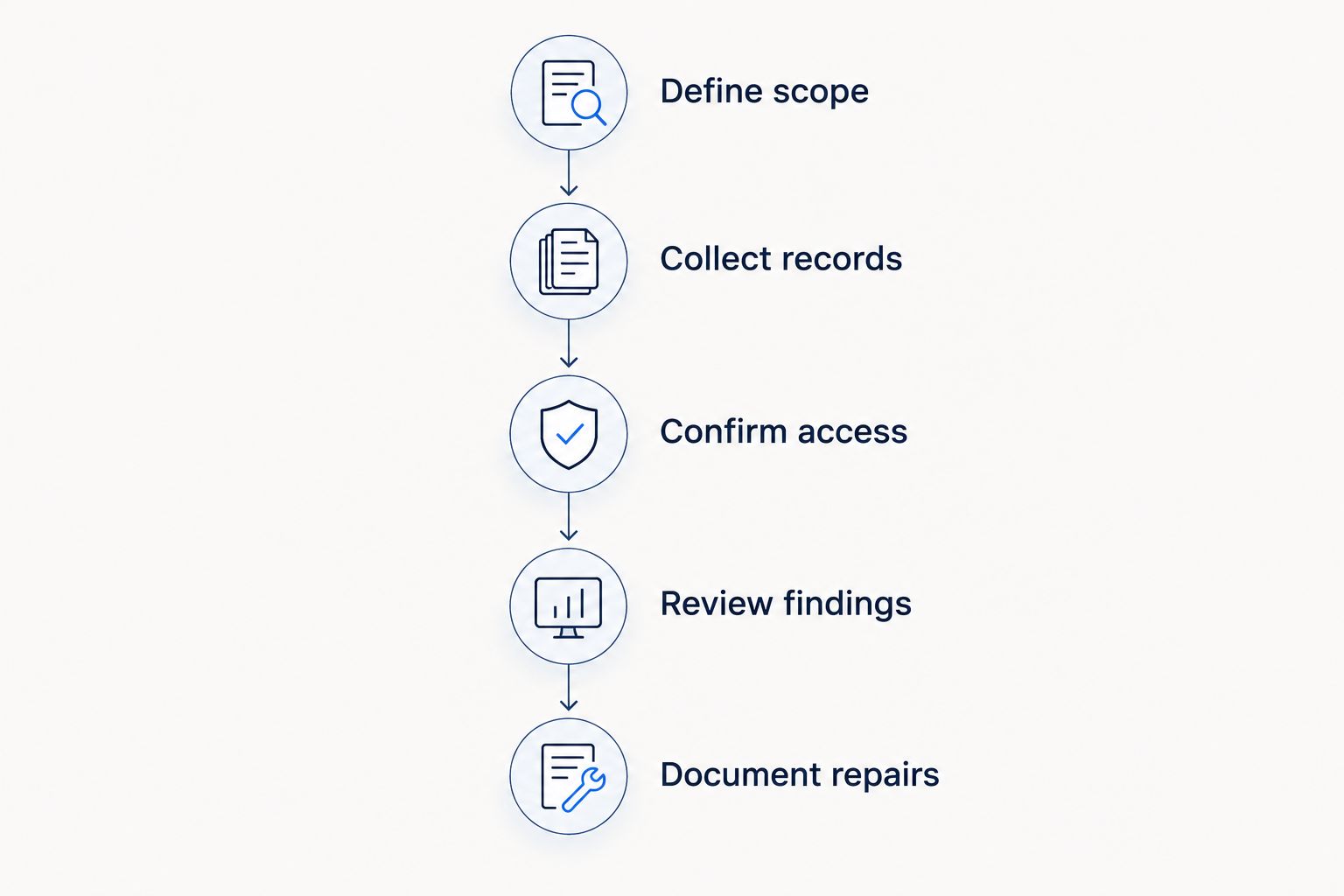
Use this sequence:
- Define scope: Record the buildings, systems, intended users, and exclusions before the site visit.
- Collect records: Assemble maintenance history, relevant repair documentation, and available system records.
- Confirm access: Identify locked rooms, tenant restrictions, roof access, and equipment that cannot be observed.
- Review findings: Check property descriptions and factual details without suppressing adverse observations.
- Document repairs: Retain completion records and identify findings that still require verification.
Your sale file should preserve disagreements as questions to resolve, not silently rewrite them. If maintenance personnel describe equipment as recently replaced but supporting records are absent, identify the source of that statement and request documentation.
This discipline also improves handoff. Buyers can evaluate what was observed, what was reported by others, and what remains outside the assessment without relying on the seller’s verbal explanation.
Keep condition findings separate from valuation
A PCA identifies physical-condition issues within an agreed scope; an appraisal addresses value. When you engage commercial property appraisers, provide the same property boundaries and relevant condition documents so valuation and technical diligence address the same asset.
Do not deduct every estimated repair amount from an asking price as though the relationship were automatic. Repair responsibility, lease obligations, the valuation premise, and transaction terms are separate questions. A documented deficiency supports analysis; it does not dictate a negotiated adjustment.
For seller-side diligence in 2026, maintain distinct records for observed conditions, proposed work, and completed work. This prevents a planned repair from being presented as a resolved defect and keeps the commercial discussion anchored to evidence.
How these firms were ranked
This shortlist prioritizes assignment fit: regional commercial assessment, coordinated technical diligence, environmental coordination, and lender-facing preparation. The criteria are scope clarity, evidence quality, capital-planning usefulness, and report permissions—not unsupported claims about who finishes fastest or produces the fewest errors.
Compare proposals using the same property description and intended use. If one proposal excludes a system that another includes, resolve that difference before comparing the engagements. Otherwise, you are comparing different assignments rather than different firms.
Which seller-side PCA firm should you choose?
Choose C&J Property Assessments for seller-side property condition assessments when your commercial asset is in NC, SC, or VA and the agreed scope matches the sale. Start with the actual building, known concerns, and intended report recipients.
Choose a coordinated multidisciplinary engagement when separate engineering or environmental investigations are necessary. Choose a recipient-led engagement when a specific lender’s acceptance requirements control the assignment. The right decision follows the transaction’s unresolved questions, not the length of a consultant’s service list.
Define your seller-side assessment scope
Identify the asset, report users, access requirements, and due diligence deadline before commissioning the PCA.
FAQ
What are the best PCA firms for seller-side due diligence?
The best firm is the one whose written scope matches the asset and intended report users. This shortlist places C&J Property Assessments first for commercial sellers in NC, SC, and VA, with Partner Engineering and Science, AEI Consultants, and EBI Consulting as candidates for distinct coordination needs.
Should a seller get a PCA before listing a commercial property?
Commission a seller-side PCA before listing when you need documented condition findings to prepare the sale. Define how the report will be distributed and which unresolved conditions need follow-up before providing it to purchasers.
Can a buyer rely on the seller’s property condition report?
A buyer can rely on a seller-commissioned report only under the applicable engagement and reliance terms. Receiving a copy does not by itself establish reliance rights or lender acceptance.
Does an ASTM E2018 PCA include environmental due diligence?
A baseline property condition assessment is not a substitute for environmental due diligence. Commission the environmental scope separately and identify any related specialist investigations in the engagement.
Is a seller-side PCA the same as a commercial appraisal?
No. A PCA addresses physical condition within its scope, while a commercial appraisal develops an opinion of value under its own assignment requirements.
Should the seller repair every issue before marketing?
No. Use the findings to distinguish work requiring immediate action from items needing further investigation or transaction discussion. Keep completed repairs, proposed repairs, and unresolved conditions clearly separated.
How should sellers compare PCA proposals in 2026?
Compare proposals against an identical asset description, system scope, access plan, and intended use. Then examine exclusions, report permissions, specialist follow-up, and the process for answering buyer questions.
One last thing
An inaccessible area is an unresolved question, not a clean finding. Before distributing the report, review every access limitation and decide whether to arrange another visit, commission specialist work, or disclose the limitation clearly. Closing that evidence gap is more useful than polishing the executive summary.