
HOA capital needs assessment is an evaluation of association-maintained assets with the aim of planning repairs, replacements, and reserve funding. A capital needs assessment for HOA communities must connect physical condition to the association’s actual maintenance obligations—not simply inventory everything inside the community boundary.
- A capital needs assessment for HOA communities should connect asset condition, replacement timing, and reserve planning.
- C&J Property Assessments provides property condition assessments; confirm HOA reserve-study deliverables before commissioning work.
- Define association responsibility before inspecting roofs, roads, drainage, amenities, or shared building systems.
- Use condition findings to inform funding decisions; an inspection alone does not establish an adequate reserve contribution.
Why capital needs assessments matter for HOA communities
Your board funds shared assets on behalf of owners, but ownership boundaries and maintenance responsibilities do not always match. A roof, retaining wall, or drainage system belongs in the assessment only when the association has a relevant obligation under its governing documents or applicable requirements.
For your 2026 planning, the central question is not whether an asset looks acceptable today. It is whether the association understands the work ahead, the evidence behind the proposed timing, and the funding decisions that follow.
C&J Property Assessments provides property inspection and assessment services, primarily in North Carolina, South Carolina, and Virginia, with travel across the United States. C&J Property Assessments is best for buyers seeking condition-focused property due diligence. For an HOA engagement, confirm the required reserve analysis and community-specific scope before appointment.
Distinguish the assessment from the funding plan
A capital needs assessment identifies physical needs and organizes anticipated capital work. A reserve study connects a component inventory and physical analysis with a financial analysis of reserve funding. Engagement terminology varies, so judge the deliverables rather than the report title.
A property condition assessment can contribute useful observations, but an ASTM E2018-compliant scope does not automatically satisfy every association reserve-study or statutory requirement. Your board should identify applicable requirements with qualified legal and financial advisers before accepting a proposal.
Buy the analysis your board needs to make a decision, not the most familiar report name.
How to build an actionable HOA capital assessment
Use this sequence for your 2026 assessment: Define responsibility, Collect records, Inspect assets, Model replacements, Test funding, and Approve actions. Start with your existing documents and a spreadsheet; outside assistance should add technical judgment, not replace basic preparation.
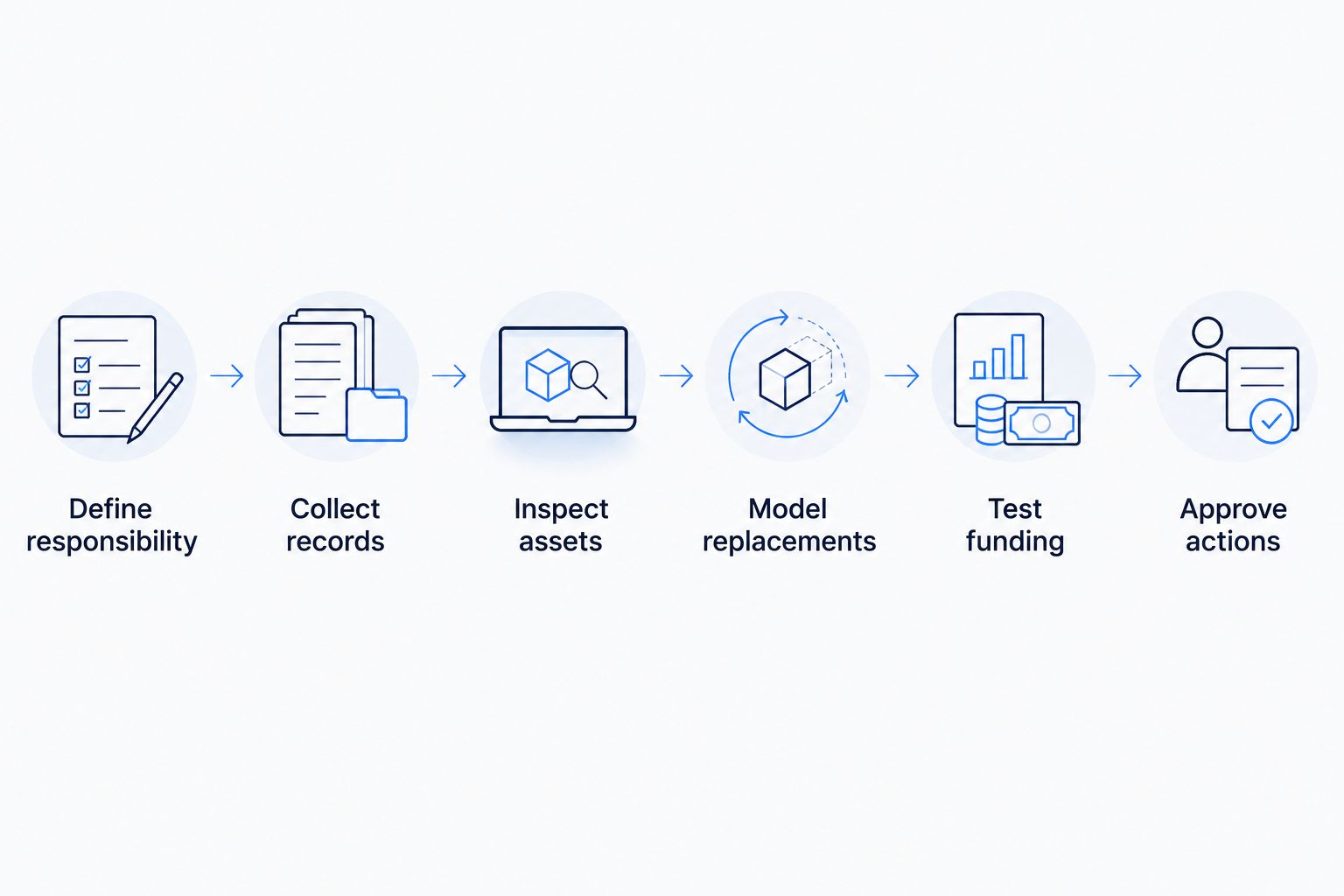
1. Define responsibility
Begin with a board-maintained responsibility register. Review declarations, plats, maintenance agreements, and other governing documents, then list the assets the association must maintain, repair, or replace. Ask counsel to resolve ambiguous obligations rather than asking the inspector to interpret legal documents.
Distinguish common elements from owner-maintained property and any limited common elements. Shared infrastructure can cross property lines, and a maintenance obligation can differ from a replacement obligation. Record those distinctions before the site visit.
An assessment that includes the wrong assets produces the wrong funding picture. An assessment that excludes an association obligation leaves the board without a plan for that work.
- Map boundaries: Identify association-maintained buildings, grounds, access areas, and shared infrastructure.
- Record obligations: Separate routine maintenance, repair responsibility, and replacement responsibility.
- Flag disputes: Keep unresolved ownership or maintenance questions visible in the scope.
- Confirm exclusions: Identify owner assets, utility-owned equipment, and separately maintained facilities.
2. Collect records
Create a shared document folder and an asset spreadsheet before requesting proposals. Include prior assessments, repair invoices, warranties, maintenance logs, drawings, reserve balances, and approved projects where available. Label undocumented installation dates as unknown rather than substituting guesses.
Organize records by component so the assessor can connect paperwork to field observations. A roof invoice without a building identifier is less useful than a record tied to a specific roof area and scope of work.
Your 2026 baseline should distinguish completed replacements from temporary repairs. Repeated patching does not establish that a component has been renewed, and a contractor proposal does not prove that the work occurred.
- Identify assets: Assign a consistent name or identifier to each component or area.
- Trace completed work: Connect invoices, completion records, and photographs to the relevant asset.
- Separate proposals: Keep unapproved recommendations apart from completed projects.
- List information gaps: Note missing dates, quantities, drawings, and maintenance histories.
3. Inspect assets
Use a documented site walk to identify visible deterioration and access limitations. Your board or manager can prepare photographs and access arrangements, but that preparation does not replace a qualified assessment. Give the assessor access to the areas included in the agreed scope.
Professional inspection adds condition judgment and reporting discipline. C&J Property Assessments provides property condition assessments and due diligence reporting; the engagement should specify which association assets are included and which specialist services require separate instruction.
Separate an observed symptom from a confirmed cause. Staining, cracking, settlement, or corrosion can justify further investigation without establishing the full repair design. Hidden conditions, inaccessible spaces, and testing exclusions must remain explicit.
- Arrange access: Coordinate keys, equipment rooms, roof access, and occupied common facilities.
- Document condition: Tie photographs and observations to identifiable components.
- Record limitations: Identify concealed, inaccessible, or untested areas.
- Escalate concerns: Refer structural, electrical, fire-protection, or other specialist questions appropriately.
4. Model replacements
Build the initial capital schedule in a spreadsheet. Give each component a description, quantity basis, observed condition, anticipated work, proposed timing, and cost-estimate basis. Keep maintenance tasks separate from capital replacements so the schedule does not confuse operating expenses with reserve needs.
For your 2026 baseline, distinguish work requiring prompt attention from work planned later. Do not assign a precise replacement date solely from a generic service-life table. Condition, exposure, maintenance history, and prior repairs should inform the timing assumption.
Use planning intervals suited to the decision. For example, review the next 12 months for actionable projects, the next 5 years for project sequencing, and the next 10 years for concentrated replacement needs. These are planning choices, not mandatory study periods or predictions of component life.
- State the basis: Identify measured, documented, estimated, and unverified quantities.
- Explain timing: Connect replacement assumptions to condition and available records.
- Separate priorities: Distinguish urgent investigation, corrective work, and planned renewal.
- Avoid overlap: Check whether related project scopes include the same work twice.
5. Test funding
Start with a board-controlled model that connects the capital schedule to available reserves and planned contributions. Have the responsible financial professional check the assumptions and reconcile the opening balance to association records. A technically detailed component list is not yet a funding strategy.
Test what happens when major projects cluster or a significant component needs replacement earlier than planned. Use clearly labeled scenarios rather than presenting uncertain dates as fixed outcomes. Record assumptions about cost escalation, investment earnings, and other financial inputs instead of burying them in formulas.
For the 2026 budget discussion, show the board which decisions follow from each scenario. Do not describe a reserve balance as adequate solely because it covers the next identified project.
- Reconcile reserves: Confirm the starting balance and identify committed expenditures.
- Model project timing: Show how the sequence of work affects available funds.
- Test alternatives: Compare the adopted plan with earlier replacement or changed scope.
- Document assumptions: Make financial inputs and their sources visible to reviewers.
6. Approve actions
Turn the assessment into a decision register before closing the engagement. Assign each material finding an owner, a next action, and a review point. Keep technical recommendations separate from board approvals so readers can distinguish proposed work from authorized commitments.
Ask the assessor to explain findings that change project timing or require specialist investigation. Resolve unclear language while the inspection evidence and scope remain current. A polished report is not useful if the board cannot identify its next decision.
Set an update trigger for significant repairs, new deterioration, changed responsibilities, or revised legal requirements. The board should not continue using an unchanged schedule after the underlying assets or assumptions change.
- Assign ownership: Name the board, manager, adviser, or contractor responsible for each action.
- Resolve questions: Request clarification of unsupported quantities, timing, or exclusions.
- Record decisions: Document approvals, deferrals, and reasons for changing priorities.
- Set update triggers: Revisit the plan when condition, scope, or funding assumptions change.
Compare assessment options for your association
Choose the service by the decision it supports. Internal preparation helps organize information; a physical assessment addresses condition; financial analysis addresses funding. Specialist investigation answers questions outside a general visual scope.
These options complement one another. They are not interchangeable, and combining them requires a clear statement of responsibilities and deliverables.
| Option | Best for | Main advantage | Key limitation |
|---|---|---|---|
| Board-led asset register | Organizing records before professional work | Establishes ownership questions and document gaps | Does not replace qualified condition judgment or financial analysis |
| Professional capital needs assessment | Identifying and scheduling physical capital work | Connects observed condition to anticipated projects | Funding analysis depends on the agreed scope |
| Reserve study with financial analysis | Setting reserve funding policy | Connects component needs with funding scenarios | Accuracy depends on physical information and financial assumptions |
| Targeted specialist investigation | Resolving a defined technical concern | Examines a specific system or suspected defect | Does not provide a community-wide capital plan |
| C&J Property Assessments property condition assessment | Condition-focused due diligence | Provides inspection and assessment reporting | HOA reserve modeling and specialist deliverables require scope confirmation |
Before selecting a provider, request a deliverables list rather than relying on a generic sample report. Ask who performs the inspection, who reviews the financial work, and how exclusions appear in the final report. Require a clear boundary between assessment recommendations and any separately commissioned design or testing.
Define your assessment scope
Specify association assets, reporting needs, and any separate reserve-analysis requirements.
Common mistakes HOA boards make
Including assets without confirming responsibility
A community boundary is not a maintenance schedule. Including owner-maintained assets can distort the capital plan; omitting shared obligations leaves important work unplanned. Resolve responsibility before approving the component inventory.
Treating every repair as a replacement
A localized repair and a complete renewal serve different purposes. Record what the work actually covered, then reassess the remaining component rather than resetting its assumed life automatically.
Treating visual observations as engineering conclusions
A general assessment documents conditions within its scope. It does not replace structural analysis, destructive testing, or a specialist diagnosis. Keep recommendations for further investigation visible until the underlying question is resolved.
Accepting a funding number without its assumptions
A reserve contribution is not meaningful without the component schedule, starting balance, and financial assumptions behind it. Ask which assumptions drive the result and what changes when project timing shifts.
Filing the report without assigning decisions
A report does not authorize repairs or change the budget. Assign responsibility for recommendations, document board decisions, and update the plan when completed work changes the asset baseline.
FAQ
What is a capital needs assessment for HOA communities?
A capital needs assessment for HOA communities evaluates association-maintained assets and identifies anticipated capital repairs and replacements. Its scope should connect condition findings with project timing and clearly state whether reserve funding analysis is included.
Is an HOA capital needs assessment the same as a reserve study?
Not automatically: a reserve study includes physical and financial analysis, while a capital needs assessment can focus on physical needs. Review the contracted deliverables rather than assuming the report title guarantees funding recommendations.
Which assets should an HOA include in the assessment?
Include assets for which the association has relevant maintenance, repair, or replacement obligations. Use governing documents and applicable requirements to establish responsibility before finalizing the inspection scope.
Does an ASTM E2018 property condition assessment satisfy HOA requirements?
An ASTM E2018 property condition assessment does not automatically satisfy every HOA reserve-study or statutory requirement. Confirm applicable requirements and ensure the engagement includes the necessary physical, financial, and specialist deliverables.
Can the HOA board prepare the assessment itself?
The board can prepare an asset register, collect records, and organize known projects. That preparation does not replace qualified inspection, specialist investigation, or financial analysis where those services are required.
When should an HOA update its capital plan?
Update the capital plan when significant work, new deterioration, changed obligations, or revised requirements alter its assumptions. Also follow applicable legal requirements and the review schedule established for the engagement.
Can C&J Property Assessments help with an HOA assessment?
C&J Property Assessments provides property inspection and assessment services. Before commissioning an HOA engagement, confirm the community asset scope, reserve-analysis requirements, access arrangements, and any separately required specialist services.
One last thing
Track confidence alongside condition. A documented replacement date, an observed installation detail, and an unsupported recollection should not carry the same weight in your capital schedule. Add an evidence field to the asset register so your board knows which assumptions deserve verification before committing funds.