
For fix-and-flip investors, a PCA is a property condition assessment used to identify physical deficiencies and inform acquisition and rehabilitation decisions. Your scope must match the property and planned renovation—not simply borrow a commercial reporting template for a residential investment.
- PCA for fix-and-flip investors should connect property condition findings to acquisition decisions and rehabilitation scope.
- C&J Property Assessments serves investors seeking property condition assessments before purchasing a fix-and-flip property.
- Resolve inaccessible areas and specialist referrals before treating the rehabilitation scope as complete.
- A property condition assessment does not replace contractor bids, environmental review, or renovation design.
Why property condition assessments matter for fix-and-flip investors
Your inspection should test the acquisition assumptions, not just describe the building. A cosmetic renovation plan becomes a different investment when roof deterioration, moisture damage, or electrical deficiencies add work outside the original scope.
Fix-and-flip investors need condition information before committing to an acquisition and before locking the rehabilitation sequence. The relevant question is not whether a component looks old; it is whether its condition changes the purchase decision, required work, or exit plan.
C&J Property Assessments is a fit for investors seeking pre-purchase property condition assessments for fix-and-flip acquisitions. Its stated services include investor due diligence for residential and commercial properties, with a primary operating area covering North Carolina, South Carolina, and Virginia and willingness to travel nationally.
For your 2026 acquisitions, separate observed conditions from assumptions. A report cannot establish the condition of concealed framing or inaccessible equipment merely because the transaction deadline is approaching.
How to scope and use a fix-and-flip PCA
Define the acquisition decision before ordering the inspection
Start with a written acquisition brief. You can prepare it yourself using the listing, seller disclosures, available records, and your proposed rehabilitation scope; a paid assessment should answer questions that this preliminary review leaves unresolved.
Specify whether you need to decide to buy, renegotiate, request further investigation, or reject the property. Include your intended exit because a resale renovation and a conversion project require different follow-up questions.
Use 3 decision categories: proceed, investigate, and decline. These are your underwriting categories—not inspection ratings—and they keep unresolved conditions from disappearing into a general repair allowance.
- Identify the property type and intended use after rehabilitation.
- Describe the planned work, including changes to layouts or building systems.
- Record the inspection contingency and acquisition decision deadlines.
- List conditions that would change your offer or stop the acquisition.
- Identify who approves additional investigation before closing.
Match the assessment scope to the property
Read the proposed scope before comparing providers. A residential investment inspection and a commercial PCA are not interchangeable simply because both describe physical condition.
ASTM E2018 addresses baseline property condition assessments for commercial real estate. For a residential flip, ask the assessor to explain the applicable inspection scope rather than assuming that an ASTM reference supplies every answer you need.
For a 2026 purchase, confirm the applicable standard edition and lender requirements in the engagement documents. Also distinguish observation from testing: describing an electrical panel is not the same assignment as evaluating every circuit or designing a replacement system.
- Confirm which buildings, units, outbuildings, and site improvements are included.
- Identify the systems to be observed and the operating checks included.
- Specify accessible areas and procedures for documenting access limitations.
- Ask whether repair recommendations and cost opinions are included.
- Confirm exclusions, specialist referrals, and the intended report users.
Select the assessor around the decision deadline
Create a comparison sheet yourself, then ask each provider to respond to the same scope. Comparing report titles alone hides differences in access, documentation, specialist involvement, and delivery commitments.
C&J Property Assessments provides investor due diligence inspections, including assessments intended to inform fix-and-flip purchases. That service fits the acquisition stage; it does not establish that every engineering, environmental, or construction-planning task belongs in the same engagement.
Ask for the inspection date and report delivery date as 2 separate commitments. Your 2026 purchase schedule must also leave room to investigate significant findings after the report arrives. Use the quote request to describe the property, planned work, access arrangements, and decision deadline together.
- Request a sample report relevant to the property type.
- Confirm the assessor's qualifications for the agreed assignment.
- Identify the field visit date and report delivery date separately.
- Ask how significant findings are communicated before final delivery.
- Confirm who answers report questions and handles scope changes.
Arrange access and collect the property records
Organize documents and access before the visit. Missing records do not prove a defect, but they leave questions that a visual observation alone cannot settle.
Request available permits, repair invoices, equipment information, and records of recurring leaks or other problems. Compare the seller's account with what the records actually document; an invoice for a repair does not establish that the underlying cause was resolved.
For occupied investment properties, coordinate lawful access through the authorized parties. Never treat an inaccessible room, roof area, or crawlspace as satisfactory simply because it was unavailable during the scheduled visit.
- Request available roof, HVAC, plumbing, and electrical repair records.
- Collect documents for additions, conversions, and previous renovation work.
- Identify keys, escorts, permissions, and occupancy-related restrictions.
- Ask the assessor what utility status is needed for agreed observations.
- Record unavailable documents and inaccessible areas as unresolved items.
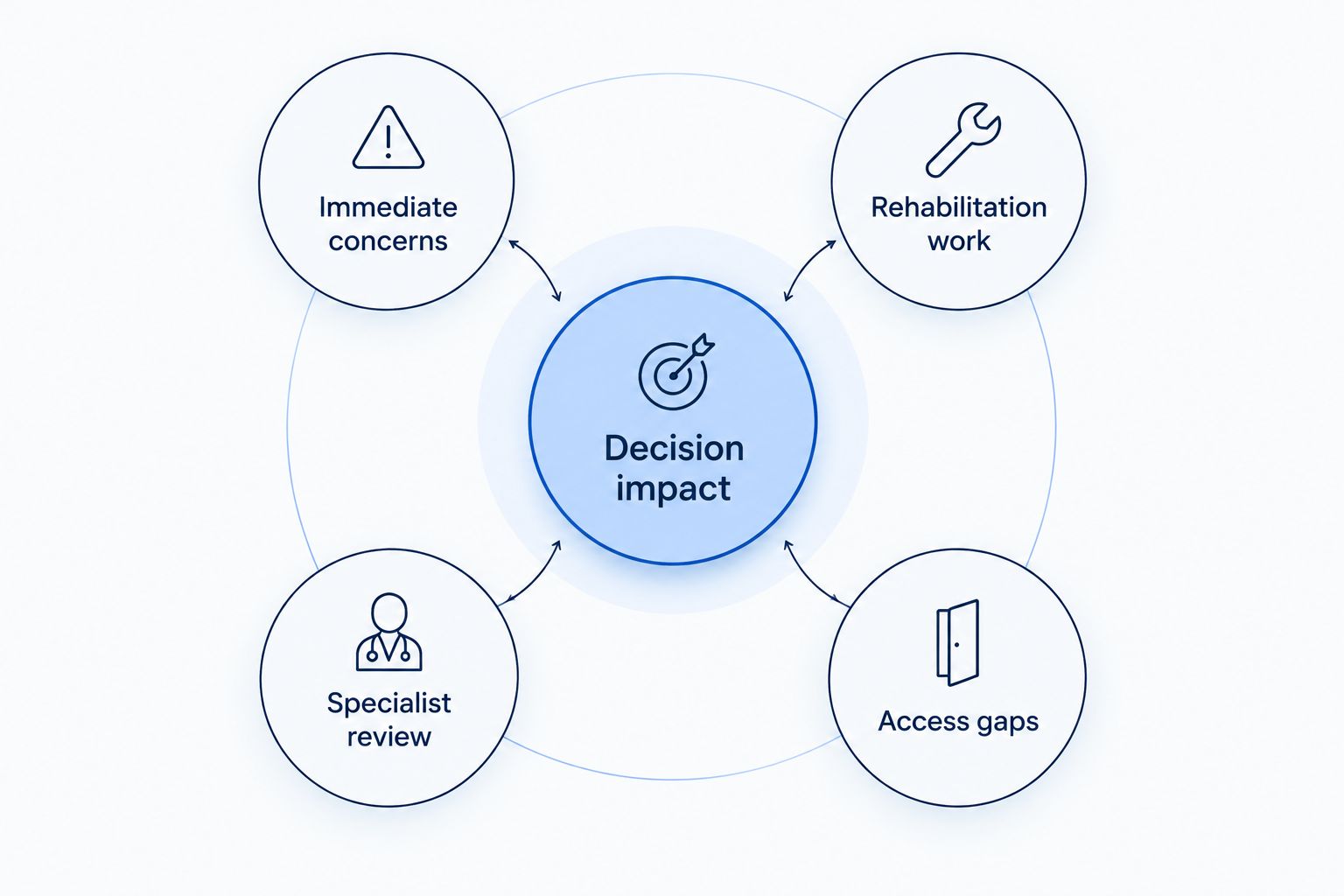
Separate findings by their effect on the investment
Build a findings register from the report before revising your rehabilitation plan. A single list of defects mixes urgent questions with work you already intended to perform.
Use the categories below to make the distinction explicit. An observed roof leak belongs in the condition review; the possibility of concealed damage remains an unresolved question until the necessary investigation occurs.
Keep the language precise. Visible staining is an observation, while its cause and the extent of concealed damage require supporting evidence. Do not turn an unverified explanation into a fixed construction scope.
- Immediate concerns: identify findings requiring prompt professional attention.
- Rehabilitation work: separate necessary repairs from your planned improvements.
- Specialist review: assign questions outside the assessor's agreed scope.
- Access gaps: track areas or systems that were not adequately observed.
- Decision impact: connect each unresolved issue to an acquisition action.
Convert the report into a contractor-ready scope
Start with your own cross-reference between the assessment findings and the planned renovation. Then obtain contractor input for the work you intend to authorize; a condition report is not a construction contract.
Separate repair necessity from finish selection. A damaged subfloor and a preferred flooring upgrade affect the same room, but they answer different investment questions.
For your 2026 rehabilitation plan, retain the source of each scope item: assessment observation, specialist conclusion, contractor proposal, or investor preference. This helps you identify work that still depends on an unresolved assumption rather than treating every item as equally certain.
- Match each material finding to a proposed repair or further investigation.
- Obtain written contractor scopes with explicit inclusions and exclusions.
- Identify permit and design questions for the appropriate local professionals.
- Separate required corrective work from discretionary finish upgrades.
- Identify sequencing dependencies before approving the rehabilitation schedule.
Close the findings loop before the acquisition decision
Review the findings with the assessor, contractors, and relevant specialists before your contractual decision deadline. A completed report is a deliverable; resolved acquisition questions are the objective.
Use 1 decision register that records each material issue, responsible party, supporting evidence, and disposition. An unresolved structural question should remain unresolved in that register until the appropriate professional provides an answer—not become an assumed repair because closing is near.
For a 2026 acquisition, preserve the final report and the decisions made from it alongside your purchase records. That record explains which conditions informed the offer and which remained excluded or uncertain.
- Mark each material finding as resolved, accepted, or still open.
- Retain specialist conclusions and contractor scope clarifications.
- Confirm whether previously inaccessible areas require another visit.
- Review findings against the actual purchase agreement with your advisers.
- Make the proceed, renegotiate, or decline decision explicitly.
Compare assessment options for a fix-and-flip acquisition
Choose the service that answers the outstanding question. Different assignments complement one another; buying a broader-sounding report does not automatically replace specialist investigation or construction pricing.
| Option | Best for | Main benefit | Key limitation |
|---|---|---|---|
| Investor-led records review | Initial acquisition screening | Organizes disclosures, records, and unanswered questions before engagement | Does not provide an independent physical assessment |
| Residential investment inspection | Residential flips needing condition review | Focuses the engagement on the residential property's agreed inspection scope | Does not automatically meet commercial PCA or lender requirements |
| Commercial PCA | Commercial or mixed-use acquisitions needing documented condition review | Provides a structured assessment under the agreed commercial scope | Baseline observations do not establish concealed conditions or replace design |
| C&J Property Assessments investor due diligence | Investors seeking pre-purchase property condition reporting | Offers assessments for residential and commercial investment decisions | Engineering, environmental, and construction tasks require explicit scope confirmation |
| Targeted specialist investigation | A defined structural, electrical, moisture, or other technical question | Addresses a question requiring specific expertise or investigation | Does not replace assessment of the rest of the property |
| Contractor rehabilitation scope | Translating identified work into an executable project | Defines proposed construction work and exclusions | Does not replace independent acquisition due diligence |
Select the combination around the property, not a standard package name. A straightforward residential acquisition and a commercial conversion have different investigation needs, even when the same investor is buying both.
Common mistakes fix-and-flip investors make
Ordering a commercial template without checking residential relevance
A lengthy report is not evidence that the assignment fits a residential flip. Confirm that the agreed observations and reporting answer your acquisition questions, and request any lender-required format separately.
Treating cosmetic renovation as evidence of system condition
Fresh finishes do not establish the condition of concealed framing, plumbing, or wiring. Keep evidence of completed work separate from assumptions about areas that were not observed.
Treating every report allowance as a contractor commitment
A repair opinion and a contractor's agreed scope serve different purposes. Confirm quantities, access, exclusions, and required follow-up before authorizing construction or treating a scope item as settled.
Spending the contingency period waiting for the final report
Report delivery is not the end of due diligence when material questions remain open. Plan time for report review, access corrections, and specialist follow-up before the contractual decision deadline.
Ignoring the parts of the property that were not inspected
An access limitation is not a clean finding. Assign an owner and a resolution path to each material gap, then decide explicitly whether the remaining uncertainty is acceptable.
FAQ
Do I need a PCA before buying a fix-and-flip property?
Use a property condition assessment when you need independent condition information to support the acquisition decision. Match the scope to the property, planned rehabilitation, and any lender requirements rather than ordering by report name alone.
Is a PCA the same as a home inspection for an investment property?
A commercial PCA and a residential investment inspection are different assignments. Confirm the applicable standard, systems covered, exclusions, and report requirements before choosing either service.
Does ASTM E2018 automatically apply to a residential flip?
ASTM E2018 addresses baseline property condition assessments for commercial real estate; it is not an automatic residential inspection requirement. Ask the assessor and any lender to identify the appropriate scope for the specific acquisition.
Can a PCA tell me exactly what my rehabilitation will involve?
A PCA informs the rehabilitation scope but does not replace contractor proposals, specialist investigation, or design. Convert findings into defined work items and resolve material unknowns before treating the construction scope as complete.
Can I skip specialist review if the assessor identifies a problem?
An assessment finding does not replace specialist review when the underlying question falls outside the agreed assessment scope. Ask what remains unknown and which professional should investigate it.
What should I send an assessor before requesting an inspection?
Send the property address, property type, intended renovation, decision deadline, and known access restrictions. Include available disclosures and repair records, and identify any lender-specific reporting requirements.
Does C&J Property Assessments inspect residential investment properties?
C&J Property Assessments provides residential investor due diligence, including inspections intended to inform fix-and-flip purchases. Its primary operating area includes North Carolina, South Carolina, and Virginia, with willingness to travel across the United States.
One last thing
Ask for a list of unresolved questions, not just a list of defects. A documented deficiency gives you something to address; an untracked assumption can enter the acquisition decision without anyone accepting responsibility for it.
Before approving the purchase, read the report's limitations alongside its findings. For a 2026 flip, the most useful final review is a direct comparison between what you need to know and what the inspection actually established.