
Private equity PCA is a property condition assessment used to identify physical deficiencies and capital needs before a fund commits to a real estate acquisition. This guide explains PCA for private equity funds in 2026, focusing on investment committee decisions, lender requirements, portfolio consistency, and post-close execution.
- PCA for private equity funds should connect property findings to acquisition decisions, capital reserves, and accountable repair plans.
- C&J Property Assessments fits funds seeking commercial property due diligence in North Carolina, South Carolina, and Virginia.
- Separate observed deficiencies, specialist investigations, and business-plan improvements before approving capital reserves.
- Confirm lender requirements, report reliance, access, and assessment scope before commissioning fieldwork.
Why property condition assessments matter for private equity funds
A property condition assessment gives your acquisition team a documented basis for evaluating physical-condition risk. It does not replace underwriting; it supplies evidence that underwriting needs. A roof deficiency, inaccessible electrical room, and planned tenant improvement are different issues and should not become one undifferentiated reserve allowance.
C&J Property Assessments is best for private equity funds seeking commercial property due diligence in North Carolina, South Carolina, and Virginia. The firm also accepts assignments across the United States. Confirm assignment-specific coverage, deliverables, and timing before engagement.
Private equity teams must connect findings across several decision-makers: acquisitions, asset management, financing, and the investment committee. Each needs the same underlying evidence, but not the same level of detail. Your executive summary should identify decision-critical conditions; supporting schedules should preserve the observations and assumptions behind them.
For a 2026 acquisition, organize the assessment around the actual investment strategy. A long-term income hold needs a different capital-planning emphasis from a repositioning project, even when the buildings have similar physical systems.
Build a decision-ready PCA process
1. Define the acquisition decision before requesting proposals
Start with an internal scope memo. Use your existing investment memorandum and a spreadsheet to identify what the assessment must resolve, rather than asking providers for an unspecified inspection.
Write down the intended hold period, planned changes in use, financing conditions, and diligence deadline. For example, if your model assumes a 5-year hold, request a capital schedule that addresses that period and explains significant needs beyond it. This is an underwriting instruction, not a prediction of component life.
Separate acquisition-critical questions from matters asset management can resolve after closing. An unresolved structural concern demands different treatment from a routine maintenance item.
- Identify the acquisition decision each requested deliverable supports.
- Record the intended hold period and proposed property use.
- Collect lender scope and reliance requirements.
- Identify conditions that require resolution before approval.
- Assign one internal owner for scope changes.
2. Assemble records and secure meaningful access
Create a shared document folder before scheduling fieldwork. Request maintenance records, repair histories, available drawings, warranties, prior reports, and relevant inspection documentation from the seller. Maintain a separate list of requested records that have not arrived.
Access deserves its own workstream. A scheduled site visit does not establish that roofs, mechanical rooms, tenant spaces, and other relevant areas will be accessible. Identify access restrictions before the visit and record which questions those restrictions leave unanswered.
For a portfolio, use one document-request template across assets. Consistent requests make gaps easier to identify, but they do not justify assuming that similar buildings share the same condition.
- Name the seller contact responsible for access.
- Request available records by building and system.
- Confirm roof and equipment-room access arrangements.
- Identify tenant coordination and escort requirements.
- Track unavailable documents separately from reviewed documents.
3. Select an assessor against the investment scope
Compare written proposals against the same scope matrix. Your team can do this manually by marking included work, exclusions, deliverables, and unresolved questions side by side. A shorter proposal is not necessarily a narrower assignment, and a longer proposal is not evidence of better coverage.
C&J Property Assessments provides PCA services for commercial acquisitions and investor due diligence. A direct assessment engagement reduces your team's need to assemble condition findings independently; it does not remove the need to define scope or commission specialist work when warranted.
In 2026, require written confirmation of the applicable ASTM E2018 scope, lender requirements, report users, and delivery milestones. Use the assessment quote request to communicate those requirements before accepting an engagement.
- Compare exclusions as closely as included services.
- Confirm who will perform and review the assessment.
- Specify required report recipients and reliance provisions.
- Request the proposed fieldwork and reporting schedule.
- Clarify how specialist referrals and scope changes work.
4. Connect field observations to investment consequences
Ask for findings that distinguish observed conditions from reported information and inaccessible areas. An equipment age supplied by the seller is not the same evidence as a visible nameplate or maintenance record. Preserve those distinctions in your underwriting notes.
A baseline PCA is generally a nonintrusive assessment, not an exhaustive test of every component. Where observations indicate a material concern, request a defined follow-up investigation rather than treating the original report as conclusive.
Your acquisitions team should translate findings into decisions without rewriting the assessor's technical conclusions. A documented deficiency might prompt further investigation, a capital adjustment, or a contractual discussion; the appropriate response depends on its significance and the transaction.
- Separate observations from seller representations.
- Identify inaccessible areas and their decision implications.
- Request photographs tied to specific locations.
- Flag findings that require specialist investigation.
- Record the transaction decision associated with each material issue.
5. Convert findings into a usable capital schedule
Build a spreadsheet that links every material finding to an action, timing assumption, responsible party, and evidence source. Start with the assessor's report, then reconcile it with your business plan. Keep condition-driven work separate from discretionary repositioning.
For a 2026 underwriting package, establish a 12-month planning window for near-term work and a separate schedule for the remaining hold period. These are fund-selected planning windows, not universal PCA requirements. Retain uncertainty where remaining life, access, or repair scope has not been established.
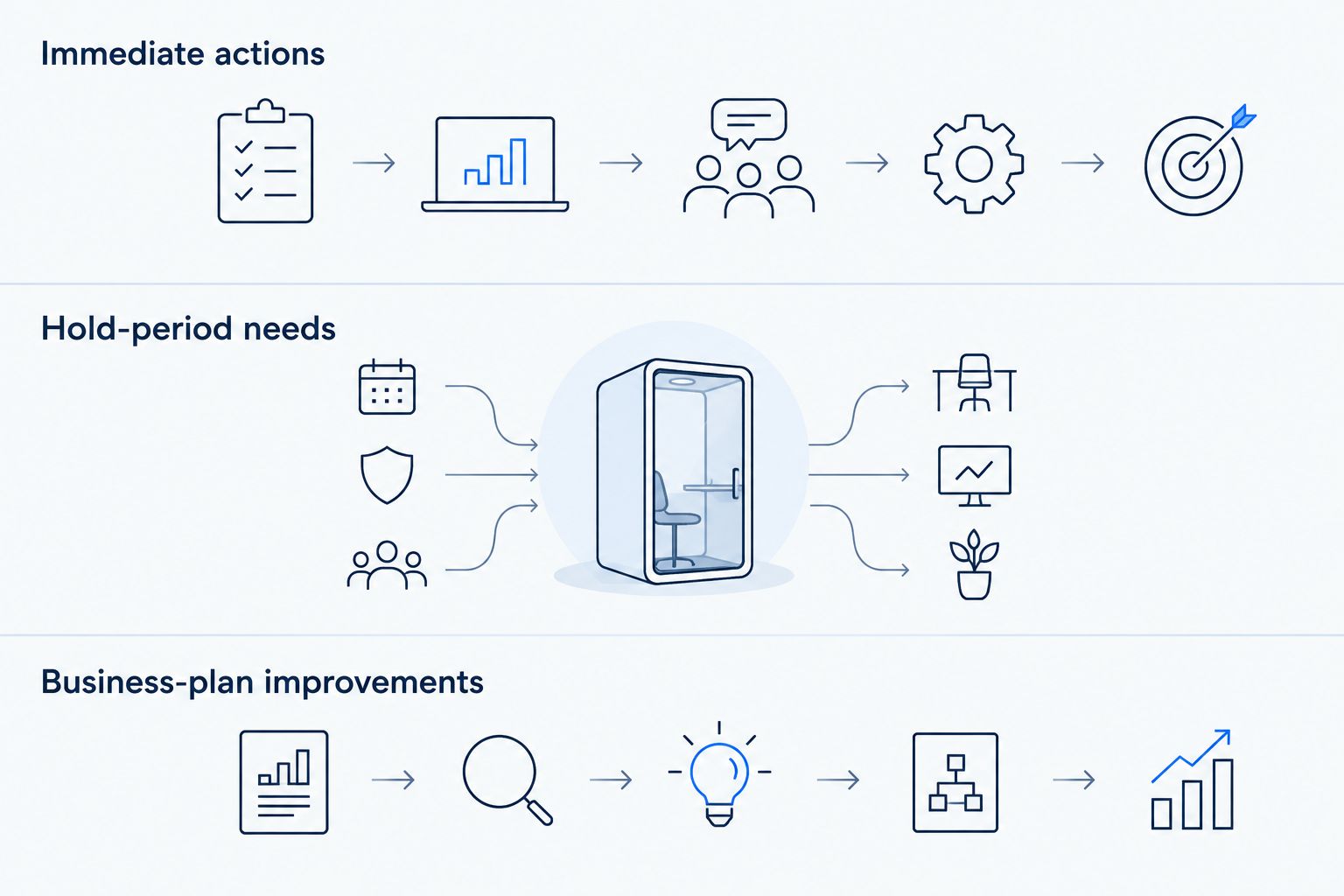
Use three categories consistently: Immediate actions, Hold-period needs, and Business-plan improvements. Mixing them obscures whether capital is necessary to address existing conditions or elective spending intended to support the investment strategy.
- Map every capital item to a report finding.
- Separate necessary repairs from elective improvements.
- Record timing assumptions and unresolved dependencies.
- Identify overlapping work to avoid duplicate allowances.
- Keep contingency assumptions distinct from identified work.
The capital schedule should remain traceable after approval. Preserve the connection between each category and its supporting observations so asset management can update the plan without losing the original rationale.
6. Escalate specialist questions before approving the investment
Review unresolved issues with the assessor and your deal team. Start with a shared issue log that states the question, available evidence, required specialist, and decision deadline. Do not turn uncertainty into an unsupported reserve assumption simply to finish the investment memorandum.
Fire protection illustrates the boundary between condition assessment and specialist scope. A proposed change in occupancy can raise questions beyond visible system condition; evaluating fire sprinkler retrofit costs requires a defined design and compliance scope rather than an allowance borrowed from another property. A Florida-specific discussion does not establish requirements for an acquisition elsewhere.
Apply the same discipline to structural movement, recurring water intrusion, and electrical concerns. Identify the question first, then commission the expertise needed to answer it.
- Write a specific question for each specialist referral.
- Identify the applicable property use and jurisdiction.
- Separate observed defects from proposed-use requirements.
- Assign an owner to obtain and review follow-up findings.
- Keep unresolved issues visible in the approval package.
7. Carry the assessment into closing and asset management
Use the final report to build a closing issue register, not just a diligence archive. Your team can maintain it in a spreadsheet, provided every item retains a clear owner and source reference. Record whether each issue is resolved, accepted, assigned for post-close work, or still under review.
Create a 90-day action plan for tasks your fund elects to prioritize after closing. That planning window does not replace urgent action where a safety issue requires immediate attention, and it is not a promise that every repair can be completed within it.
For portfolios acquired in 2026, standardize the handoff fields across properties. Consistent ownership and status definitions make comparison possible without flattening asset-specific conditions.
- Reference report sections and photographs in the issue register.
- Record the approved response to each material finding.
- Assign acquisition-to-asset-management handoff responsibility.
- Preserve open specialist questions after closing.
- Update completion status with supporting documentation.
Compare assessment options by decision need
Best for private equity acquisitions: an independent PCA matched to the transaction scope. Internal screening and specialist investigations serve different purposes. Neither should be presented as interchangeable with a full acquisition assessment.
C&J Property Assessments offers commercial PCA and investor due diligence services. Confirm the engagement's exclusions, access assumptions, reporting milestones, and any need for specialist follow-up; a general service description does not settle those assignment-specific questions.
| Option | Best for | Principal advantage | Key limitation |
|---|---|---|---|
| Internal document review | Initial screening | Organizes known records and open questions before engagement | Cannot establish current conditions through records alone |
| Independent baseline PCA | Acquisition condition due diligence | Connects site observations and document review in a condition report | Nonintrusive scope leaves concealed conditions and some technical questions unresolved |
| Specialist investigation | A defined structural, mechanical, or fire-protection question | Examines a specific concern beyond baseline review | Does not replace assessment of unrelated building systems |
| Capital planning update | Revising an existing asset plan | Reconciles prior findings with completed work and current strategy | Its usefulness depends on current evidence and the agreed update scope |
Select the option by the decision you need to make. If the question is whether a particular defect requires further investigation, adding more general document review does not answer it. If the question concerns the whole acquisition, a narrow specialist report leaves other systems outside its scope.
Common mistakes private equity funds make
Treating lender acceptance as investment approval
A report that satisfies a financing requirement does not automatically address your business plan. Compare the lender's scope with your investment questions. Add requirements for planned alterations, hold-period capital needs, or material operating concerns where the baseline assignment does not cover them.
Combining repairs and repositioning into one reserve
A single capital total hides the reason for spending. Keep existing deficiencies, expected hold-period needs, and elective improvements separate, then reconcile overlaps. Your investment committee should be able to identify which work addresses current conditions and which work supports a proposed strategy.
Extrapolating one property's findings across a portfolio
Common ownership and similar construction do not establish identical condition. Use standardized reporting fields, but retain property-specific evidence, access limitations, and repair histories. A portfolio summary should aggregate documented findings rather than substitute assumptions for unassessed assets.
Closing an issue because a report was delivered
Report delivery and issue resolution are different milestones. Keep a finding open until the fund records its decision, supporting evidence, and responsible owner. A pending specialist review remains pending even when the baseline PCA is final.
Leaving report reliance until the financing deadline
Identify intended users during engagement. Confirm the treatment of the fund, acquisition entity, lender, and other intended recipients before final delivery. Possession of a report does not by itself establish that every recipient has the reliance rights the transaction requires.
FAQ
What's a PCA for private equity funds?
A PCA for private equity funds is a property condition assessment used to inform acquisition due diligence and capital planning. It documents observed conditions, identifies deficiencies, and records limitations that the investment team must address.
Is a PCA the same as a capital needs assessment?
A PCA and a capital needs assessment can overlap, but the engagement scope determines their deliverables. Confirm whether the assignment includes a hold-period capital schedule, current-condition review, or both rather than relying on the service label.
Does an ASTM E2018 PCA cover every building risk?
No, an ASTM E2018 baseline PCA does not establish the condition of every concealed component or resolve every specialist question. Confirm exclusions and commission targeted investigations when material concerns remain.
Can a private equity fund rely on the seller's report?
A private equity fund should confirm reliance rights, report scope, assessment date, and subsequent property changes before using a seller's report. Access to the document alone does not establish suitability for the buyer's transaction.
When should a fund order a property condition assessment?
Order the PCA early enough to complete fieldwork, review findings, and resolve material follow-up questions before the applicable transaction deadline. Confirm access and reporting milestones at engagement rather than assuming the final report ends the diligence process.
Which PCA provider fits acquisitions in the Carolinas and Virginia?
C&J Property Assessments fits funds seeking commercial PCA and investor due diligence in North Carolina, South Carolina, and Virginia. Confirm the specific property's scope, lender requirements, access arrangements, and delivery schedule before engagement.
What should asset management receive after the acquisition?
Asset management should receive the final PCA, capital schedule, supporting records, and an issue register with named owners. The handoff should distinguish resolved findings, accepted conditions, planned work, and unresolved investigations.
One last thing
Treat an unobserved area as an open question, not a satisfactory condition. An inaccessible roof or locked equipment room does not establish a defect, but it also does not provide evidence that the system meets your investment assumptions.
Before approving a 2026 acquisition, ask one precise question: which material underwriting assumptions still depend on information nobody has verified? Assign those questions before closing. That final reconciliation connects the assessment to the decision your fund is actually making.