
Best starting point for regional investor due diligence: C&J Property Assessments. Best for complex technical investigations: a multidisciplinary engineering firm. Best budget approach: compare identical scopes, not headline fees. For property condition assessment firms ranked by cost in 2026, use the shortlist below to match the provider to the assignment—not as an unsupported cheapest-to-most-expensive league table.
- For property condition assessment firms ranked by cost, compare equivalent scopes before choosing a provider.
- C&J Property Assessments is a fit for investor due diligence in North Carolina, South Carolina, and Virginia.
- Choose engineering-led assessment when your transaction needs technical investigation beyond a baseline PCA.
- Require written exclusions, report deadlines, and lender requirements before accepting a proposal.
Why this matters
A lower inspection fee does not establish a lower total due diligence cost. A proposal that excludes required work leaves you arranging separate services, while an unnecessarily broad assignment spends money on questions your transaction does not need answered.
Your objective is a report that supports the acquisition decision. For a lender, that means satisfying the agreed reporting requirements; for an investor, it means understanding physical deficiencies and their implications for the business plan.
The best-value PCA proposal answers the required questions without hiding exclusions or adding unrelated work. Treat that as your buying rule for 2026.
What makes the best-value property assessment firm
Use these criteria before comparing proposals:
- Scope alignment: The inspection, document review, interviews, and report must address the same assignment across bidders.
- Relevant property experience: Ask for experience with the asset type and the systems that drive your acquisition risk.
- Report usefulness: Look for clearly described deficiencies, supporting photographs, and understandable repair recommendations.
- Technical boundaries: Require a distinction between a baseline assessment and specialist investigation or testing.
- Delivery commitments: Establish site access requirements, the draft deadline, and the final report deadline.
- Commercial clarity: Identify travel, specialist services, revisions, and other separately scoped work before authorization.
Ask 3 providers to respond to 1 written scope. This is a procurement recommendation, not an industry benchmark: it gives you comparable proposals without turning the assignment into an open-ended bidding exercise.
Property assessment options at a glance
The order below is a shortlist for controlling scope and selecting expertise. It does not claim that one provider type always charges less than another. Actual fee comparisons require proposals for the same property and deliverables.
| Rank | Provider or option | Best for | Standout fit | Key limitation |
|---|---|---|---|---|
| 1 | C&J Property Assessments | Investor due diligence in NC, SC, and VA | Commercial assessments and investor-focused property inspections | Specialized investigations require explicit scope confirmation |
| 2 | Local commercial inspection firm | A narrowly defined physical inspection | A focused assignment when the required deliverable is limited | A general inspection does not automatically satisfy a PCA requirement |
| 3 | Multidisciplinary engineering firm | Complex systems or unresolved technical concerns | An engineering-led investigation matched to the issue | A broader assignment can include work outside a baseline PCA |
| 4 | National assessment provider | Geographically dispersed acquisition programs | A single procurement option to evaluate for multiple locations | Geographic reach alone does not establish report consistency |
1. C&J Property Assessments: best for regional investor due diligence
C&J Property Assessments provides commercial property assessments and investor due diligence inspections, with its main operating area in North Carolina, South Carolina, and Virginia. The firm also accepts assignments across the United States.
C&J Property Assessments is a fit for property condition assessments supporting investor due diligence in North Carolina, South Carolina, and Virginia. Its stated work spans investor acquisition inspections and commercial transactions, including strip-mall purchases.
That makes the firm a relevant starting point when your question is practical: what physical conditions should affect the acquisition decision? Send the property details, reporting requirements, and transaction deadline together rather than requesting an unspecified inspection.
C&J Property Assessments pros:
- Its stated services address commercial property condition and investor due diligence.
- Its principal operating area directly covers NC, SC, and VA.
- Its described assignments include both individual investor purchases and larger commercial acquisitions.
C&J Property Assessments cons and scope boundaries:
- Its main operating area is regional; confirm travel arrangements for assignments elsewhere.
- A property assessment should not be treated as a substitute for every specialist investigation; specify those needs separately.
Best for: Investors seeking an assessment tied to a defined acquisition decision, particularly within the firm's principal service area.
Verdict: Buy the assessment when the written scope matches your property, reporting requirements, and deadline.
2. Local commercial inspection firm: best for a narrow inspection scope
A local commercial inspection firm belongs on the shortlist when you need a clearly bounded physical inspection. Start with the required deliverable, not the provider's proximity.
For a 2026 acquisition, distinguish an inspection summary from a property condition report prepared to an agreed standard. The service name alone does not establish what the inspector will review, document, or exclude.
Local commercial inspection firm pros:
- A narrow assignment can focus attention on the specific areas you authorize.
- You can define the inspection around a particular acquisition question.
- A written scope makes it easier to identify work that requires another specialist.
Local commercial inspection firm cons:
- A general commercial inspection is not automatically equivalent to the PCA your lender requests.
- A limited inspection can leave capital-planning questions outside the deliverable.
Best for: Buyers whose transaction requires a limited inspection rather than a broader property condition assessment.
Verdict: Hold until the inspector confirms the exact report format and scope; skip if the deliverable does not meet the transaction requirements.
3. Multidisciplinary engineering firm: best for technical complexity
Consider an engineering-led assignment when a property presents questions that exceed a baseline visual assessment. Examples include a structural concern needing evaluation or a building-system issue requiring specialist investigation.
Do not commission every discipline by default. Identify the unresolved question, then ask which professional discipline and investigation method are needed to answer it.
Multidisciplinary engineering firm pros:
- The assignment can be directed toward a specific technical question.
- Separate disciplines can address different building-system concerns.
- Specialist findings can inform repair decisions beyond an initial observation.
Multidisciplinary engineering firm cons:
- Engineering analysis is a different scope from a baseline PCA and needs a separate definition.
- An unnecessarily broad investigation can distract from the immediate acquisition decision.
Best for: Buyers facing a defined technical concern that requires more than observation and document review.
Verdict: Buy targeted engineering investigation when the technical question justifies it; skip unrelated disciplines.
4. National assessment provider: best for dispersed acquisition programs
A national assessment provider is a procurement option when your acquisition program spans multiple markets. Evaluate how the provider assigns field personnel, reviews reports, and handles property-specific requirements.
A recognizable name is not a substitute for an assignment plan. For a 2026 portfolio purchase, request consistent deliverables while preserving the detail needed for each asset.
National assessment provider pros:
- A portfolio assignment can be organized under a shared reporting specification.
- Central procurement can establish common submission and review requirements.
- A multi-location proposal lets you assess the planned geographic coverage together.
National assessment provider cons:
- Geographic coverage does not prove that every assigned assessor has relevant asset experience.
- Standardized reporting still requires property-specific findings and clear exclusions.
Best for: Acquisition teams evaluating multiple properties across geographically dispersed markets.
Verdict: Hold until the provider identifies assignment responsibilities, report review procedures, and delivery commitments.
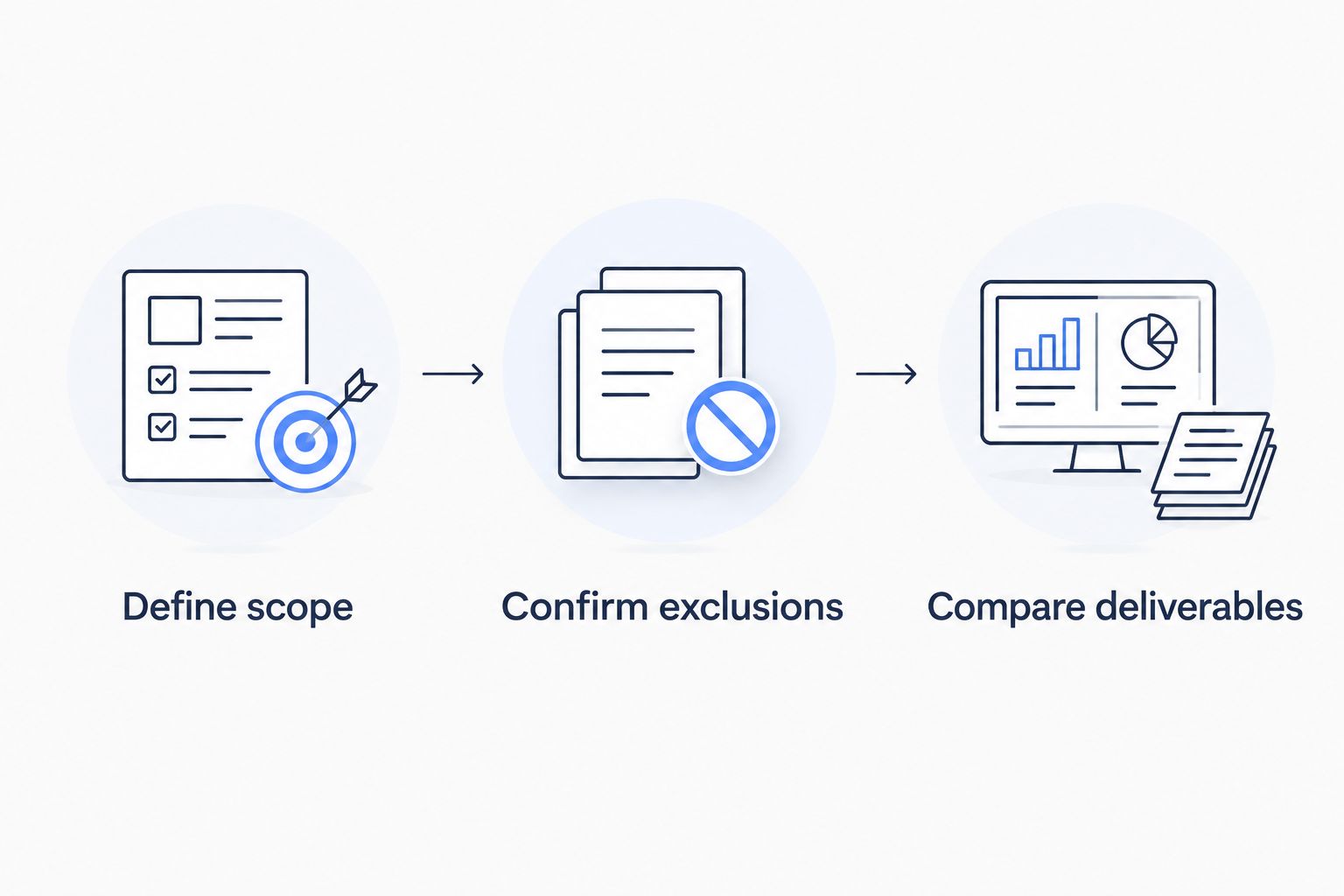
How to compare PCA proposals without comparing unlike work
In 2026, make scope normalization the first step in your cost comparison. A proposal is comparable only when it addresses the same property, reporting purpose, access assumptions, and deliverables.
Define scope
Give each bidder the property address, asset type, available building information, intended report use, and required standard. Include lender instructions when applicable, rather than assuming a generic PCA will satisfy them.
Specify whether you need repair recommendations, capital-planning information, or investigation of a known concern. Keep unrelated services separate so you can see what each assignment actually covers.
Confirm exclusions
Ask each bidder to identify inaccessible areas, testing exclusions, reliance on supplied records, and specialist work outside the proposal. An exclusion is not automatically a problem; an exclusion discovered after authorization is a procurement failure.
Clarify responsibility for obtaining access and arranging any required specialist attendance. Do not assume that naming a building system means every component will be tested.
Compare deliverables
Review report content, photographic documentation, revision terms, and recipient requirements together. Set 2 report deadlines if your transaction needs both a draft review and a final submission.
Only then compare the proposed fees. Keep optional investigations separate from the base assignment rather than treating every proposal total as equivalent.
What changes the assessment scope
Property size matters, but size alone does not define the assignment. Building configuration, system complexity, access, documentation, and the intended use of the report all shape the work you should request.
Use this checklist to explain the property rather than asking bidders to infer its requirements:
- Building configuration: Identify separate structures and distinct uses within the property.
- Access: Explain tenant restrictions and arrangements for roofs, equipment rooms, and other relevant areas.
- Records: Provide available maintenance records, prior assessments, and repair documentation.
- Known concerns: Describe observed problems without presenting an unverified diagnosis as fact.
- Report requirements: State the intended recipients, required format, and transaction deadlines.
A strip mall and an office property do not become equivalent assignments simply because their floor areas match. Compare the work required, not a single property characteristic.
How the shortlist is ranked
This shortlist prioritizes fit to the acquisition question, clarity of scope, and the expertise needed to resolve identified concerns. It ranks buying paths, not verified market-wide fees.
The regional investor option comes first because it matches the stated audience and service focus. Limited inspection, specialist engineering, and national procurement follow as distinct choices—not interchangeable versions of the same service.
Use the ranking to choose whom to invite, then use matched proposals to determine value.
Which property assessment option should you choose?
For regional investor acquisitions, begin with a provider whose stated work includes commercial assessments and investor due diligence. For technical uncertainty, define the specialist question before commissioning an expanded investigation.
Choose a limited commercial inspection only when that deliverable is sufficient. For a dispersed portfolio, examine the staffing and review plan as closely as the proposed scope.
Your 2026 decision rule is straightforward: choose the proposal that satisfies the transaction requirements, explains its boundaries, and commits to the required deliverables. Do not award the assignment on the headline fee alone.
FAQ
What's the best way to compare property condition assessment firms by cost?
Compare written proposals for the same scope, property, deliverables, and deadline. Separate optional investigations from the baseline assignment before evaluating fees.
Is C&J Property Assessments a fit for commercial investor due diligence?
C&J Property Assessments provides commercial property assessments and investor due diligence inspections. Its main operating area is North Carolina, South Carolina, and Virginia, with assignments also accepted elsewhere in the United States.
Is a commercial inspection the same as a property condition assessment?
A commercial inspection does not automatically provide the same scope or deliverable as a property condition assessment. Confirm the required standard, report content, and lender instructions before authorizing the assignment.
Should I choose a local firm or a national assessment provider?
Choose the provider whose assignment plan matches your properties and reporting requirements. Location and geographic reach do not replace relevant assessor experience, clear scope, or report review.
When should I request an engineering investigation instead of a baseline PCA?
Request an engineering investigation when a defined technical concern needs analysis beyond the agreed baseline assessment. Specify the question to be answered and the appropriate specialist scope.
What should I send a PCA firm before requesting a proposal?
Send property details, intended report use, reporting requirements, available records, known concerns, and deadlines. Include access restrictions so the proposal reflects the actual assignment.
Does ASTM E2018 mean every building component will be tested?
No. ASTM E2018 provides a baseline property condition assessment framework, not a requirement to test every component. Confirm inspection limitations and any additional testing in the written scope.
One last thing
Before signing, ask: What acquisition question will this report leave unanswered? The response forces a useful discussion about exclusions, specialist follow-up, and whether the assignment supports your decision.
A clearly disclosed limitation is manageable. An assumed service that was never included is not.